












Air-permeable hydrogels!
Hydrogels are squishy, bio-friendly materials that are made mostly of water and a bit of polymer. The Jell-O-like substance is available in the form of medical patches, sprays, and glues, and can be stuck to the skin or implanted in the body to dress wounds, affix implants, and encapsulate and release medicine over time.
For all their sticky, stretchy, and protective properties, hydrogels lack one key trait: breathability. If worn for too long, a bandage or patch can trap moisture and sweat, which can irritate tissues and reduce the effectiveness of any device that a hydrogel adheres.
Now engineers have come up with a recipe for a hydrogel that is both hydrated and aerated, or permeable to air. The new material is just as soft, stretchy, and robust as conventional hydrogels, but a network of tiny tunnels running through the gel allows air to pass through.
The aerated hydrogel can be worn for longer periods of time compared to conventional hydrogels, without causing skin irritation. It can also reduce sweat buildup, even during exercise. In experiments, volunteers wore wireless heart monitors that were attached to their chest with the new breathable hydrogel. After working out regularly for 10 days, the volunteers showed no signs of skin irritation, and the heart monitors maintained clear readings.
The results, which are reported in the journal Nature, may enable longer-lasting hydrogel products, such as breathable bandages and dressings, cosmetic face masks, and contact lenses, along with better-performing health monitors and implants.
“Water and oxygen are both essential for life,” says the senior author. “Now that we’ve added air to hydrogels, people can find broad applications.”
Water makes up about 90 percent of a typical hydrogel. The rest of the material consists of polymers. When mixed with water in a chemical process known as “cross-linking,” the polymers settle into a sort of scaffold that holds the water in place, forming a gel that’s both squishy and stretchy. But because hydrogel’s composition is mainly water, it’s inherently challenging for any air to make its way through the material effectively.
“In general, water is not breathable,” co-lead author says. “Hydrogel is 80 to 90 percent water, similar to Jell-O. And you cannot breathe through Jell-O.”
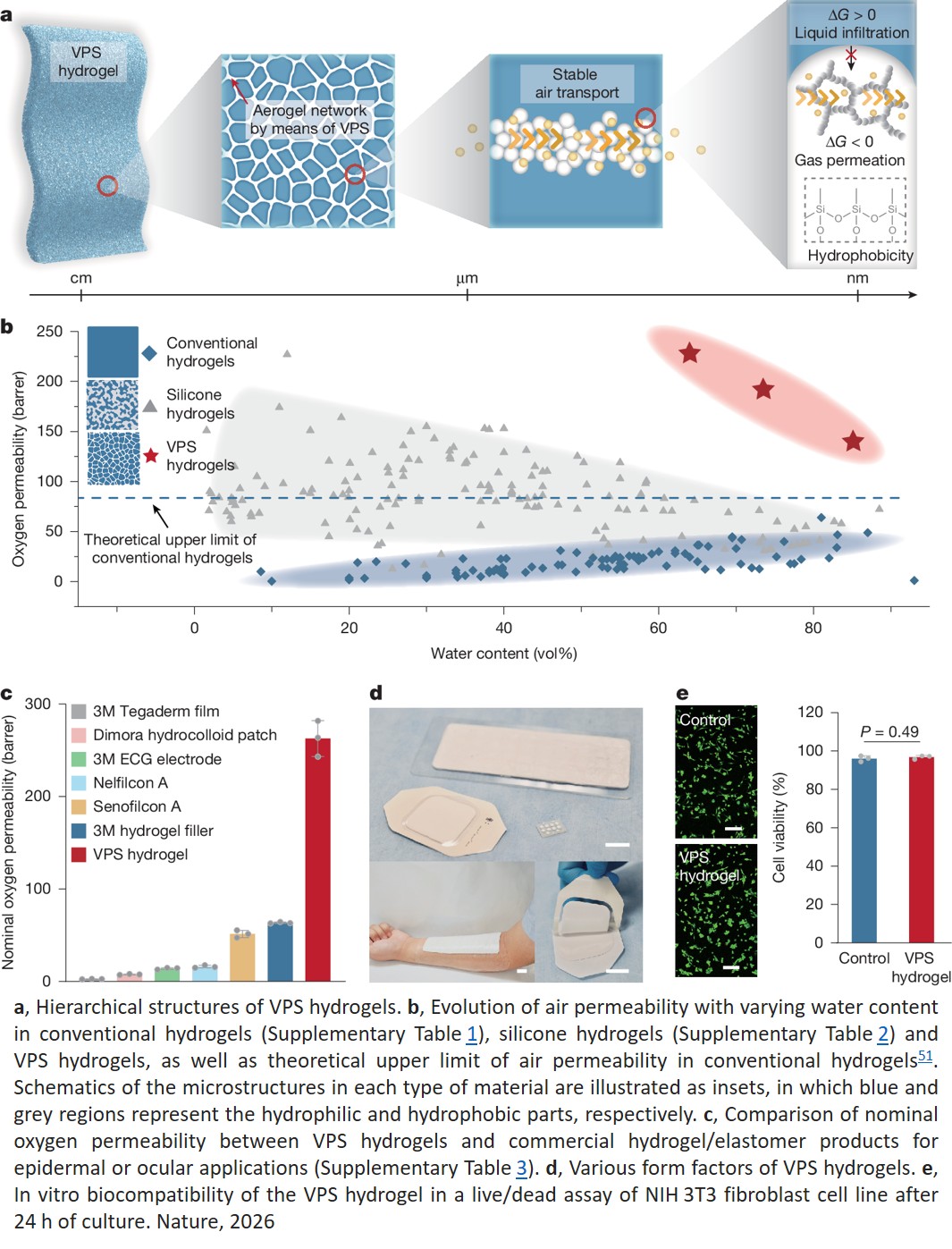
Other groups have tried to design air-permeable hydrogels, mainly taking one of two approaches. The first has been to essentially puncture microscopic holes throughout the gel. Such designs are breathable, but only in air. When they are placed in liquid, the holes quickly clog up.
Researchers have also tried mixing hydrogel with certain polymers, such as silicone, that naturally allow air through. But this approach requires adding a large amount of polymers to the hydrogel in order to create enough permeable space for air to move through the entire gel. These hydrogels end up having a greater balance of polymer to water, making them less hydrated in general.
After several years of investigation, the team hit on an ideal recipe for a breathable hydrogel that minimizes the non-water ingredients needed to let air through. In their new study, they report that the key to the recipe is “phase separation.” A common example of this process is the interaction between oil and water. The difference in the two liquids’ phases cause them to instantly separate. When the two are mixed, oil and water glom to their own kind, while avoiding the other.
The authors took advantage of viscoelastic phase separation in concocting a breathable hydrogel. For their new design, they mixed their conventional hydrogel recipe with a very small amount of silica aerogel particles, which are essentially “solid-form” air bubbles.
“They are like boba beads,” the author offers. “The particles are made of silica, which is hydrophobic, meaning that water does not want to leak through them, so they are very stable in water.”
And as it turns out, the particles are similar to oil when mixed with water. The researchers found that when they mixed just a small amount of the particles with a solution of the water-heavy hydrogel, the water molecules glommed together, essentially finding each other faster than the less abundant silica particles. This effect of viscoelastic phase separation created large pockets of water and squeezed the silica particles into skinny, interconnected tunnels. The team observed that after a few hours, this effect formed a network of thin and sturdy, silica-skinned tunnels through which air could flow.
“It’s as if the particles formed a network of connected tunnels, like air-permeable highways within the hydrated hydrogel,” says the co-lead author.
Once they confirmed that the network had formed, the team cross-linked the mixture, essentially freezing the gel, and its breathable network, in place. They then tested the gel’s breathability and mechanical performance over multiple experiments, including one in which they asked several volunteers to wear the gel, attached to a wireless electrocardiogram (ECG) monitor, while exercising for 20 minutes. The volunteers also wore monitors with conventional, commercial hydrogel adhesives.
Throughout the workouts, the researchers observed that the breathable hydrogel maintained a strong ECG signal, in contrast to the conventional gel which exhibited significant signal fluctuations. The researchers observed similar results in an experiment with several volunteers who wore the breathable hydrogel and ECG monitor over 10 days.
“We reliably saw that after 10 days, the quality of the ECG signal is still pretty good, and after you take off the monitor, there were no noticeable blisters or redness on the skin,” the author says. “This indicates healthy skin conditions.”
The team also exercised the gel itself, putting it through 10,000 cycles of stretching and compression. After these tests, they found the gel still retained the network of air channels, maintaining its breathability.
“After 10,000 cycles, there was less than a 5 percent drop in oxygen permeability,” the author says. “That matters, because even with your heartbeat, your chest continuously undergoes small strains. So we have to make sure this gel is durable for such daily activity.”
The senior author says the new study provides a novel approach for others to fabricate breathable and multifunctional hydrogels, using the concept of visoelastic phase separation as a guide.
“We’ve discovered that this process can create these air-permeable hydrogels, and we demonstrate one application,” the author says. “But we think there can be very broad applications. This is a technology platform.”