

Dried blood spot biomarker test for the detection of Alzheimer’s disease
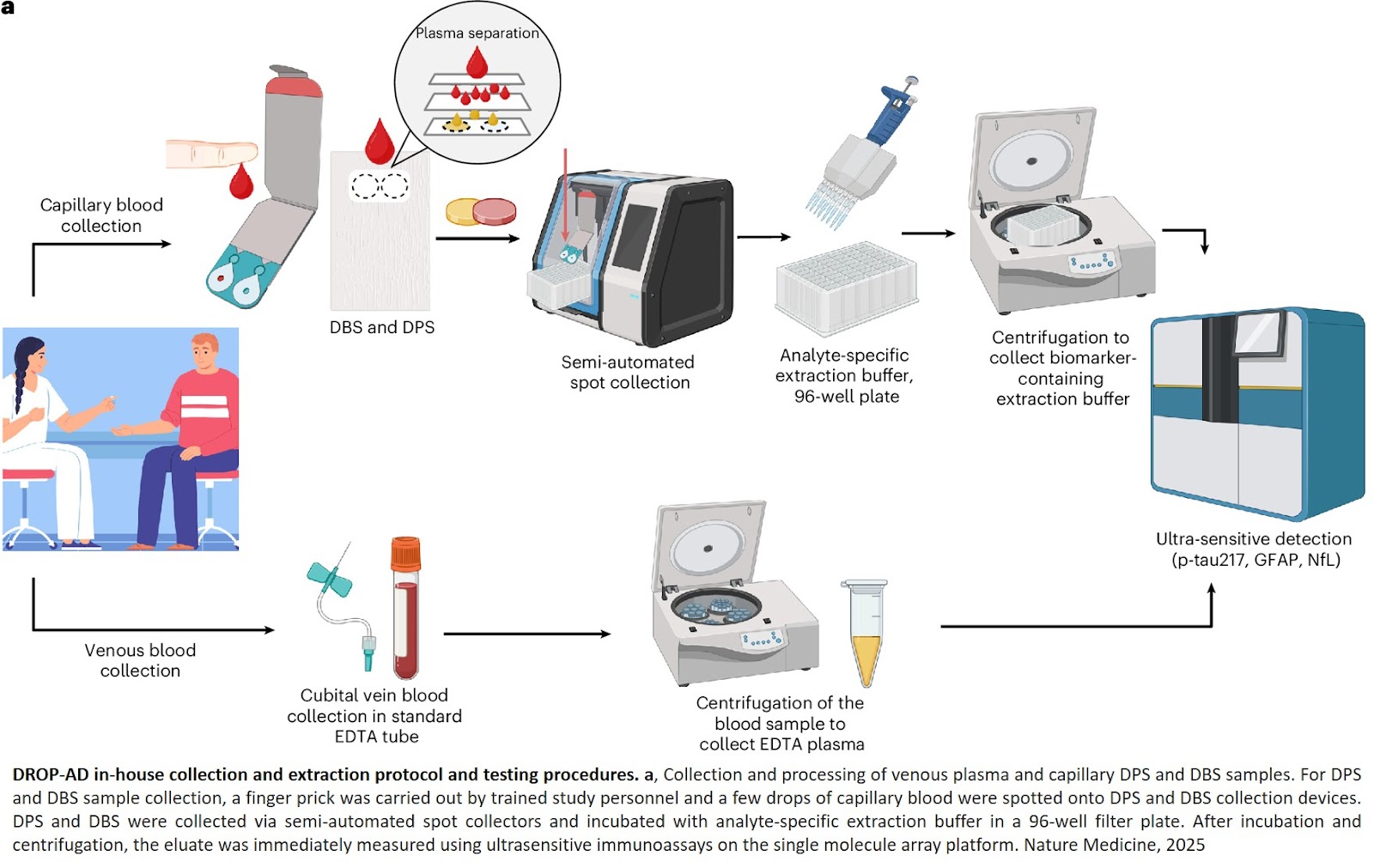
A groundbreaking international study has demonstrated that Alzheimer's disease biomarkers can be accurately detected using simple finger-prick blood samples that can be collected at home and mailed to laboratories without refrigeration or prior processing.
The research published in Nature Medicine. It represents the first large-scale validation of this accessible testing approach that removes geographic barriers and opens brain disease research to global populations without requiring specialised healthcare infrastructure.
The researchers successfully tested 337 participants and proved that finger-prick blood collection can accurately measure key markers of Alzheimer's pathology and brain damage. This breakthrough enables worldwide research participation by eliminating the logistical constraints that have historically limited biomarker studies to well-resourced medical facilities.
Alzheimer's disease is usually confirmed through brain scans or spinal fluid tests, which are invasive and expensive. Blood tests that measure biomarkers, such as p-tau217, are emerging as accurate and accessible tools for detecting Alzheimer's disease. Although drawing blood through venipuncture (inserting a needle into a vein) is much simpler than procedures such as spinal taps or brain scans, practical hurdles remain outside of clinics, including how samples are handled and stored and whether people have access to trained staff to collect them.
The lead investigator of the study said: "This breakthrough could fundamentally change how we conduct Alzheimer's research by proving that the same biomarkers doctors use to detect Alzheimer's pathology can be measured from a simple finger prick collected at home or in more remote community settings. While we're still years away from clinical use, we're opening doors to research that was previously impossible – studying diverse populations, conducting large-scale screening studies, and including communities that have been historically underrepresented in Alzheimer's studies.
“Ultimately, we are moving toward a pathway of treating people for Alzheimer’s disease before symptoms emerge. If this trajectory continues, we will need innovative ways to identify eligible individuals who are not routinely presenting in clinical settings. This work represents one such approach in that direction and further validation remains.”
The researchers tested a new method for detecting Alzheimer's disease using a few drops of blood obtained from the fingertip and then dried on a card. This process was used to find proteins linked to Alzheimer's disease and other brain changes in the 337 participants.
The study found that levels of p-tau217 in finger-prick samples closely matched results from standard blood tests and were able to identify Alzheimer's disease-related changes in spinal fluid with an accuracy of 86 per cent. Two other markers, glial fibrillary acidic protein (GFAP) and neurofilament light (NfL), were also successfully measured and showed strong agreement with traditional tests.
While not ready for clinical use, this breakthrough addresses critical barriers in Alzheimer's research by enabling remote participation in studies, clinical trial recruitment and monitoring, broader population sampling for epidemiological research, and inclusion of underrepresented communities and regions with limited healthcare infrastructure.
The findings suggest that this simple technique could make large-scale studies and remote testing possible, including for people with Down syndrome, who face a higher risk of Alzheimer's disease and for other underserved populations.
Another author said: "What excites me most is that this work makes this type of research far more accessible. We're moving toward a future where anyone, anywhere, can contribute to advancing our understanding of brain diseases. This isn't just a technical advancement – it's a paradigm shift in how we conduct neuroscience research.”
A co-author added: “Our ongoing work will determine whether this could also be a valuable way of identifying people in the community who would benefit from more detailed diagnostic tests for Alzheimer’s disease.”
The method also shows promise for research applications beyond Alzheimer's, including studies of Parkinson's disease, multiple sclerosis, ALS, and brain injuries by the detection and accurate measurement of neurofilament light (NfL), a key biomarker of neurodegeneration.
The researchers emphasize that significant additional research and validation is required before any clinical application and caution that the method is not ready for clinical use yet.
https://www.nature.com/articles/s41591-025-04080-0
https://sciencemission.com/dried-blood-spot-biomarker-test-for-ALZ