

Free radicals in the brain that may fuel dementia
Researchers have discovered that free radicals generated at a specific site in non-neuronal brain cells called astrocytes, may promote dementia, according to a study. Their findings, published in Nature Metabolism, demonstrated that blocking this site lowered brain inflammation and protected neurons, suggesting a novel therapeutic approach for neurodegenerative disorders, including frontotemporal dementia and Alzheimer’s disease.
“I'm really excited about the translational potential of this work,” a co-lead of the research. “We can now target specific mechanisms and go after the exact sites that are relevant for disease.”
The researchers focused on mitochondria—metabolic structures inside cells that generate energy from food and, in the process, release molecules known as reactive oxygen species (ROS). At low levels, ROS play an important role in cell function, but they can be harmful when produced in excess or at the wrong time. “Decades of research implicate mitochondrial ROS in neurodegenerative diseases,” said the other co-lead.
Given these pathological ties, some efforts to combat neurodegenerative disorders have centered on using antioxidants to mop up these chemical spills. “But most antioxidants tested in clinical studies have failed,” said the author. “That lack of success might be related to the inability of antioxidants to block ROS at their source and do so selectively without altering cell metabolism.”
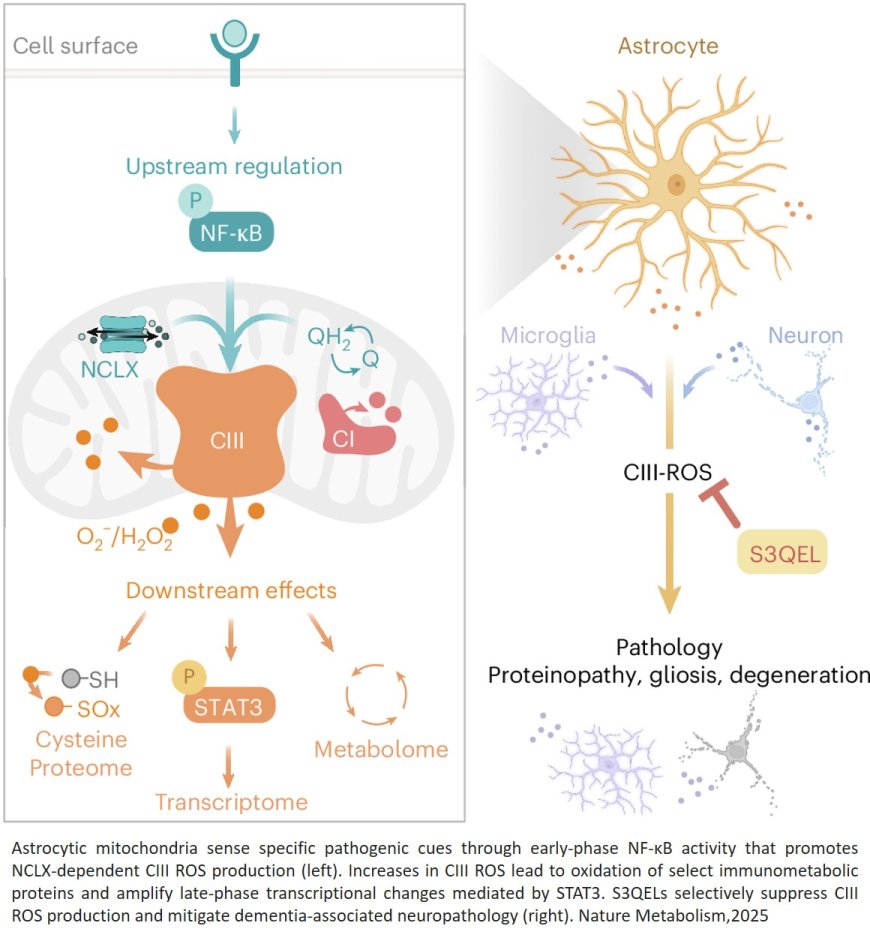
The researchers targeted Complex III, a site for oxidative metabolism that tends to push out ROS from the mitochondria into the rest of the cell, where ROS are more likely to disrupt vital cellular components.
They were surprised to find that the ROS did not come from the neurons’ own mitochondria, but were produced by astrocytes, supportive cells cultured along with the neurons. “When we added S3QELs, we found significant neuronal protection but only in the presence of astrocytes,” said a graduate student. “This suggested that ROS coming from Complex III caused at least some of the neuronal pathology.”
Additional experiments revealed that exposing astrocytes to disease-related factors, such as neuroinflammatory molecules or proteins associated with dementia, such as amyloid-beta, boosted the cells’ mitochondrial ROS production. S3QELs suppressed much of this increase, whereas blocking other potential sources of cellular ROS was not effective.
The author determined the ROS oxidizes certain immune and metabolic proteins linked to neurological disease and found this influences the activity of thousands of genes, especially those involved in brain inflammation and associated with dementia.
This degree of specificity was unexpected and intriguing. “The precision of these mechanisms had not been previously appreciated, especially not in brain cells,” the lead said. “This suggests a very nuanced process in which specific triggers induce ROS from specific mitochondrial sites to affect specific targets."
When the researchers fed their S3QEL ROS inhibitor to a mouse model of frontotemporal dementia, they found it reduced astrocyte activation, blunted neuroinflammatory genes and reduced a tau modification seen in patients with dementia—even when the treatment was initiated well after the disease process had started. Prolonged treatment with S3QEL extended lifespan in the mice, was well-tolerated and produced no obvious side effects, which the authors attribute to its unique specificity.
The team hopes to develop the compounds as a new type of therapeutic. At the same time, the researchers will continue to explore how disease-linked factors influence ROS production in the brain. They also plan to examine whether genes associated with an increased—or decreased—risk for neurodegenerative disease influence ROS generation from specific mitochondrial sites.
“The study has really changed our thinking about free radicals and opened up many new avenues of investigation,” the author said. The potential of these findings to open new research approaches to inflammation and neurodegeneration is highlighted in the journal.