
Ligand selectivity in G protein-coupled receptors
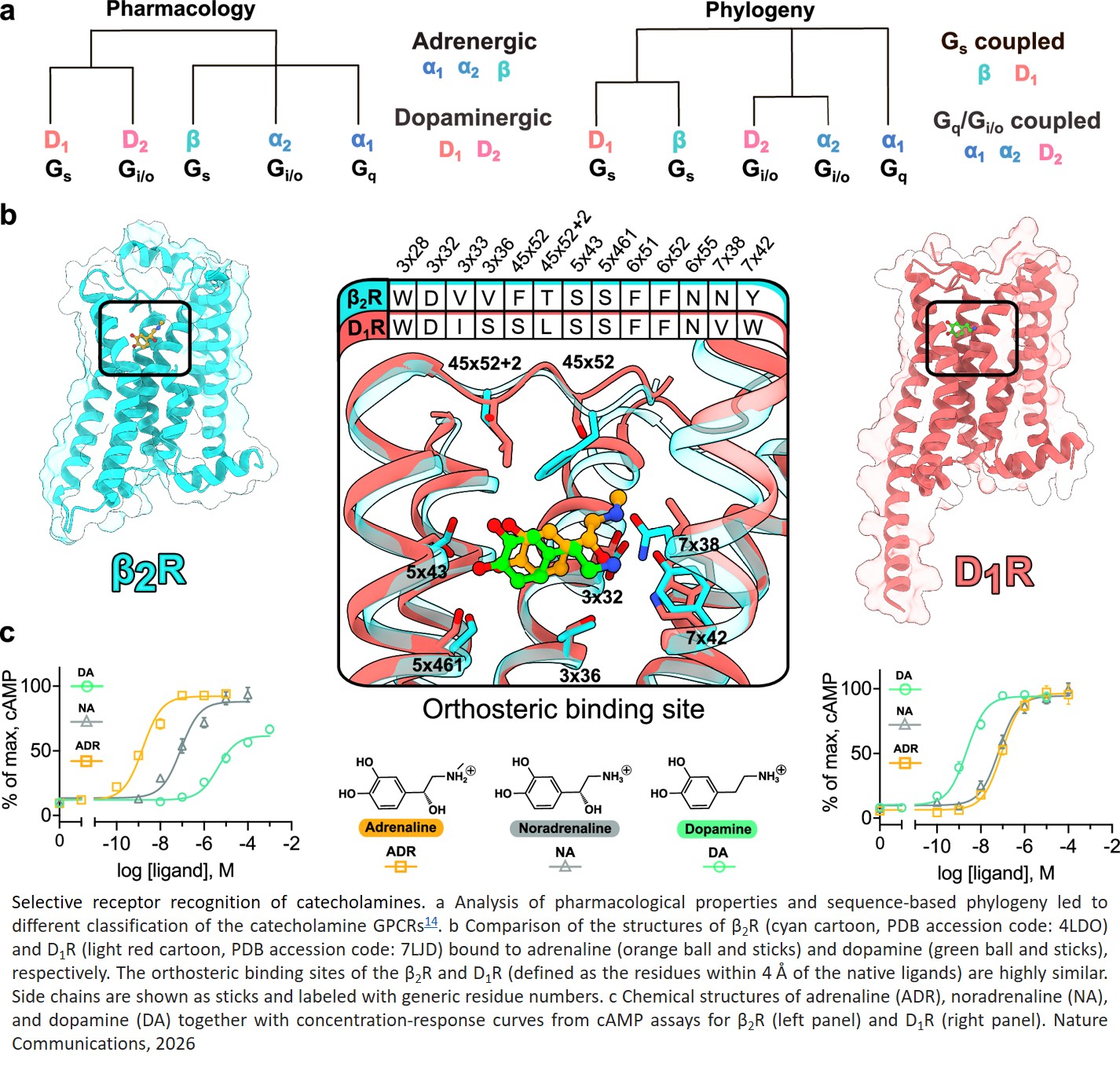
Different receptors respond to different neurotransmitters or hormones, such as adrenaline involved in the fight-or-flight response, or dopamine linked to reward and motivation. Both the receptors themselves and the substances they recognize are often very similar, but still makes the body react in completely different ways.
How the receptors know whether to respond to adrenaline or dopamine with such high precision has puzzled researchers. To solve this mystery, they studied the receptors at the molecular level and began swapping out small parts of the receptors’ building blocks. Step by step, they tested how much is actually required to change the receptor’s preference.
“This is one of the most comprehensive projects in my entire scientific career,” says one of the corresponding authors of the study.
G protein-coupled receptors (GPCRs) are central regulators of physiological processes and therefore major targets in drug discovery. The researchers set out to shed light on the structural mechanisms of GPCR selectivity.
They identified amino acids responsible for ligand selectivity in two closely related groups of receptors, the β-adrenergic and D1-like dopamine receptors. By modifying these amino acids, they made each receptor prefer the other’s native ligand. Importantly, and unexpected to the researchers, this selectivity is governed not only by residues interacting with the ligand, but also by regions outside of the primary binding site.
“It turned out that surprisingly few changes were needed — and in places one wouldn’t have initially expected,” says another corresponding author.
To uncover the molecular mechanisms, the researchers used a combination of experimental and computational approaches, including pharmacological assays, cryo-electron microscopy, bioinformatics and simulations.
“My big eureka moment was when I realized that evolution probably took different paths if a receptor evolved from dopamine-preferring to noradrenaline-preferring, rather than if it evolved in the opposite direction. A moment of great satisfaction was when our studies of additional receptor subtypes for dopamine and noradrenaline confirmed our initial results,” says another author.
An easily accessible server to study ligand selectivity in GPCRs is provided, to enable other scientists to take these findings further.
The researchers now believe that this knowledge could open the door to designing entirely new receptors tailored for the treatment of diseases.
“We could engineer receptors with tailored selectivity and signaling properties for applications in biosensors, chemogenetics, and gene therapy,” says one of the three shared first authors.
https://www.nature.com/articles/s41467-026-71361-8
https://sciencemission.com/native-ligand--selectivity