





Potential blood RNA biomarkers for Alzheimer’s disease identified!
The researchers have discovered blood RNA biomarkers that offer a promising minimally invasive approach for earlier diagnosis of Alzheimer’s disease, according to findings published in Nature Communications.
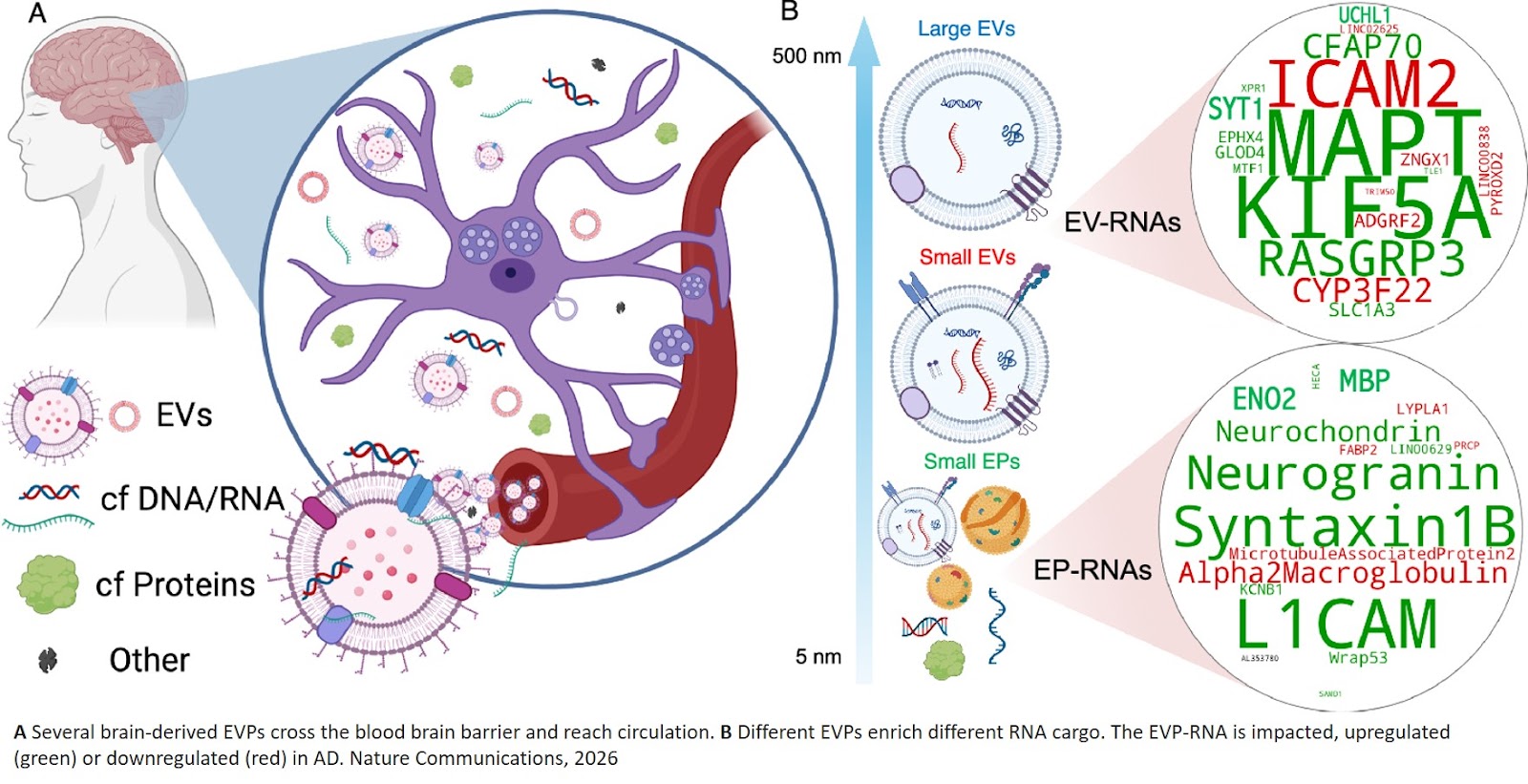
An estimated 55 million people worldwide are living with Alzheimer’s disease, according to Alzheimer’s Disease International. Yet diagnosis remains challenging because symptoms often overlap with those of other conditions, and current diagnostic methods can be costly or invasive. Blood-based biomarkers could support routine clinical use while reducing the need for lumbar puncture and positron emission tomography (PET) imaging. Recent research has shown that brain-specific RNA biomarkers are present in circulating blood nanoparticles, including exosomes, extracellular vesicles (EVs), and extracellular vesicles and particles (EVPs).
Researchers developed a simple, efficient, and cost-effective method to isolate EVPs from blood and brain tissue. They measured RNA biomarkers in blood and brain tissue samples from people with Alzheimer’s disease and from controls to determine gene expression patterns and cellular origins. The researchers separated EVPs into three subpopulations: large EVs, small EVs, and small extracellular particles (EPs).
The researchers also identified small blood nanoparticles known as “SECmeres” that carried Alzheimer’s-related brain signals more clearly than standard EVs. These nanoparticles were enriched with brain-specific markers and may offer a minimally invasive approach for earlier diagnosis of the progressive neurodegenerative disease.
“In 2025, FDA cleared the first protein-based blood test for Alzheimer’s disease diagnoses, which measures the pTau217/ß-amyloid 1-42 ratio,” said co-corresponding author. “Our study demonstrates that blood EVPs carry brain-specific RNA information that could be used for liquid biopsy approaches, pending validation in larger blinded clinical trials. We believe EVP-derived RNAs may reveal disease-related changes earlier in the disease process, before proteins or pathology become detectable.”
“We provide evidence that novel brain-derived nanoparticles, termed ‘SECmeres,’ may play a key role in neurodegenerative disease development and hold promise as a real-time, non-invasive diagnostic tool for the living human brain,” the author added.
The senior author said the findings could have important implications for liquid biopsy technologies designed to detect neurodegeneration disorders, cancer, and other diseases through minimally invasive testing.
“Alzheimer’s disease represents a major global health challenge due to its increasing prevalence, profound impact on patients and families, and substantial economic burden,” said a co-corresponding author. “Our findings support the development of RNA-based liquid-biopsy assays that may help advance earlier detection of Alzheimer’s disease.”