

Rare stem T cells may hold the key to fighting chronic diseases
T cells are an elite fighting force of the immune system, seeking out and destroying diseased cells. But in a prolonged campaign against a chronic condition — like a viral infection, or cancer — the body needs a steady supply of these killer troops. Where and how these killer troops are generated has been a mystery.
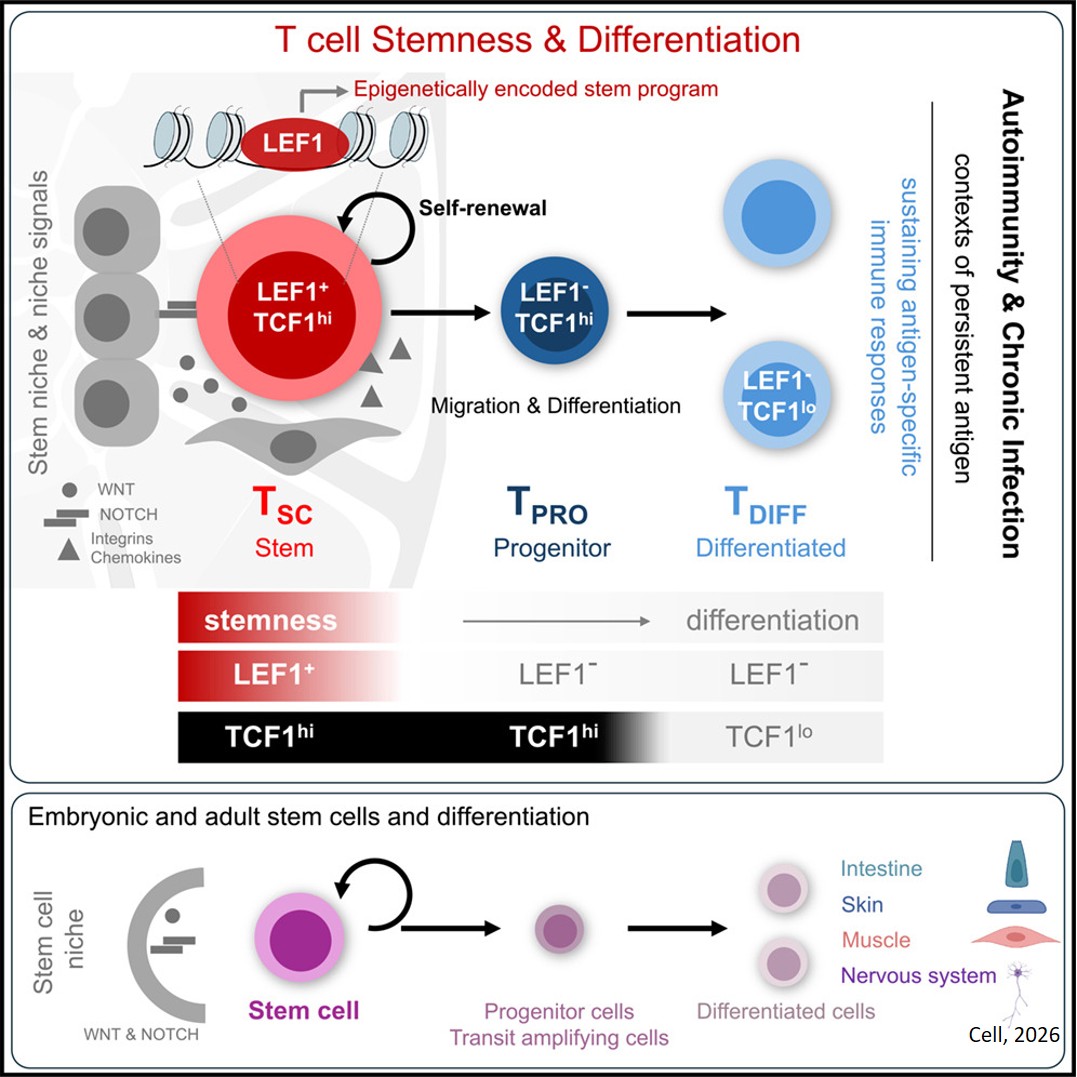
That led a team of scientists to dig deeper. They found that a small subset of T cells, called stem T cells, are responsible for making new T cells and for continuously replenishing them in chronic disease. Importantly, these rare stem T cells express a protein called LEF1.
The team’s findings in laboratory models, published in Cell, showed that focusing on this population of LEF1-positive T cells is key. Boosting LEF1-positive cells overcame T cell “exhaustion” in the case of chronic infection. And removing them was successful in reining in overactive immune cells in the case of type 1 diabetes, an autoimmune disease.
“Although it was not part of this study, cancer is a chronic disease where T cells lose their capacity to fight cancer cells over time,” the senior author says. “So that’s what we’re looking at next.”
To prove that LEF1 wasn’t just a marker of stem cells (or “stemness”), but a central player, the researchers used CRISPR gene editing to delete the LEF1 gene from these rare stem T cells in their mouse models.
The results were striking. Without LEF1, stem T cells lost their ability to persist and self-renew.
In the autoimmune diabetes model, mice whose T cells lacked LEF1 were significantly protected from developing the disease because the disease-causing T cells could no longer sustain themselves and destroy insulin-producing cells in the pancreas.
Meanwhile, going in the other direction proved equally revealing. When the researchers boosted LEF1 levels, more stem T cells formed — and fewer cells reached the terminal, “burned out” stage in the viral infection model.
“Our study shows that LEF1 is key to T cell stemness and persistence,” the senior author says. “Turn it up, and you get more stem cells. Remove it, and the stem cell pool disappears. Which of those is desirable depends on the disease context.”
One of the most surprising findings came when the team compared stem T cells from the two diseases side by side: autoimmune diabetes and chronic infection with a virus called lymphocytic choriomeningitis — a well-established model for studying chronic viral infection in mice.
On the surface, these conditions couldn’t be more different. In autoimmune diabetes, T cells are highly active and aggressive — destroying healthy insulin-producing cells in the pancreas. In chronic viral infection, T cells become functionally “exhausted,” burning out over time and allowing the virus to persist.
And yet, when the researchers mapped the molecular profiles of both cell types using a computational visualization technique, the two stem T cell populations clustered together as a single group — essentially indistinguishable from one another. This suggests that LEF1-driven stemness isn’t a disease-specific quirk, but rather a shared feature of how the immune system sustains itself under chronic stress; the team found 117 genes across both diseases that share the same pattern of being switched on or off.
“This points to a common underlying mechanism of stem T cell state, driven by LEF1, that is shared across these two very different diseases,” says co-senior author. “LEF1 drives a fundamental mechanism by which the immune system sustains stem T cells during chronic infection, as well as drives autoimmune conditions, rather than being unique to a particular disease. This opens the possibility to new therapeutic strategies for a broad range of immune related conditions.”
The authors were surprised to find that many genes and pathways employed by stem T cells matched those of embryonic and adult stem cells, which are found throughout our tissues, including the skin, intestine, muscle, and bone marrow.
Similar to stem cells in the gut or the bone marrow — which depend on specialized environments called “niches” — the location of immune stem T cells matters. Each T cell population expressed different molecular “address labels” directing them to distinct locations within lymph nodes and tissues. The authors disrupted those location signals — either by blocking proteins called integrins or interfering with a pathway called Notch signaling — and strikingly, the stem T cell pool collapsed.
“Stemness isn’t just about what’s inside the cell,” the senior author says. “It’s also about where the cell lives and what signals it receives from its environment.”
For the authors, the findings also underscore the importance of doing research into fundamental human biology, which is often called “basic science.” The idea is that by working to understand how T cells replenish themselves, new therapeutic strategies may emerge.
“We’ve identified what we believe is a fundamental mechanism, one that the immune system uses broadly to sustain itself in chronic disease,” the author says. “That’s the kind of finding that can open up entirely new directions for treatment.”
In this case, disrupting stem T cells could potentially block them from attacking an individual’s own tissues in the case of autoimmune disorders. Or, alternatively, in the case of viral infections — or cancer — the pool of stem T cells could be boosted, helping the immune system to maintain a durable fighting force.
“This work demonstrates the power of multidisciplinary collaboration where well-designed disease models, cutting edge experiments, and advanced computational analysis are brought together to address important scientific questions,” co-senior author says.