

Neurodegenerative mechanisms in SETBP1 variants
Previously, SETBP1 mutations were linked to two known disorders:
· Schinzel–Giedion syndrome (SGS), caused by missense variants in the degron region, leading to toxic gain-of-function.
· SETBP1 haploinsufficiency, typically caused by truncating mutations or deletions.
However, missense variants outside the degron were poorly understood and often labeled as ‘variants of uncertain significance’.
For the research, 18 individuals with non-degron SETBP1 variants were studied - the largest such cohort to date. Clinical, genetic, and cellular data revealed a distinct disorder with a wide range of cognitive, speech, and motor impairments.
The variants cause a clinically and functionally variable developmental syndrome, showing only partial overlaps with classical SGS and SETBP1-haploinsufficiency disorder.
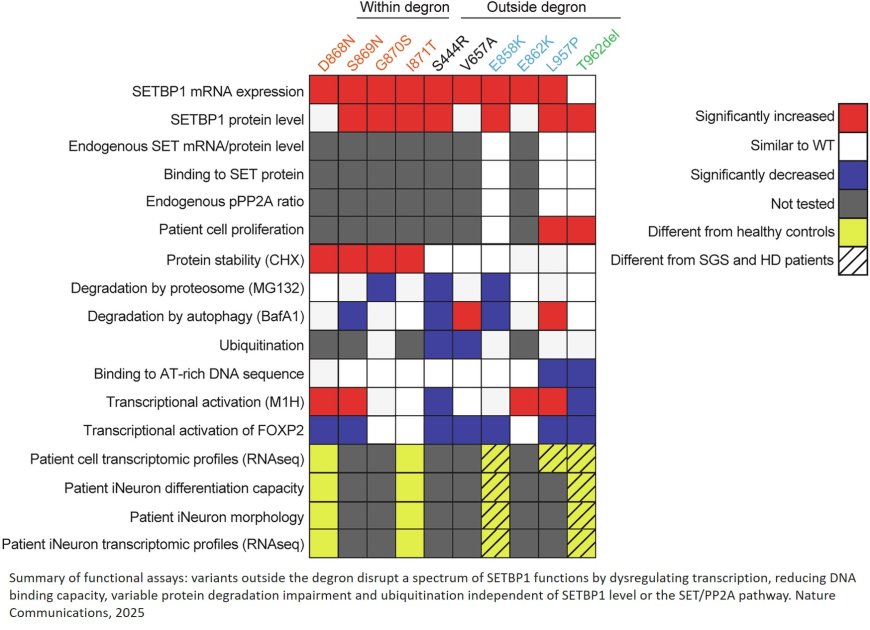
Functional experiments showed that many of these variants disrupt:
· Protein stability (often increasing SETBP1 levels through various degradation pathways)
· DNA-binding and transcriptional activation
· Neuronal morphology and differentiation
Notably, the p.(Thr962del) variant, a single amino acid deletion, resulted in near-complete loss of function across all tested assays. Transcriptomic analyses confirmed unique expression patterns that partially overlap with SGS and haploinsufficiency but also show distinct regulatory effects.
In contrast to SGS and SETBP1 haploinsufficiency, these effects are independent of protein abundance.
This study reshapes the understanding of SETBP1-related conditions as a mechanistic continuum, adding a third category beyond classical SGS and haploinsufficiency. For clinical genetics, it improves the interpretation of uncertain SETBP1 variants and highlights the importance of functional follow-up studies.
The findings also underline the critical role of multidisciplinary collaboration, combining genomics, transcriptomics, and cell biology to uncover how subtle genetic changes drive complex neurodevelopmental outcomes.
https://www.nature.com/articles/s41467-025-64074-x
https://sciencemission.com/heterogeneous-neurodevelopmental-disorder