

Single-cell method for mapping DNA-protein interactions
A new technology allows scientists to map, in single cells, the DNA binding sites of transcription factors and other regulatory proteins that control gene activity. With key advantages over methods currently in use, the technology is expected to be a powerful addition to biologists’ toolkit for studying cells in health and disease.
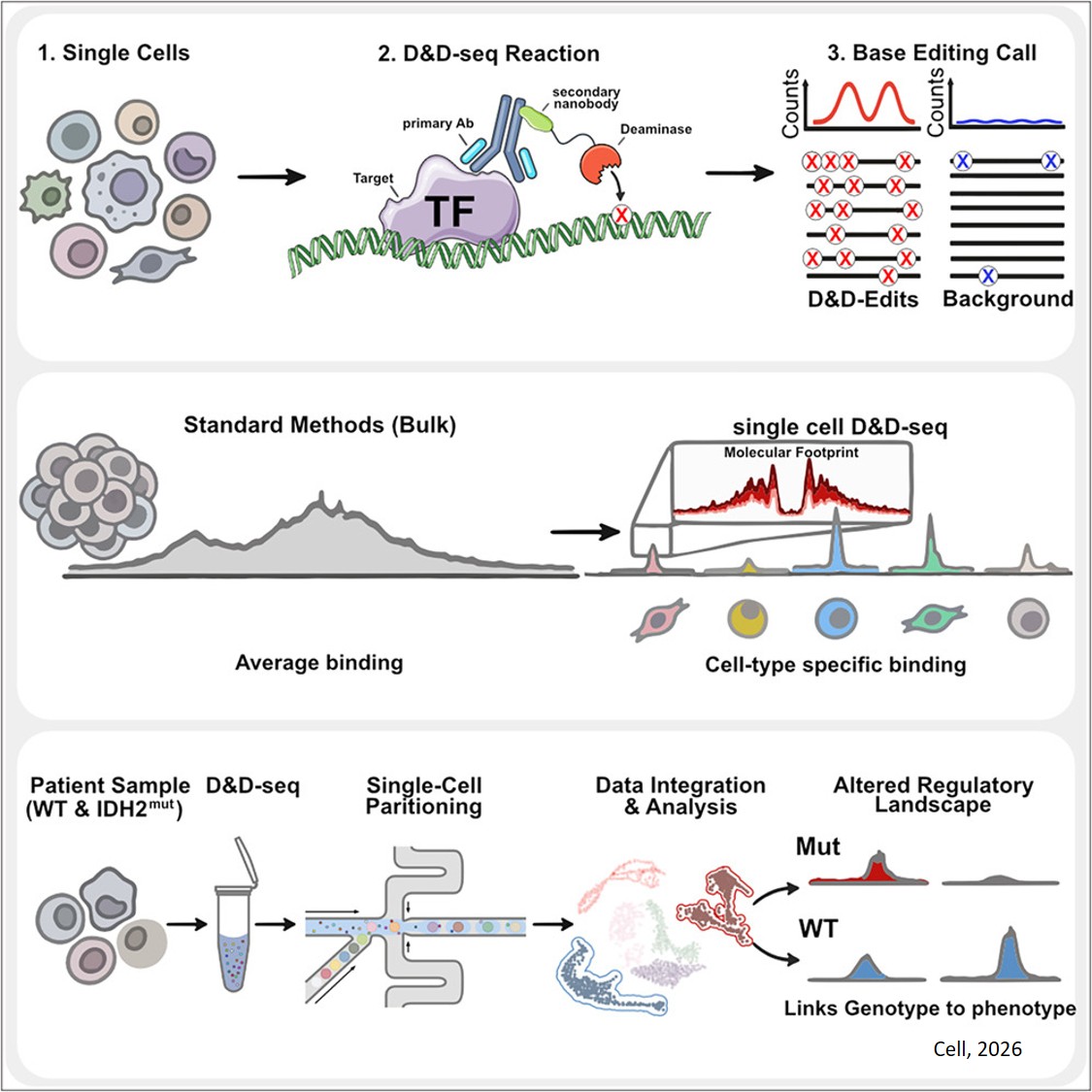
“D&D-seq,” as the new method is called, uses antibodies to bring a DNA-editing enzyme close to a target protein, allowing researchers to record where that protein interacts with DNA. The study describing the technique, published in Cell, showed that it surmounts key technical drawbacks of current methods for mapping protein-DNA interactions, and is the first of its kind that can be easily incorporated into high-throughput, single-cell “multi-omics” workflows.
“A lot of research has been held back because we didn't have the right tools for mapping DNA-protein interactions in single cells; and now that we have such a tool there is enormous excitement—it’s really a foundational technological advance,” said study co-senior author.
Multi-omics refers to combined analyses of different layers of information within cells, including DNA sequences (genomes), gene activity patterns (transcriptomes), and protein populations (proteomes). What is sometimes called the regulome covers transcription factors and other proteins that bind to DNA to switch genes “on” or “off.”
These regulatory proteins are known to be critically important in biology. A large proportion of the disease-risk hotspots identified in genetics studies lie at transcription factor binding sites. Yet the tools available for mapping actual transcription factor DNA-binding events in cells, including primary cells taken from patients, have had significant limitations. These include a relative insensitivity to weak or transient binding events, and an incompatibility with other standard multi-omics tools—an incompatibility that can make it difficult to get the big picture of how a gene or gene-network is regulated.
D&D-seq takes its name from the docking of a protein of interest to a deaminase enzyme, followed by ordinary sequencing. Even a transient binding of the deaminase-linked protein to DNA will leave a mark that can be detected in sequencing data.
“DNA is a marvelous molecule for recording and storing information, and we are exploiting this property to our advantage,” the author said.
The researchers demonstrated D&D-seq’s potential by using it to map the binding sites of several transcription factors as well as chromatin remodeling proteins, which influence gene activity by locally opening or closing the twisted structure of DNA. The demonstrations included a mapping of the DNA binding sites of a key transcription factor in blood cells, comparing cells with and without a common leukemia mutation—and enabling the researchers to see in detail how the mutation changes the transcription factor binding.
“We’re entering an era of medicine in which transcription factors and other gene-activity regulators will increasingly be therapeutic targets,” said another author. “This kind of technology should have an important role in developing and evaluating such therapies.”
The researchers showed that D&D-seq—though a work in progress, with many improvements planned—can already be used with standard single-cell multi-omics platforms, allowing the mapping of DNA-protein interactions alongside related readouts of gene activity patterns, overall genome sequences and other “-omic” layers in individual cells.
“D&D-seq is platform-agnostic—it’s basically a plug-and-play feature that you can add to existing platforms to get more information from your experiments,” the author said.
https://www.cell.com/cell/fulltext/S0092-8674(26)00573-8
https://sciencemission.com/DNA-protein-interactions