


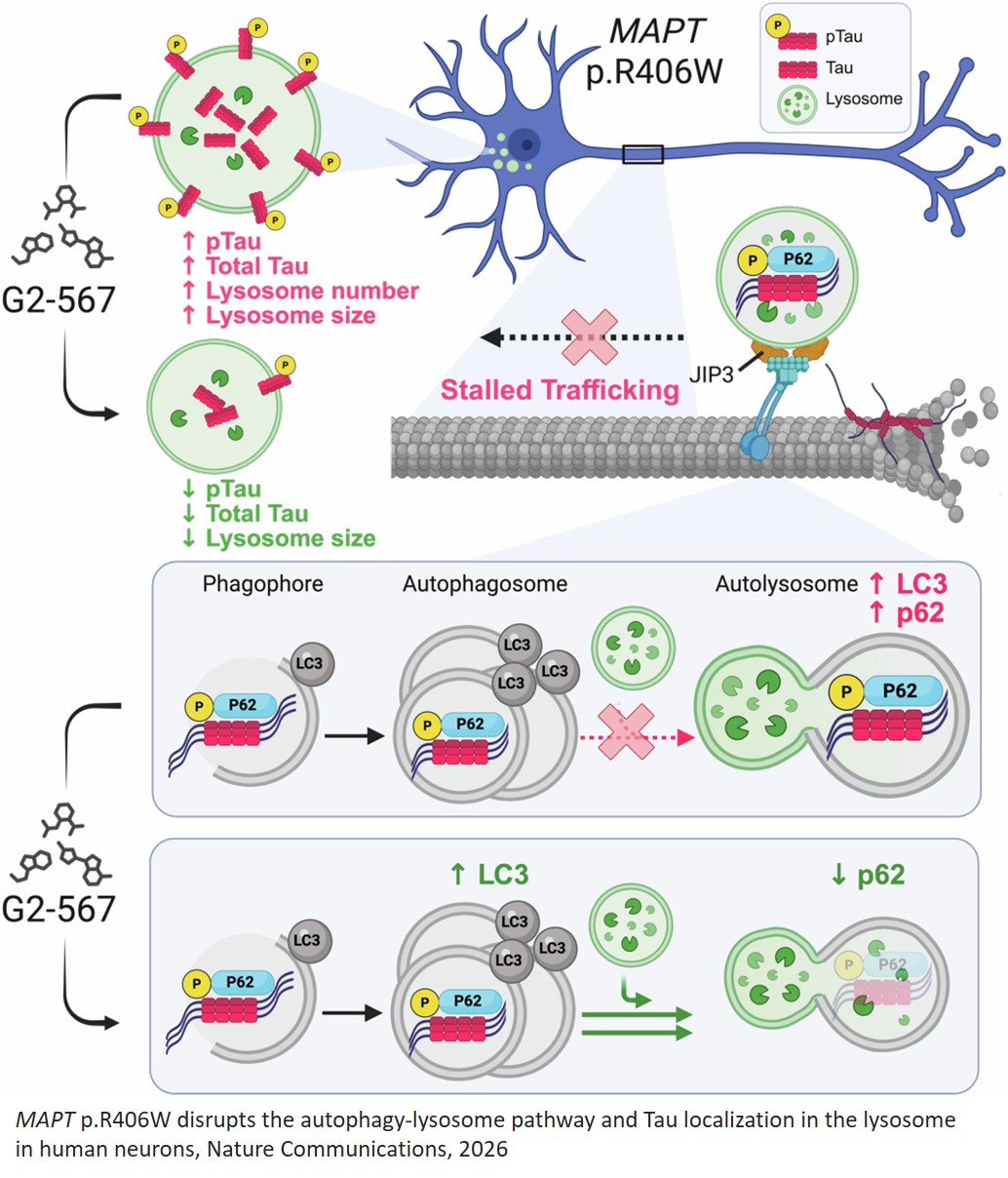
Tau mutation drives autophagy-lysosome dysfunction
New research adds to growing evidence that helping brain cells break down and eliminate their own cellular waste is a promising treatment strategy for a variety of neurodegenerative diseases. In lab experiments, the researchers found that exposure to a novel compound can clear a harmful protein from human neurons modeling frontotemporal dementia — a devastating and ultimately fatal condition — and prevent those neurons from dying.
The study is published in the journal Nature Communications.
According to the researchers, the study’s results provide further evidence that enhancing autophagy, a key cellular process involved in breaking down and recycling cellular waste, could help treat neurodegenerative diseases. Autophagy is known to decline with age, so strategies to restore it could help address multiple age-related diseases.
The researchers studied a specific mutation in a brain protein called tau that causes the protein to become misfolded and alter its normal function. In general, when tau proteins become misfolded, they build up inside neurons and contribute to various forms of dementia, including Alzheimer’s dementia and frontotemporal dementia, a neurodegenerative disease similar to Alzheimer’s that often strikes earlier — in middle age — and typically involves significant changes in personality and behavior that precede cognitive decline.
“We found that this tau mutation can clog the cell’s normal cellular clean-up system and interfere with how cells in the brain clean up misfolded proteins,” the author said. “One compound in particular had an impressive effect in making the cells look almost normal in their clearance of misfolded proteins. In the future, we can envision new therapies for neurodegenerative diseases that may be similar to what we have now for cancer: multi-pronged treatments that combine several drugs attacking different aspects of the disease simultaneously.”
For example, in Alzheimer’s disease, a therapy designed to enhance autophagy could help eliminate tau and, in theory, be combined with FDA-approved antibody therapies that reduce amyloid beta, another damaging Alzheimer’s protein that builds up in neurons and contributes to dementia. More broadly, an autophagy-based approach that clears misfolded proteins could be combined with drugs such as antisense oligonucleotides that reduce production of those same proteins, thus creating a complementary, two-pronged strategy.
In this new study, the researchers studied neurons that had been reprogrammed from skin cells sampled from patients with frontotemporal dementia who carried the tau mutation. In the neurons, the mutated tau proteins caused waste-recycling centers called lysosomes, which are involved in autophagy, to become dysfunctional, allowing cellular waste to accumulate in the lysosomes, which may contribute to neuronal death. The researchers found that enhancing autophagy with an analog of the chemical compound G2 improved clearance of the garbage, reduced tau levels in the lysosomes and prevented cellular toxicity and death.
G2 was discovered in 2019 via screening experiments seeking drugs that could reduce the accumulation of an aggregation-prone protein in a C. elegans model of alpha-1-antitrypsin deficiency, which can cause severe liver disease. The compound was later shown to boost autophagy function in mammalian cell model systems.
The researchers also have shown that G2 can protect brain cells from death in cells modeling Huntington’s disease, a fatal inherited neurodegenerative disease caused by a genetic mutation present at birth. In the cellular model of Huntington’s disease, the compound prevented the buildup of a harmful RNA molecule.
“It’s exciting to see that this compound has protective effects in the context of multiple neurodegenerative diseases,” the author said. “G2 seems to have similar protective effects even when different dysfunctional proteins are building up in different types of cells.”
With evidence that G2 helps cells clear harmful molecules across multiple cell types implicated in different diseases, it and similar compounds are attractive candidates for preventing cell death, including neurodegeneration, in diseases driven by the toxic buildup of misfolded proteins or other damaging molecules.
In the future, the authors plan to continue evaluating the effectiveness of G2 in clearing misfolded proteins caused by a variety of tau mutations and in multiple types of brain cells.
https://www.nature.com/articles/s41467-026-70473-5
https://sciencemission.com/autophagy-lysosome-dysfunction-that-limits-Tau-degradation