

Two distinct subtypes of autism with different underlying biology
An international research team has shown that it is possible to identify at least two distinct subtypes of autism, defined by their patterns of brain connectivity. In the “hyperconnectivity” subtype, brain areas communicate more than usual; in the “hypoconnectivity” subtype, communication between brain areas is reduced. The study aims to develop tools for precise, personalized autism care and support. The research paper was published in the international journal Nature Neuroscience.
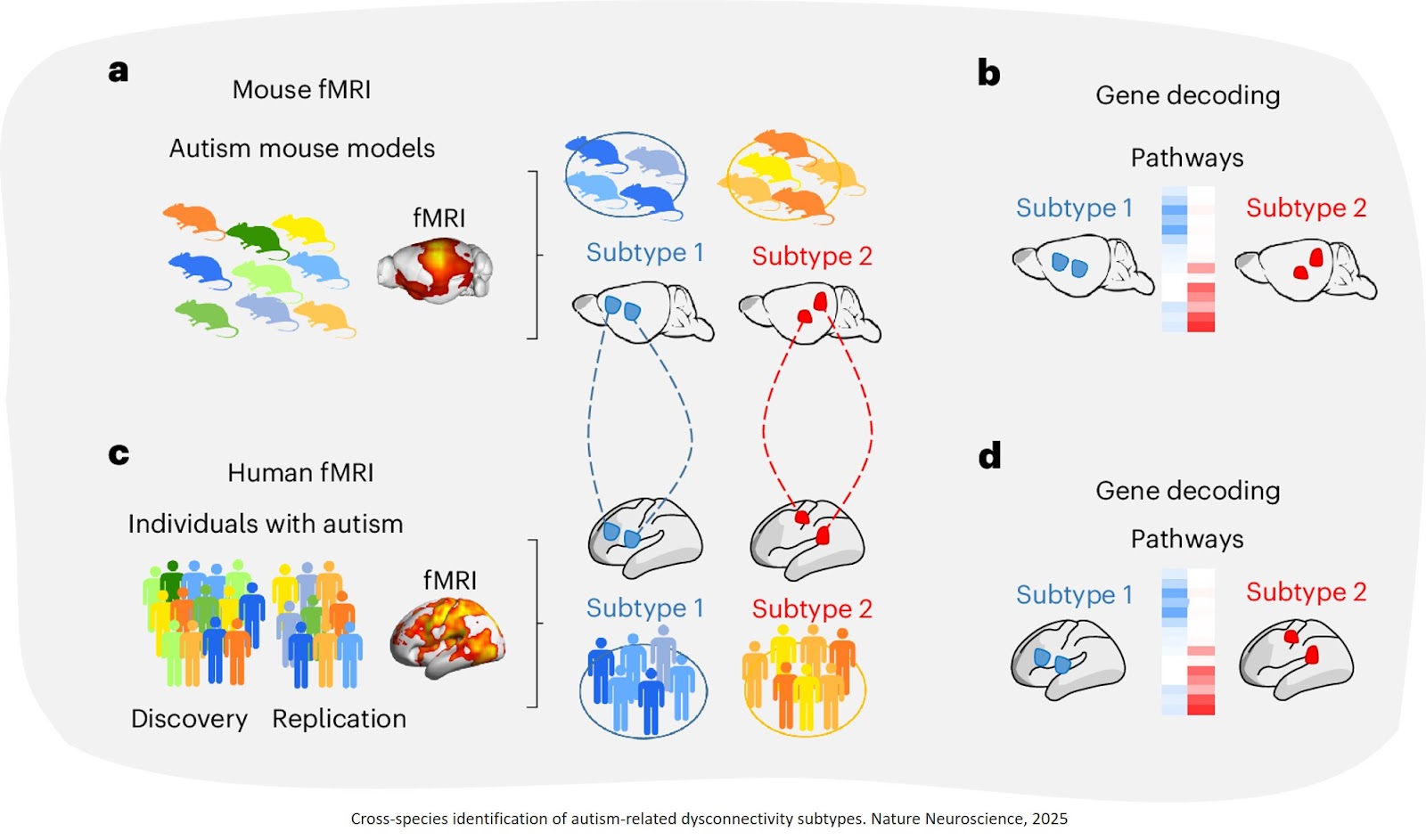
The research study represents the first systematic effort to decode human brain imaging patterns (via fMRI) by tracing them back to their molecular underpinnings in mouse models. By linking patterns of connectivity to specific biological pathways, the findings offer a foundation for precision medicine approaches.
Therefore, the researchers analyzed functional connectivity across 20 mouse models and brain scans from 940 children and young adults with autism and over 1,000 neurotypical individuals. The findings revealed two reproducible autism subtypes: one characterized by reduced brain connectivity (hypoconnectivity) linked to synaptic pathways, the other by increased connectivity (hyperconnectivity) associated with immune-related systems. Together, these subtypes accounted for approximately 25% of individuals with autism examined in the study.
"For decades, we’ve observed tremendous variability in how autism manifests, but we lacked direct evidence that these differences reflected distinct underlying biology," said the author. “Our approach enabled us to isolate specific genetic and immune factors, then translate those signatures to human brain scans, showing that different connectivity patterns encode different mechanistic pathways underlying autism.”
The team combined brain imaging with genetic and biochemical analyses in mouse models, linking connectivity patterns to specific alterations in cellular function. This revealed how specific molecular pathways, including synaptic and immune-related mechanisms, manifest as distinct connectivity patterns observable with fMRI. The study established biological reference patterns from mice that guided subtype identification in human brain scans.
"The mouse models gave us a biological 'Rosetta Stone," said another author. "We could see which biological pathways drive which connectivity signatures, then search for those same patterns in humans."
The analyses identified corresponding hypo- and hyperconnectivity subtypes in the human data. Gene expression analyses confirmed that human brain regions showing hypoconnectivity were enriched for synaptic genes, while hyperconnected regions showed enrichment for immune-related genes — mirroring the mechanisms identified in mouse models. Importantly, the subtypes were reproducible across independent datasets, validating their biological consistency.
"Finding the same subtypes reproducible across dozens of independent research sites was critical validation," added the author.
The two subtypes exhibited different functional brain architecture and showed modest differences on standardized autism assessments, with the hyperconnectivity subtype scoring moderately higher on autism severity measures.
“Brain-based biological markers reveal distinctions that current behavioral assessments don't fully capture," noted the author.
The researchers emphasize that while the current findings capture two dominant patterns of brain connectivity in autism, the full diversity of the spectrum likely encompasses additional subtypes that larger datasets and refined analytical approaches may reveal.
https://www.nature.com/articles/s41593-026-02287-z
https://sciencemission.com/Autism-subtypes