








The body’s internal clock can be determined from a hair sample
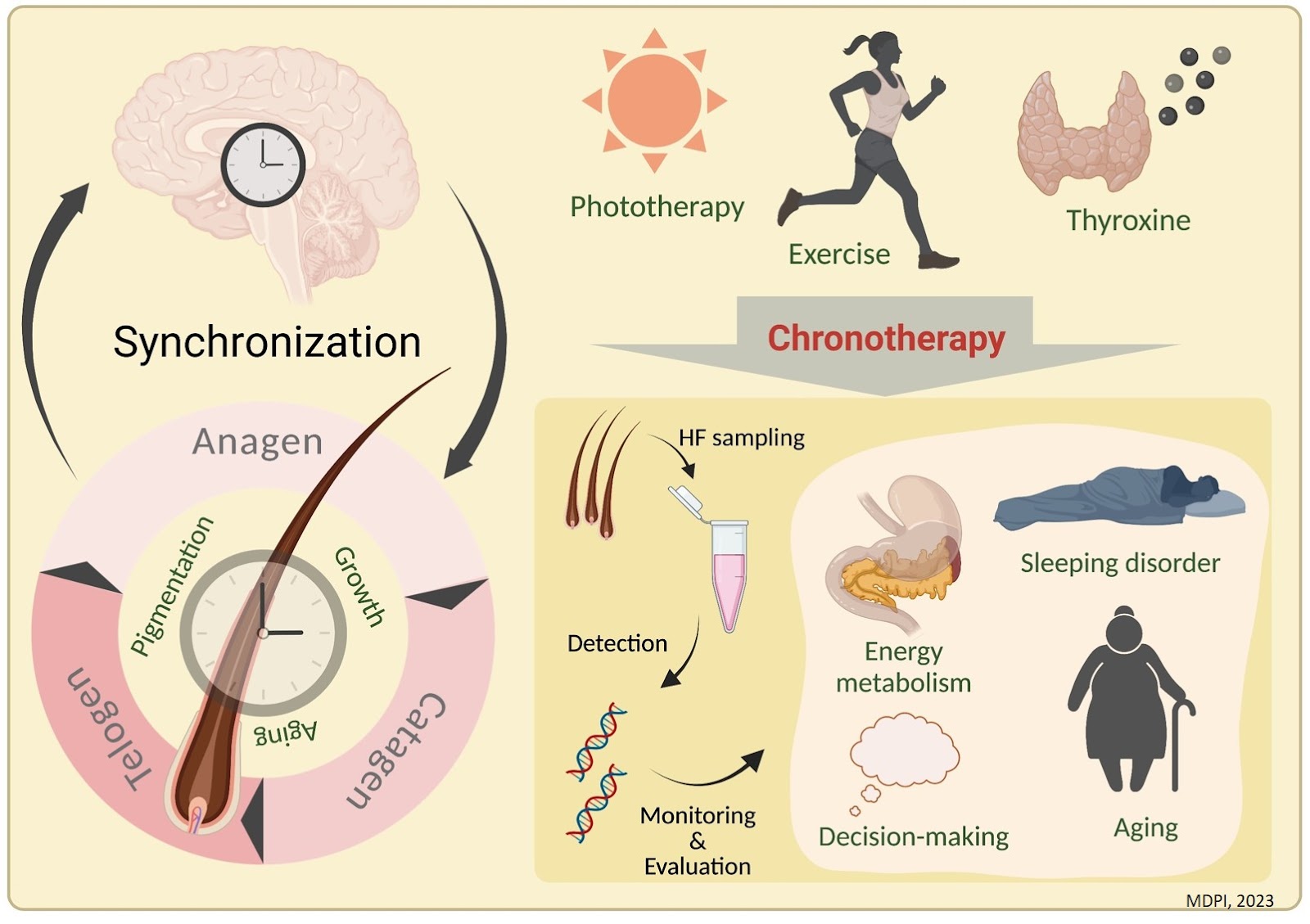
The clocks have changed, but the body hasn’t yet: Many people are particularly aware of their internal clock after the time change; they experience a kind of jet lag because the social time and their internal rhythm no longer align. However, the biological rhythm influences not only sleep but also metabolism and even the effects of medications.
“For example, studies show that the time of day at which certain cancer immunotherapies are administered can have a substantial impact on their effectiveness,” says the senior author. “This is likely because – like most of our body’s organs – the immune system also follows a roughly 24-hour rhythm. And that rhythm varies from person to person.”
The goal of circadian medicine is to systematically take this individual rhythm of the internal clock into account in diagnostics and therapy. In a new Collaborative Research Center researchers are working to advance this field of research.
Circadian medicine requires methods that allow the biological rhythm to be determined as simply as possible. This has been difficult until now: “The standard method to date measures the ‘dark hormone’ melatonin in saliva under dim light over several hours,” explains the author. “This can only be done in a laboratory and is too cumbersome for widespread use.”
The team have now developed a test that determines the rhythm of the body’s internal clock using hair – or, more precisely, using cells from a few hair follicles. “In these cells, we measure the activity of 17 genes that are part of the molecular clock or are controlled by it,” explains the the author. “Using machine learning, this pattern can be used to calculate at what point in the daily rhythm the person is currently at. A single sample is sufficient for this.”
In the current study, the researchers demonstrated that the new test determines an individual’s circadian rhythm almost as accurately as the previous standard method. “Hair analysis is, however, far easier to perform, which is what makes the method so valuable,” emphasizes the author. The team has already demonstrated that the test is suitable for widespread use: More than 4,000 people sent in hair samples from home to have their chronotype determined.
The analysis of this sample confirmed for the first time on a large scale, using biological measurements, findings that surveys had already suggested: For example, that the biological rhythm depends on age, meaning people in their mid-20s become tired on average about an hour later than those over 50. And that the internal clock signals the start of the night slightly earlier on average for the women tested than for the men. However, at six minutes, the difference revealed by the current study is smaller than that determined in questionnaire-based studies.
“We nevertheless assume that gender affects the internal clock, as sex hormones have also been shown to influence biological rhythms in other studies,” explains the author.
Overall, a person’s chronotype is determined by several factors. “Genetic predisposition, age, gender, and lifestyle all play a role,” says the chronobiologist. “And that’s why individual people’s internal clocks can differ significantly.” The researchers were surprised by how strongly lifestyle influences the biological rhythm: As the data show, the internal clock is active about half an hour earlier in working people than in those who are not employed.
To further establish the new test, the research team is working to standardize it for routine laboratory use. This will make it even easier to apply in medical practice in the future – for example, as a basis for sleep counseling or for diagnosing irregular sleep rhythms. Circadian medicine is also closer to becoming a reality. The test can now be used to determine whether therapies that are tailored to an individual’s internal clock are more effective or have fewer side effects than those without such timing adjustments.
https://www.pnas.org/doi/10.1073/pnas.2514928123