


A protein directs neuronal migration in the embryonic brain
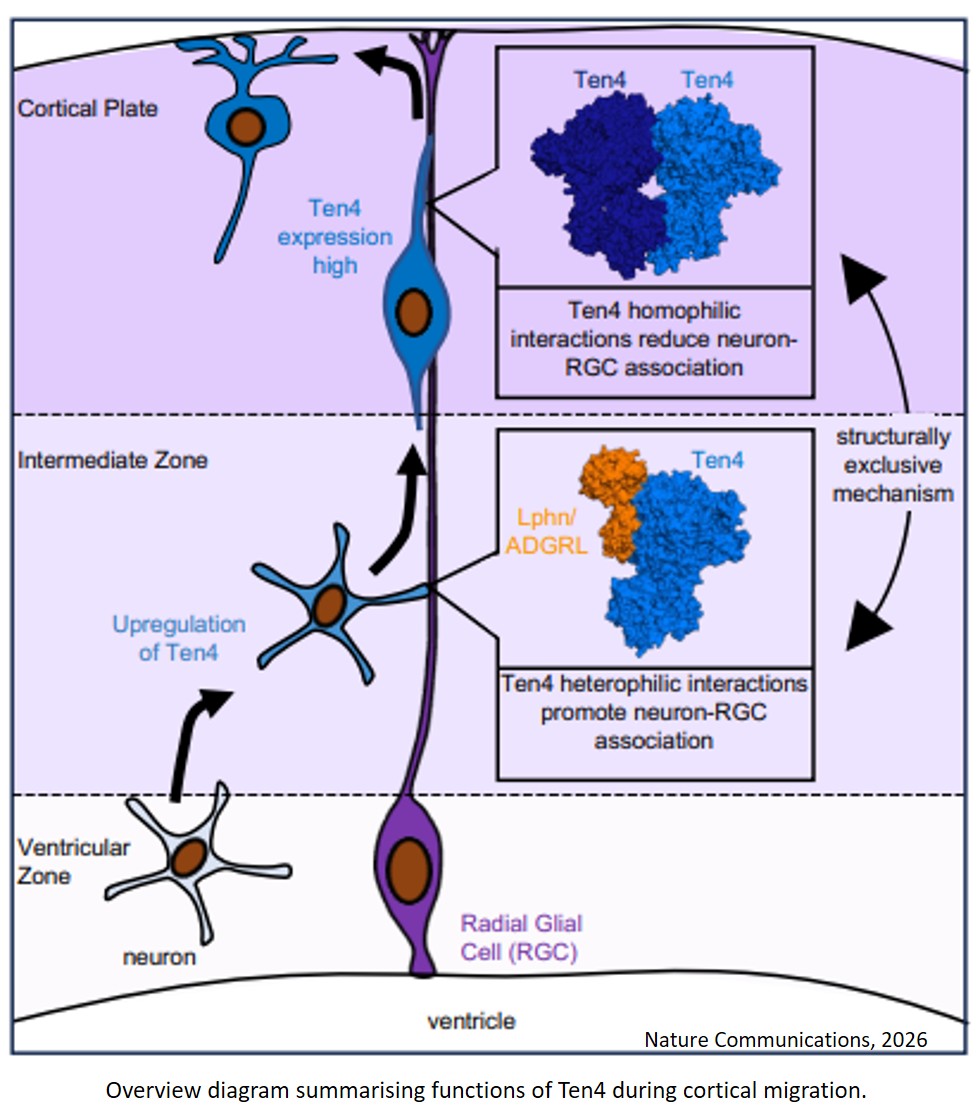
During brain development, neurons can regulate their movement until they reach their final destination thanks to a “molecular switch” involving the protein Teneurin 4 (Ten4). This protein can guide neuronal migration through mutually exclusive molecular pathways and determine the direction of nerve cells.
The discovery, published in the journal Nature Communications, improves our understanding of the molecular mechanisms that control neuronal migration and offers new insights into how the brain develops at the molecular level.
The study combines advanced techniques — structural protein studies, gene editing in animal models and super-resolution microscopy — to broaden our understanding of the origins of neurodevelopmental disorders and psychiatric or neurological conditions —schizophrenia, epilepsy, autism, bipolar disorder, etc. — which may be linked to errors in neuronal migration.
The brain is the organ that processes motor, sensory and cognitive information. During embryonic development, neurons must migrate from their place of origin to their final position, where they will form functional circuits. This journey is essential for proper brain development and for neuronal layers and synaptic connections to form. To achieve this, neurons use “highways” formed by fibres from other cells — radial glial cells — to which they attach and detach in a controlled manner to regulate their migration.
“The new study shows that the Ten4 protein acts as a switch which, depending on the context, can promote either neuronal adhesion or repulsion during their migration, but not simultaneously,” explains one of the corresponding authors.
“Specifically, the Ten4 protein can bind to molecules known as latrophilins to help the neuron adhere to the fibres. In other cases, it binds to other Ten4 proteins to reduce this adhesion to the fibres, thereby enabling faster neuronal migration,” explains the expert.
This change in function acts like a switch that guides the neuron through different stages of its journey. Therefore, the Ten4 protein appears to be the factor that regulates the dynamics of neuronal adhesion to the fibres.
“There are still many enigmas regarding how molecular interactions are orchestrated to enable neurons to migrate to their final destinations,” explains the researcher. “In light of these challenges in neuroscience, this study presents scientific evidence of a single molecule’s ability to coordinate different stages of a process as complex as neuronal migration through entirely opposing interactions.”
“Based on these findings, our study introduces a robust methodological framework for understanding the role of molecular interactions within complex tissue environments,” the team concludes.
https://www.nature.com/articles/s41467-026-71619-1
https://sciencemission.com/Structurally-exclusive-Teneurin-complexes