

Human psychological resilience signatures in acute stress
Psychological resilience is often misunderstood as simple “toughness” or an insensitivity to stress. However, true resilience is the brain's capacity to adapt and recover after a stressful event. Researchers have discovered that this recovery process doesn’t peak immediately; instead, it manifests in a distinct “resilience window” about an hour later.
Published in the Proceedings of the National Academy of Sciences (PNAS), the study using simultaneous fMRI and EEG revises long-standing assumptions about neural recovery and identifies a targetable timeframe for clinical and educational interventions.
The team tracked approximately 100 adults following an acute stressor (a cold-pressor test). While peripheral stress indicators like heart rate and cortisol levels returned to baseline relatively quickly, fMRI and EEG revealed that the brain’s high-order reorganization was only just beginning.
“Most resilience research relies on animal models, defining it as the absence of depression-like behavior,” explains the study's initiator. “But human resilience is more complex. It involves self-efficacy and past experience—things you can't ask a mouse in an interview. To understand these higher-order mechanisms, we had to study the human brain directly as it adapts.”
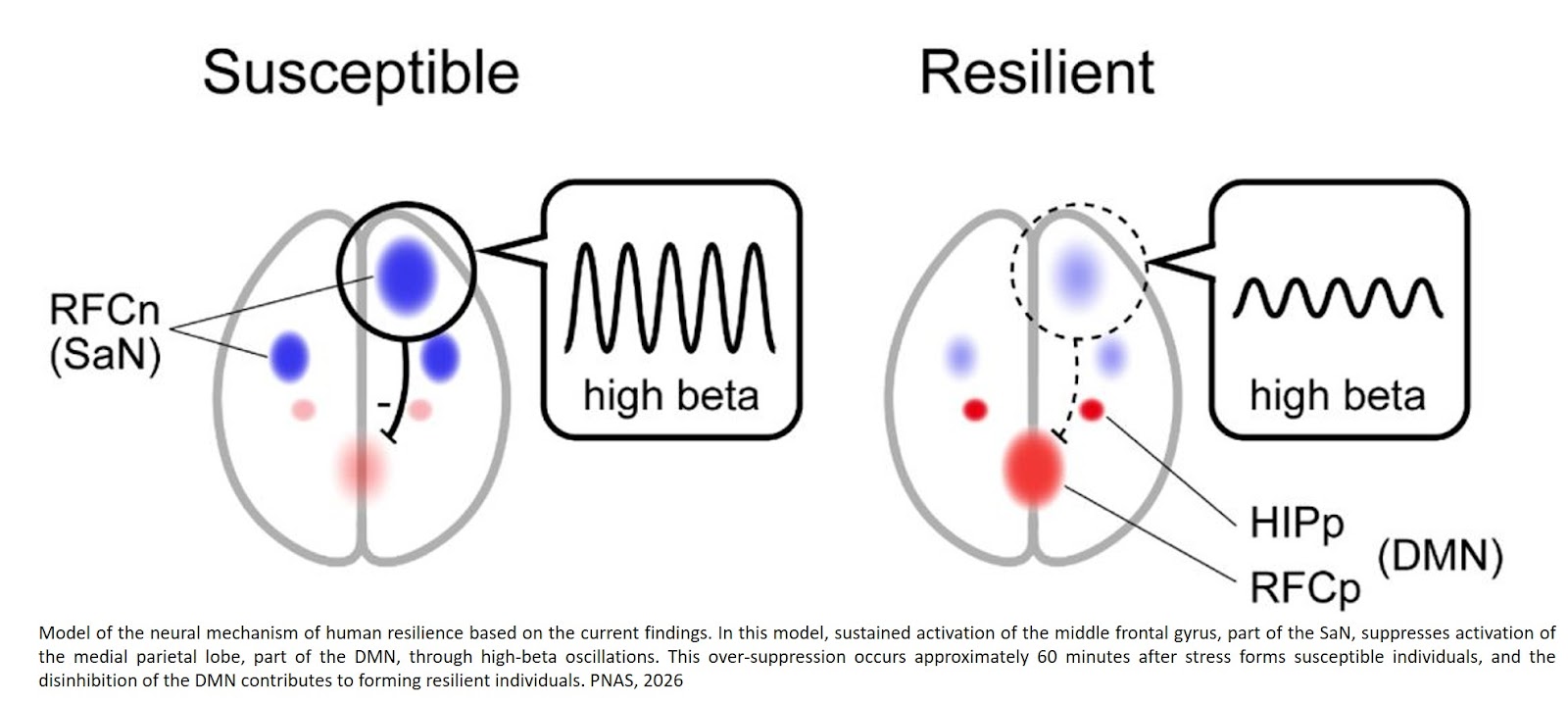
The researchers found that about 60 minutes post-stress, resilient individuals—quantified by validated psychological scales—showed a significant shift: a decrease in salience-network activity (associated with alarm and threat detection) and an increase in default-mode network activation (associated with internal reflection). This was accompanied by a marked fall in high-beta EEG power, an indicator of settling neural arousal.
“By the one-hour mark, while physical symptoms of stress had vanished, nonconscious brain changes were still unfolding,” says the senior author of the study. “This specific timing explained individual differences in resilience far better than any immediate response.”
Identifying this one-hour window provides a roadmap for “time-sensitive” care. Brief psychological support or non-invasive brain stimulation could be synchronized with this natural window to “nudge” the brain toward a resilient state.
Beyond immediate stress, these neural signatures could serve as biomarkers for PTSD and depression. By providing objective numbers, the study allows clinicians to gauge a patient's natural recovery capacity and deliver help when the brain is most receptive to change.