



Coordination of rotating brain waves
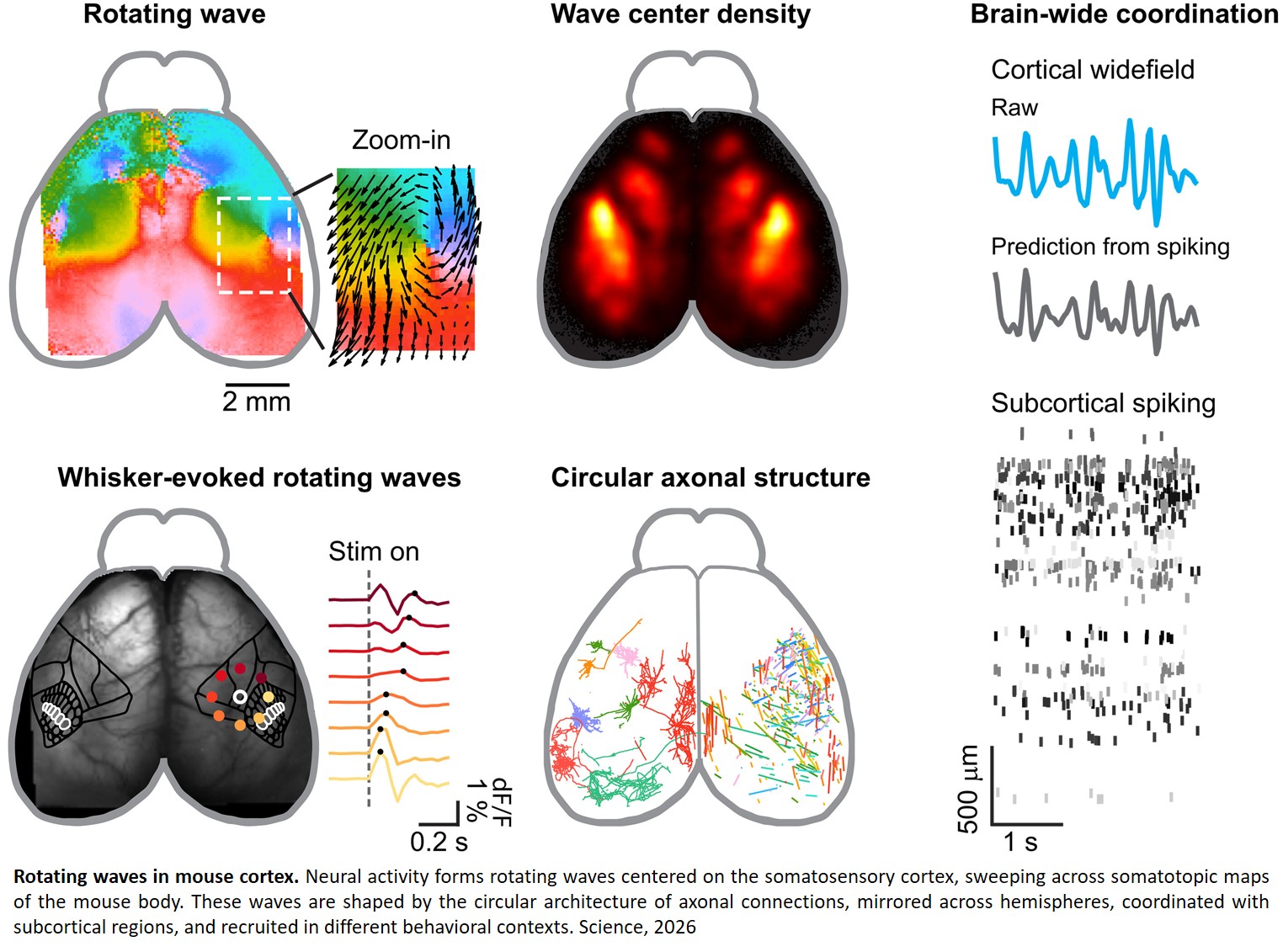
“We discovered a new kind of brain wave that specifically rotates over space and time, relies on a circular anatomical circuit in the sensory cortex, and impacts activity across the brain,” noted the lead author of the research.
Details on these traveling, whirling brain waves, as well as data on their activity during certain behaviors in mice, are reported this week in Science.
The findings on these vortex-like waves are, as they say, head-spinning.
The scientists examined how a mouse brain’s anatomical wiring coordinates the structure and propagation of the waves, which most commonly originate in the somatosensory region. This area processes sensations felt by the skin and muscles and cues about the body’s position, posture and parts, as well as other stimuli.
The neurons that generate these rotating waves form a merry-go-round-like pattern in the brain’s sensory cortex. Their axons, which produce electrical signals, point in a circle. This fixed architectural arrangement, almost like rail cars along a round track, coincides with the brain wave’s spiral motion.
The waves were mirrored on both sides of the mouse brain and coordinated between both sensory and motor parts of the brain. The scientists observed that the spiral waves also timed with spiking detected in deeper areas of the brain associated more with low-level functions. These include the thalamus, striatum and midbrain.
Because these rotating waves travel to different brain regions, they may play a role in sharing information across parts of the brain responsible for different but interdependent functions. For example, the interplay between the sensory cortex and the motor cortex of the brain is likely crucial to navigating one’s surroundings and other voluntary physical movements.
The scientists conducted their studies using cortex-wide brain imaging and large-scale electrophysiology measurements.
Among their approaches were to see the effects of a tiny puff of air on mouse’s left facial whiskers. This stimulus evoked a sequence of clockwise rotating waves of neural activity in the right sensory cortex with corresponding waves in the motor cortex.
The scientists also encouraged mice with a reward for an object-detection game that required paw and eye coordination. The scientists noticed rotating brain wave differences that varied depending on the mouse’s arousal state and its success at performing the task.
The researchers have yet to determine if rotating traveling waves are coordinated globally to the same extent in other species, including humans, as they are in mice.
As to the function of rotating wave dynamics, the scientists surmise that they might be serving as space-and-time clocks to set the chain of events of sensation followed by action. The waves could also help pave connections that become more entrenched with practicing a visual-motor task. By streaming across several brain areas, such waves might provide a way for the brain to begin to predict sensory sequences and coordinate motor responses.