

Quantification of sodium concentrations in brain astrocytes
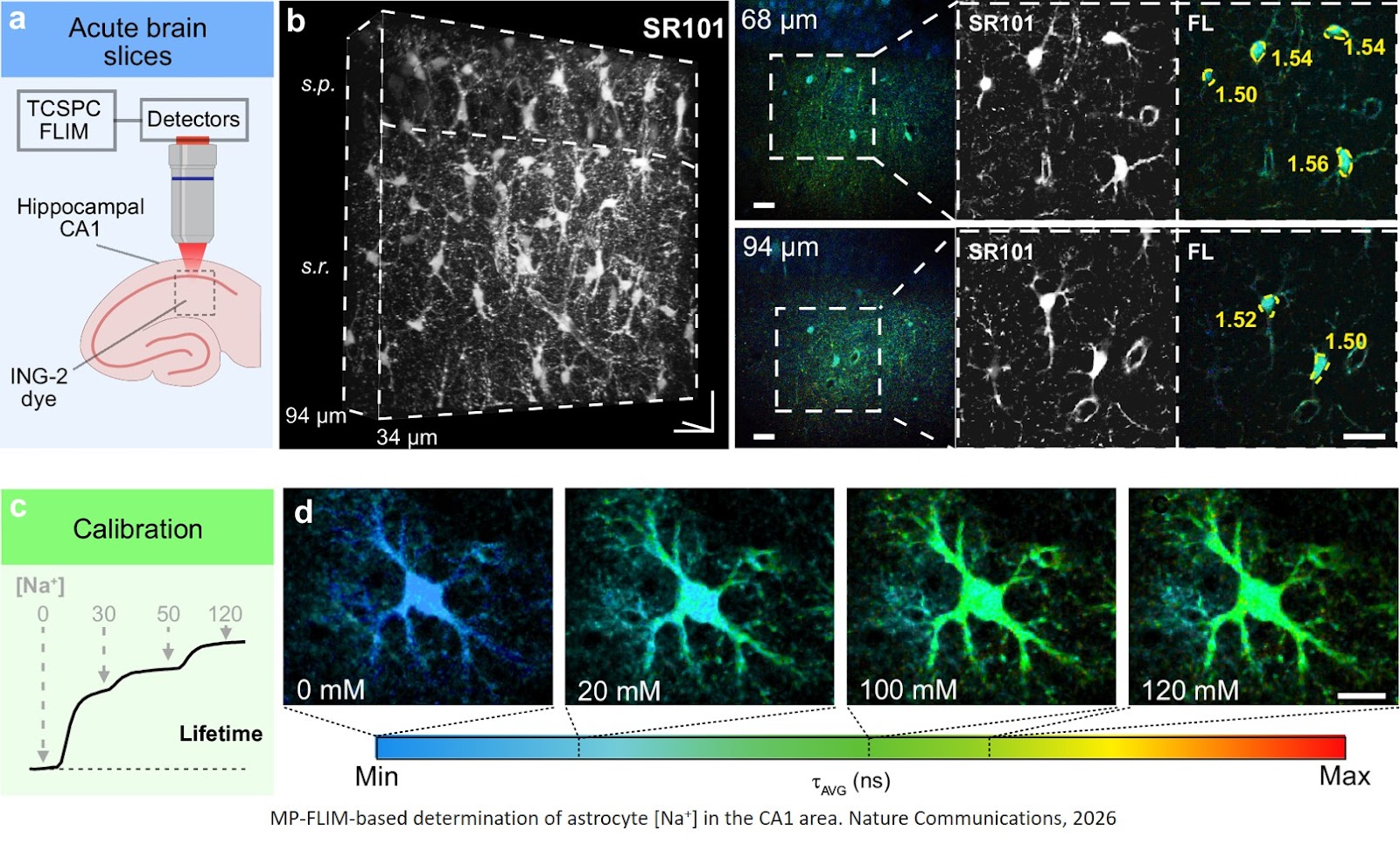
The element sodium plays a key role in nervous system function. An international research team has now conducted a closer examination of the sodium concentration in astrocytes – special cells in the brain. To achieve this, the researchers developed a method, via which they can make the sodium content of individual cells in tissue directly visible, as they now describe in the scientific journal Nature Communications.
The brain does not solely comprise nerve cells (neurons); roughly half of the organ is made up of so-called glial cells, which play an important role in brain development and are crucial for communication between neurons and the function of neural networks. Glial cells also include so-called star cells or “astrocytes”.
The element sodium, or rather positively charged sodium ions, are the most important electrolytes in the human body. These ions are crucial for many bodily functions. The main source thereof is table salt (NaCl), which is obtained from food.
Sodium ions are also involved in many processes in the brain, meaning that their concentration must be strictly regulated. In astrocytes, a low intracellular sodium concentration is important among other things for the regulation of neurotransmitters at the synapses – the junctions between nerve cells. It is also important for regulating the levels of other electrolytes. This enables astrocytes to ensure the functionality of nerve cells and regulate their excitability.
The team has now developed a new technique, which can make the sodium content in the astrocytes and their fine processes directly visible in brain tissue for the first time. The neurobiologists set out to test the existing assumption that there is a similarly low concentration of sodium in all astrocytes and in all their sub-units to enable the astrocytes to perform their vital tasks reliably.
They actually established that this is not the case. Rather, they discovered differences – both between individual astrocytes and within various sub-units of these cells. They also demonstrated that Na+/K+-ATPase (NKA), which can be found in the cell membrane of various astrocytes in differing numbers and configurations, are responsible for these differences.
The authors also found differential spatial expression patterns of NKA ß1 and ß2 subunits in astrocytes. Biophysical modeling of differential NKA expression together with varying strength of Na+ influx replicate the experimentally observed heterogeneity in astrocytic [Na+].
The lead author of the study: “We were also able to show that specialized functional sub-domains exist in astrocytes due to the different sodium concentrations. In each case, they react to the local needs of their neighboring neural network.”
The head of the study highlights further aspects: “These newly discovered properties of astrocytes may also play a role in various brain disorders where ion levels and neurotransmitter regulation are disrupted, such as epilepsy, or after a stroke. Our findings thus offer starting points for further research.”
https://www.nature.com/articles/s41467-026-73435-z