




Environmental stiffness regulates neuronal maturation
When thinking, the human brain performs a true masterpiece of information processing: around 100 billion neurons communicate with each other via approximately 100 trillion connections. An international team of researchers has discovered that the mechanical properties of the developing brain influence both synapse formation and the emergence of electrical signals. The findings could open up new approaches to understanding neurodevelopmental disorders.
In the brain, highly specific connections called synapses link nerve cells and transmit electrical signals in a targeted manner. Despite decades of research, how synapses form during brain development is still not fully understood. Now, an international research team has discovered that the mechanical properties of the brain play a significant role in this developmental process. In a study recently published in Nature Communications, the scientists showed how the ability of neurons to detect stiffness is related to molecular mechanisms that regulate neuronal development.
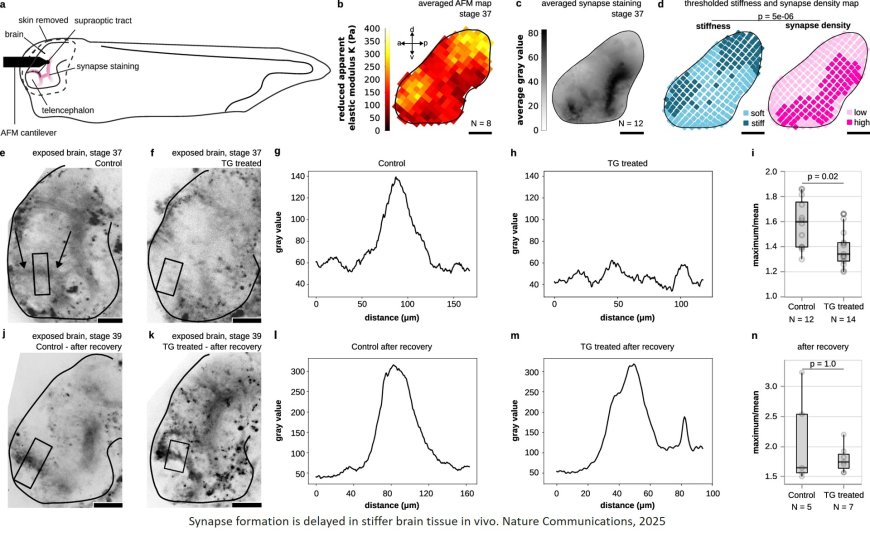
The developing brain is generally very soft, like cream cheese, but its stiffness varies across regions. In African clawed frog (Xenopus laevis) embryos, the researchers found that softer regions exhibit higher synapse densities, while stiffer regions show lower densities.
To test whether stiffness directly affects synapse formation, the team artificially stiffened the brain and observed that synapse development was delayed across all regions. The scientists thus proved that mechanical properties actively influence how quickly and where synapses are formed in the brain.
“This fundamentally changes our understanding of how the brain matures.” said the author. “Until now, neuroscience has primarily focused on how chemical signals shape brain development. Considering mechanical cues provides a new perspective on brain development and may lead to new insights into neurodevelopmental disorders,” adds the lead author of the study.
To understand how neurons adapt to their environment at the molecular level, the team studied genetically altered neurons. This allowed them to eliminate specific proteins from the neurons and examine processes such as synapse formation and electrical signalling under controlled conditions. The scientists found that both synapse formation and electrical activity depend on the stiffness of the environment. Neurons sense this stiffness through the mechanosensitive ion channel Piezo1.
The researchers then measured the expression of thousands of genes and discovered that Piezo1 delays neuronal development in stiffer environments by reducing the expression of transthyretin, a protein recently shown to regulate synapse formation. By uncovering this pathway, the team revealed how stiffness sensing is linked to molecular mechanisms that guide neuronal development.
“These findings highlight the importance of mechanical signals in brain development and point to their potential role in neurodevelopmental disorders,” concluded the third lead author.
The identified signaling cascade that controls the stiffness-dependent development of nerve cells offers researchers new opportunities to investigate developmental disorders of the nervous system that could lead to conditions such as schizophrenia or autism.
https://www.nature.com/articles/s41467-025-64810-3
https://sciencemission.com/Environmental-stiffness-regulates-neuronal-maturation