

AI finds hidden human proteins and their function
New research shows how artificial intelligence, combined with advanced experimental science, can help find “hidden” and unexplored proteins in the human body and reveal what they actually do, according to a new study published in Nature.
The discovery suggests a new way to study how cells communicate, survive stress and possibly support disease.
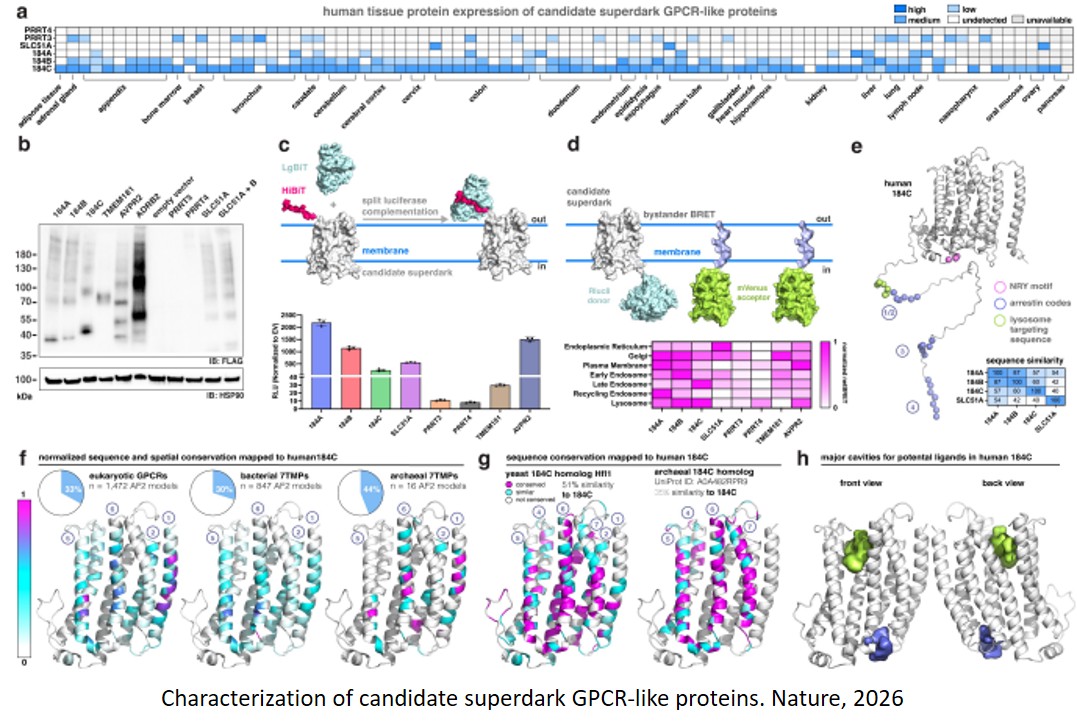
Researchers used AI to compare the shapes of more than 214 million predicted proteins. Instead of looking only at genetic sequence, they searched by three-dimensional form and found hidden members of the G protein-coupled receptor, or GPCR, family, a group that helps cells sense and respond to extracellular signals.
“For decades, we have largely explored protein biology using sequence as our guide,” said the study senior author. “We wanted to know what biology we might be missing if we searched by three-dimensional structure instead. What we found suggests there is another layer of biology that has been hiding in plain sight.”
One protein in particular, TM184C, attracted their attention.
TM184C looks like a GPCR, but the research team noted that it behaved differently. Much of it was found inside the cell, within the membranes of intracellular vesicles, tiny packages that carry materials. They found that these vesicles traveled along microtubules, the cell’s internal highways, and gathered in thin projections that connect neighboring cells.
Those projections acted like bridges. Through them, cells exchanged metabolites, vesicles, and organelles, including mitochondria, which produce the energy that powers cells.
When researchers disrupted TM184C, cells formed fewer connections and showed changes in shape and vesicle organization, suggesting TM184C helps build and manage these intercellular conduits.
“When we saw TM184C-positive vesicles moving through connections between cells, we realized these structures could be routes for substantial material exchange,” said the lead author. “That completely changed how we thought about TM184C and made us consider how cells might use these connections to cooperate and compete for resources.”
The discovery raises a basic question: When cells share resources, who benefits? In healthy tissue, this exchange may help cells survive stress by moving fuel or damaged components where they are needed. But if the exchange is unequal, one cell could gain at another’s expense.
“I think cells coordinate until they have to compete,” said a Cancer Biology graduate student in the lab. When the cells are stressed, they may coordinate to redistribute the proteins, organelles, and metabolites to support the survival of the population as a whole.”
“What excites me most is understanding what this exchange actually does to the cells on both sides,” said another graduate student. “As part of my doctoral work in the Isom lab, I am studying how these connections occur in normal cells and aggressive cancers like glioblastoma. Understanding their role could give us new insight into how these tumors communicate and potentially reveal vulnerabilities we haven’t recognized before.”
In cancer, where tumor cells often grow with limited oxygen and nutrients, cell-to-cell bridges could give some cells another way to survive by sharing resources or drawing support from surrounding cells.
TM184C also appears to help regulate autophagy, the process cells use to break down and recycle old or damaged parts. This recycling system helps cells adapt under stress. In the study, when TM184C was reduced, autophagy markers increased, suggesting the protein helps tune the process.
The team studied a yeast protein called Hfl1, which is similar to the human protein TM184C. When researchers removed Hfl1 from the yeast, the cells developed problems. However, when they added the human TM184C protein, it fixed those problems. This surprising result shows that this important function has remained similar in yeast and humans despite about a billion years of evolution.
“For decades, biomedical research has understandably concentrated on the proteins we could identify and understand,” the author said. “But there is another layer of biology that has remained largely invisible to us. AI gives us a way to start exploring it systematically. TM184C is one example of what can be found when we look.”
Scientific study needs to combine experimental validation with AI, the senior author stressed. “AI cannot be blindly trusted, but can lead to really big things in the hands of experts and prepared minds,” the author said.
The larger message is that AI is not simply speeding up science; it is changing what scientists can see. TM184C is one example of what may be hidden in the dark proteome and a new way to study how cells communicate, survive stress and possibly support disease.
https://www.nature.com/articles/s41586-026-10993-8
https://sciencemission.com/TM184C-is-a-GPCR-like-regulator