


Deciphering DHX9 gene pathogenicity in neurological disorders with distinct phenotypes
Annual Clinical Genetics Meeting, March 2026
Shen Gu, PhD, FACMG, Assistant Professor, Tianyu Guo, MSc, Chen Wang, MSc, Lihai Gong, BSc, Daniel G. Calame, MD, PhD, James R. Lupski, MD, PhD, Yong Lei, PhD, Shen Gu, PhD, FACMG
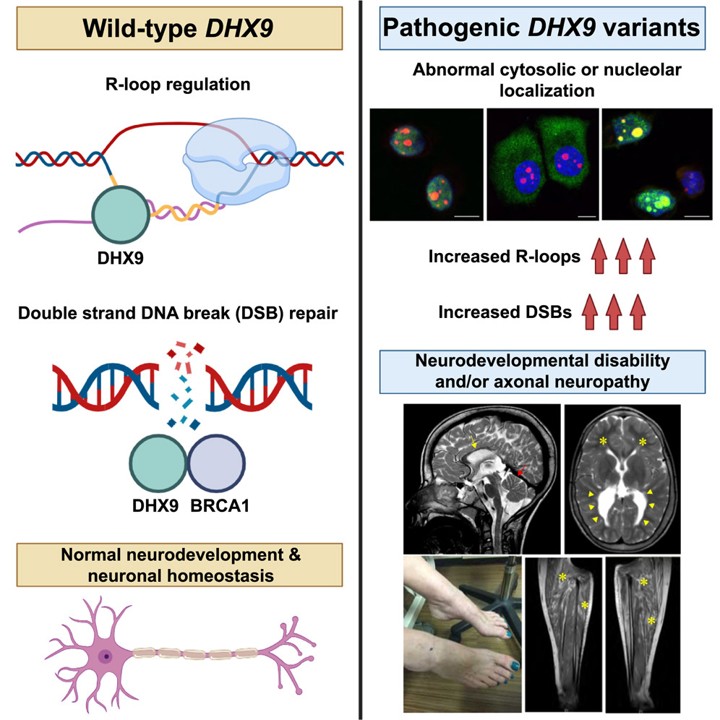
Introduction: Neurodevelopmental disorders (NDDs) encompass a spectrum of conditions affecting brain development and function, with approximately 90% lacking approved treatments. Understanding their pathogenic mechanisms is essential for developing precision therapies. Recently, we identified de novo variants in the DExH-box helicase 9 (DHX9) gene in patients exhibiting diverse neurological phenotypes, ranging from severe NDD with brain structural abnormalities, mild NDD with normal brain MRI, to adult-onset type 2 Charcot-Marie-Tooth (CMT) - a distal symmetric peripheral polyneuropathy. DHX9, an ATP-dependent helicase that unwinds complex DNA and RNA structures, plays a critical role in regulating mRNA splicing. It is predominantly expressed in the nucleoplasm and localized to nuclear speckles, which are membraneless organelles (MLOs) that serve as sites for splicing regulation. It is also occasionally found in nucleoli, which are MLOs responsible for ribosome biogenesis and cell growth.
Methods: Using CRISPR/Cas9, we generated human embryonic stem cells (hESCs) harboring patient-specific DHX9 variants, including two severe NDD variants, one mild NDD variant, and one CMT variant. These hESCs were differentiated into cerebral organoids (hCOs) to model human brain development. Additionally, we generated four mouse models carrying these patient-specific variants, as well as central nervous system (CNS)-specific knockout (KO) and germline heterozygous loss-of-function (LoF) models of Dhx9. We investigated the molecular, neuropathological, and behavioral abnormalities in these preclinical models to elucidate the distinct pathogenic mechanisms underlying DHX9-associated disorders.
0Results: Overexpression (OE) experiments of wildtype (WT) and all patient-specific mutant DHX9 revealed that LoF variants reducing gene expression and missense variants impairing ATPase activity were associated with mild NDD. Conversely, missense variants disrupting the nuclear localization signal led to cytoplasmic mislocalization of DHX9 were associated with severe NDD. In contrast, CMT variants caused nucleolar enrichment of DHX9. These expression patterns were corroborated in edited hESCs.
hCOs carrying the mild NDD variant were slightly smaller than controls, with compromised neuroepithelial (NE) loops formation resembling the ventricular zones of the developing brain. Severe NDD hCOs exhibited significantly delayed expansion of EP buds and reduced hCOs size, while CMT hCOs showed earlier EP bud expansion compared to other groups. These findings suggest that the NDD variants hinder hCO generation, with severe NDD variants causing more pronounced defects, whereas the CMT variant may accelerate this process. These observations are consistent with the clinical presentations seen in patients with DHX9 variants.
At the molecular level, transcriptomic analysis in hESCs revealed that the mild NDD variant caused modest differential expression and mis-splicing of genes involved in neural development, while the CMT variant dysregulated mRNAs related to cell proliferation. Severe NDD variants disrupted liquid-liquid phase separation (LLPS), a key feature in MLO formation. Ongoing experiments are examining the specific mis-splicing events caused by different DHX9 variants in hESC-derived hCOs.
In vivo mouse studies showed that CNS-specific KO of Dhx9 caused perinatal lethality, with significant brain size reduction and hippocampal hypoplasia. Germline heterozygous LoF of Dhx9 led to mild hippocampal hypoplasia and minor behavioral deficits, consistent with the clinical presentations of mild NDD patients. We are further investigating brain structure and behavioral phenotypes in mouse models carrying patient-specific variants.
Conclusion: Our results suggest that LoF variants reducing WT DHX9 expression result in mild NDD, while gain-of-novel-toxic function variants that alter LLPS propensity and disrupt MLO formation cause severe NDD. Gain-of-existing-function variants that prompt nucleolar enrichment lead to CMT, characterized by accelerated cellular proliferation. Findings from our preclinical models highlight the critical role of DHX9 in neurodevelopment and provide valuable insights for the development of targeted therapies.