

New acute myeloid leukemia “don’t eat me” signal discovered!
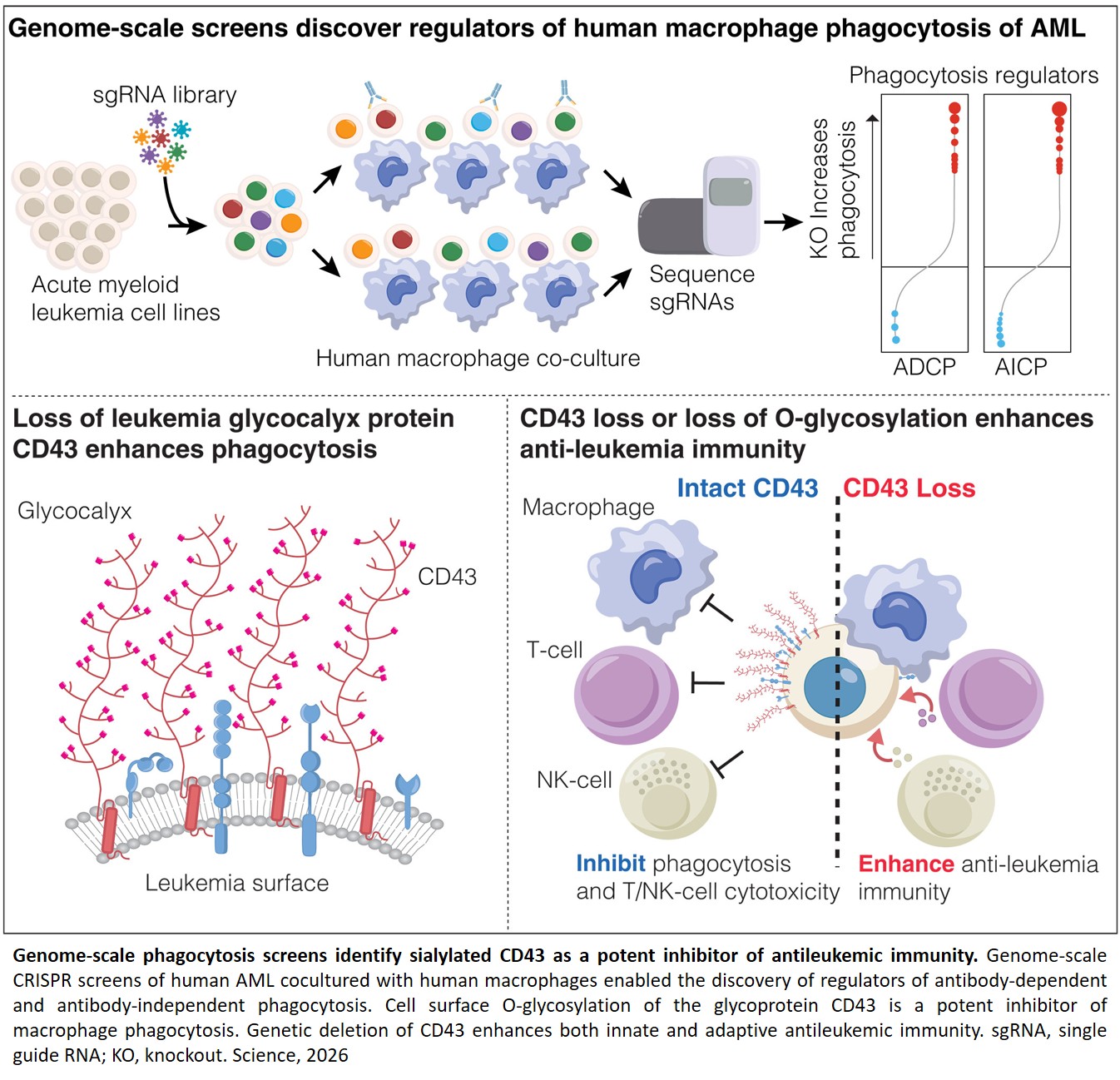
Macrophages, much like Alice of “Alice in Wonderland,” recognize and consume tumor cells that display “eat me” surface markers. However, tumor cells can evade detection by macrophages if they successfully present “don’t eat me” signals.
To counter this, researchers have developed drugs aimed at turning off these “don’t eat me” signals. However, such treatments haven’t been as effective as anticipated in patients with acute myeloid leukemia (AML) and other blood cancers.
To better understand why, a team of researchers looked at samples from patients treated for AML.
The team conducted a genome-scale loss of function screen in AML cell lines, systematically turning off individual genes and cataloging those that affected detection by macrophages.
Surprisingly, the classic CD47 “don’t eat me” signal had only a weak effect. Instead, the researchers found that another signal—CD43—had a much stronger influence on macrophage detection.
The inhibitory activity of CD43 was dependent on its sialic acid residues and the length of its ectodomain but independent of the canonical sialic acid–binding receptors SIGLEC-1, SIGLEC-7, and SIGLEC-9.
Inactivation of CD43 function restored the ability of macrophages to phagocytize AML.
The authors also found that CD43 not only restrains human macrophage phagocytosis but also human natural killer (NK) and human T cell cytotoxicity.
Their findings suggest that therapies targeting CD43 could be promising for treating patients with AML and, potentially, a broader range of cancers.
https://www.science.org/doi/10.1126/science.ady5196