

Redox and pH changes shuts down AQP3 channel
For the first time, researchers have been able to show how a cell closes the door to free radicals – small oxygen molecules that are sometimes needed, but that can also damage our cells. The study is published in Nature Communications and was led from Lund University.
For our cells to function, they need to maintain a careful balance between beneficial and harmful oxygen molecules known as free radicals. One of the most important is hydrogen peroxide – the same substance found in disinfectants, but which our cells use in very small amounts to send important signals. However, in excessive concentrations, hydrogen peroxide can cause damage and even cell death.
“Our cells produce free radicals when we inhale oxygen. Previously, it was thought that the hydrogen peroxide from oxygen could flow freely through ‘doors’ of the cell membrane, i.e. channels that also flux water, but we have shown that the channels in the cell membrane appear to have a protective system,” says the lead researcher.
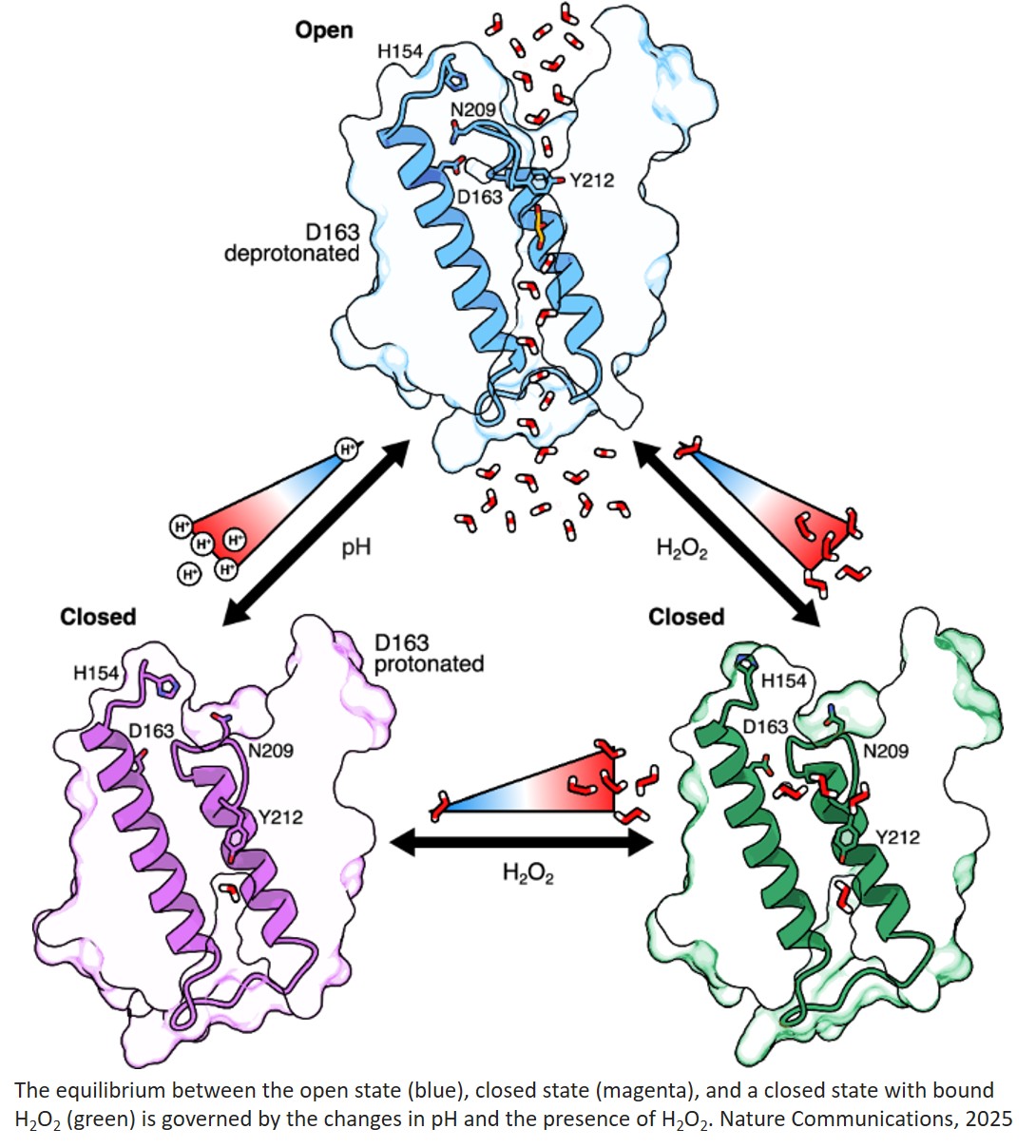
Thanks to advances in cryo-electron microscopy, the researchers were able to see that the door is normally open, allowing molecules such as hydrogen peroxide, water and glycerol to enter. However, if the amount of hydrogen peroxide outside the cell is too high, hydrogen peroxide molecules get stuck on the outside of the channel. These then act as a “lock” holding the door closed and protecting the cells from damage.
The cryo-electron microscopy showed the channel closed upon hydrogen peroxide – something no one has shown before. They demonstrate that at pH 8.0, the channel adopts an open state, while acidic pH or exposure to H2O2 promotes closure via a large conformational rearrangement of extracellular loop E.
“We were surprised by what we saw. It was like witnessing, in the moment, the cell closing the channel on something that could otherwise cause it harm. Doing that acts as an automatic protection against dangerous levels entering the cell,” says the author.
The discovery provides new understanding of how cells protect themselves against stress and damage and how they regulate free radicals – knowledge that may help researchers to understand diabetes, cancer and other conditions in which cells’ stress levels are disturbed.
“Cancer cells, for example, produce extreme quantities of free radicals when they grow quickly. Despite this, they do not die as a result, which suggests that they have ways of getting rid of the excess. One possibility is that they use the same type of channel in the cell membrane to expel the surplus and avoid being suffocated by their own free radicals. In our next study, we want to investigate whether it is possible to kill cancer cells by blocking the channels,” says the author.
The study is published in Nature Communications and the researchers used beta cells from donors with and without type 2 diabetes.
https://www.nature.com/articles/s41467-025-67144-2
https://sciencemission.com/Structural-insights-into-AQP3-channel