

Cytoskeletal remodeling with rhythmic changes lead to axon development
The researchers have uncovered a mechanism that determines why a neuron usually forms a single, long extension called “axon” – a phenomenon that is fundamental to how our brain functions. Contrary to the common view that external cues drive axon formation, the team of scientists comes to the conclusion that its growth originates primarily inside the cell. Their work, based on cell cultures and was published in the journal “Nature” reveals how a neuron’s structure is remodeled to generate the axon.
Neurons in the brain and spinal cord form a vast network in which each cell receives many inputs but sends output through only a single, long extension: the “axon”. “If our neurons had multiple axons, this would cause chaos in the brain,” says the senior author. “Nature has therefore found a clever way to make sure that neurons generate only one axon. This applies not only to humans, but across the entire animal kingdom. So, we’re dealing with very fundamental processes that shape the wiring of the brain and nervous system.”
During early embryonic development, neurons are initially largely symmetric, exhibiting small projections known as neurites. Eventually one of these develops into the axon, thereby breaking the symmetry. Until now, it was largely assumed that this process is determined by biological growth factors that act on a neuron from the outside – and that, much like attractants, lead to the development of the axon. The research team reaches a different conclusion. “According to our observations, the axon forms as a result of a remodeling of the cytoskeleton initiated by the young neuron. The process originates in the cell body, the so-called soma – the very center of the neuron,” says the first author of the current publication.
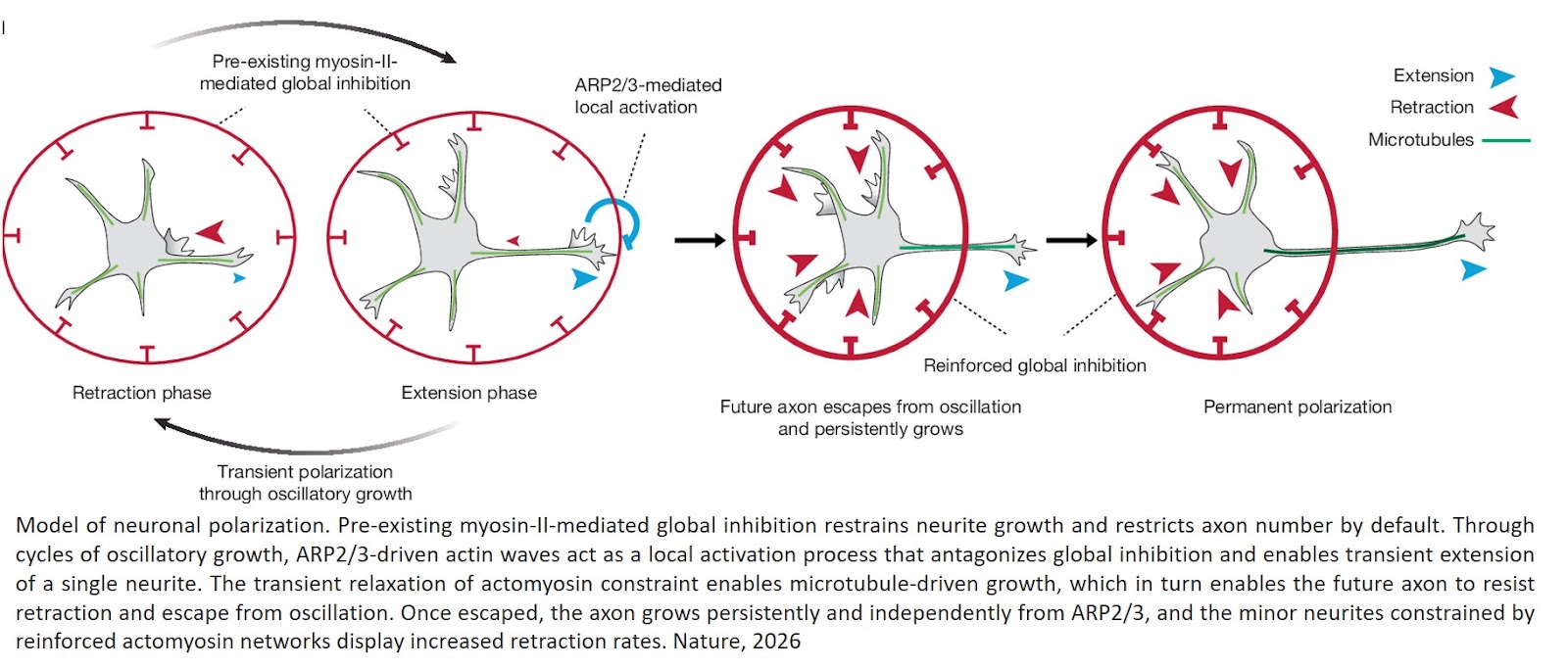
Young neurons display a rhythmic behavior: Their neurites stretch out somewhat, and then shrink back slightly. “This happens on a minute-by-minute basis. In a sense, the process follows the principle of two steps forward and one step back. This sequence repeats again and again,” says the author. Within typically 48 hours, however, one of the neurites grows into an axon. The remaining neurites later develop into receptors for inputs. “Actually, this recurring process was already known. But it was unclear what lies behind it. We have now been able to shed considerable light on the underlying mechanisms.”
The key lies in the neuron’s cytoskeleton, a tension‑bearing, molecular scaffold that acts like a corset around the cell. “This is where a protein complex called Arp2/3 enters the picture. Our findings show that it works like a zipper, locally opening the cell’s corset,” says the author. “By doing so, Arp2/3 drives the cell’s rhythmic shape-shifting, repeatedly loosening a network that would otherwise tighten up again.”
The researchers found that Arp2/3 always acts on only one neurite at a time, temporarily enabling its growth. “This comes with a locally confined restructuring of the cytoskeleton that spreads like a wave,” says the atuhor. “These events continue until the wave subsides because, although the cellular corset has been loosened, it still offers a certain degree of resistance. Then the process begins again. The same neurite may be affected once more, or a different one may be involved. Which one seems to be a matter of chance.”
Parallel to this outward extension, relatively rigid structural proteins grow into the neurites from within. “Eventually, one of the neurites becomes stable enough to resist being pulled back. It can then continue growing independently of Arp2/3 and ultimately develops into the axon. Meanwhile, the overall ’wave-driven’ outgrowth comes to a stop,” says the author.
“We cannot exclude the possibility that external factors play a certain role. However, given our data, we are convinced that the basic process that drives axon growth originates within the cell itself,” says the senior author. Open questions remain: What initiates the remodeling? Why does it proceed rhythmically and one neurite at a time? And, why does remodeling stop as soon as one of the neurites has grown large enough? “The young nerve cell presumably follows a protocol encoded in its genome. However, we do not yet know the relevant genetic program, and our understanding of the associated regulatory processes remains limited. Thus, there is still plenty of research ahead, which motivates us to continue pursuing this topic.”
https://www.nature.com/articles/s41586-026-10755-6
https://sciencemission.com/cytoskeletal-oscillator-and-neuronal-polarity