

Rare inherited EGFR mutation linked to increased lung cancer risk
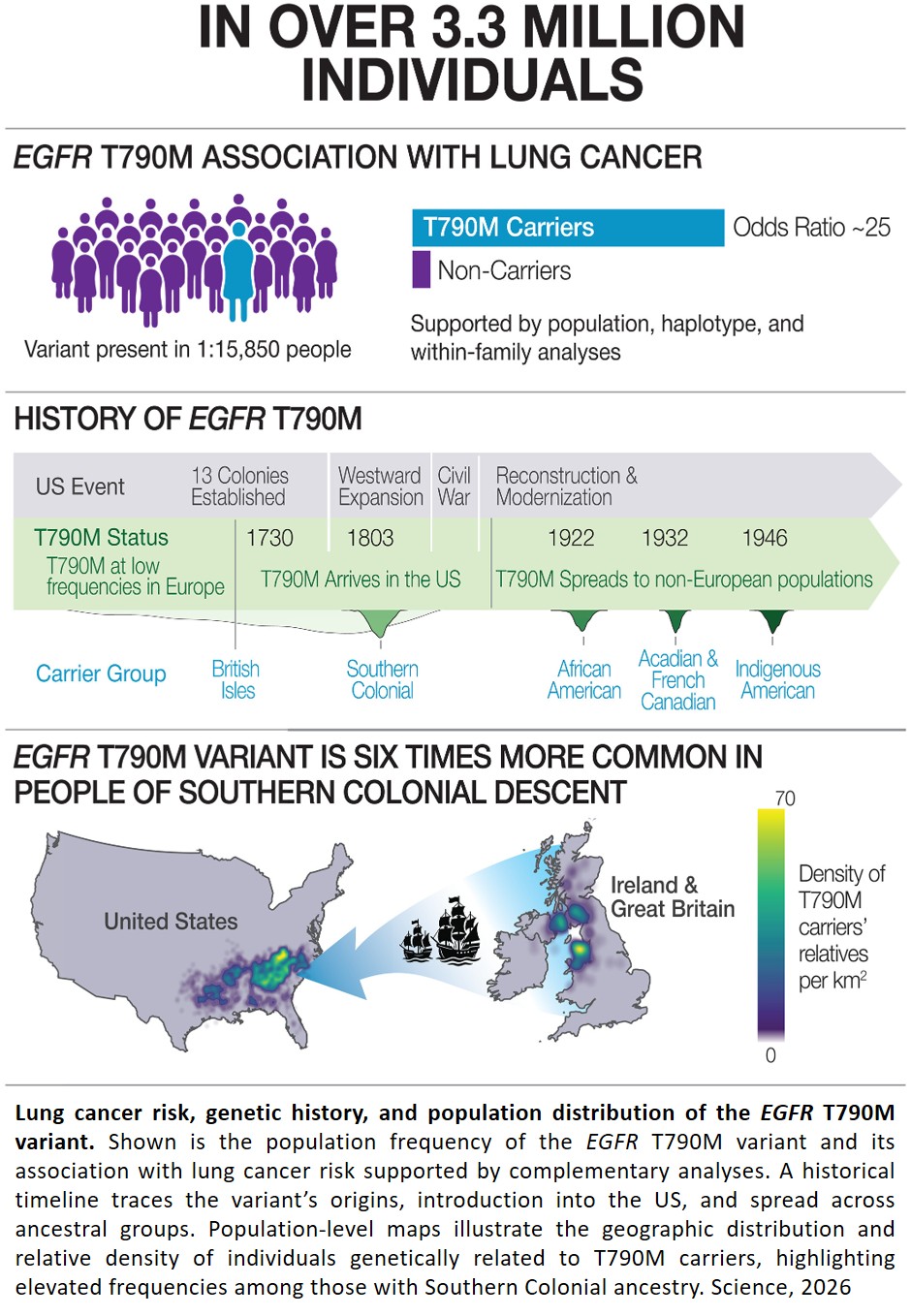
A rare inherited mutation in the Epidermal Growth Factor Receptor (EGFR) gene is associated with a 25-fold increased risk of lung cancer, according to a study. The findings included de-identified, aggregated genetic data from more than 3.3 million 23andMe research-consented participants.
Among people who never smoked, carriers of the mutation were more than 60 times as likely to develop lung cancer as people without it. Researchers identified EGFR T790M as one of the strongest inherited risk factors for lung cancer discovered to date. This could have important implications for genetic testing and future lung cancer screening strategies for people who carry the mutation.
The findings were published in Science.
"Today, lung cancer screening is driven almost entirely by smoking history,” says a co-lead of the study. “Our findings raise the possibility that, in the future, screening could also be dictated by inherited genetic risk. If further studies confirm the benefit, people with EGFR T790M could be identified through genetic testing and offered personalized CT screening to identify lung cancers when they are at their most curable stage."
Although most lung cancers are associated with tobacco use or exposure, the proportion diagnosed in people who have never smoked has been rising. Yet the genetic factors underlying these cancers, particularly the role of inherited risk, aren’t well understood.
In 2005, researchers identified a rare inherited mutation called EGFR T790M in a European family with multiple cases of lung cancer. Since then, the mutation has been reported in other families with unusually high rates of the disease.
"For years we've known that some families inherit a markedly increased risk of lung cancer, but because this variant is so rare, we've never been able to accurately measure that risk,” said a co-senior author. “By studying more than three million people, we were able to demonstrate just how strongly this inherited mutation is associated with lung cancer."
Comparing people with lung cancer to those without the disease, the researchers examined whether EGFR T790M was more common among those who had developed lung cancer. They also analyzed people who had never smoked separately to determine whether the association persisted in the absence of tobacco use. Additional data supporting the association came from participants in the INHERIT Study (NCT05587439).
The researchers expected EGFR T790M to increase lung cancer risk, but they had not anticipated the magnitude of the increased risk.
“One of the remarkable findings here is just how strong an effect a single mutation can have,” said another co-senior author, “To my knowledge it's one of the strongest, if not the strongest, cancer risk increasing mutations that has ever been found.”
Among people who smoked, carriers of the mutation were about 10 times as likely to develop lung cancer as noncarriers. Among people who never smoked, carriers were more than 60 times as likely to develop lung cancer. This relative risk does not mean smoking is protective, the researchers explained. Because smoking already greatly increases lung cancer risk, the mutation’s effect appears smaller by comparison.
“Smoking is bad for lung cancer. This mutation is bad for lung cancer. When you do both, your risk is the sum of those two risks,” the author said. “So, you definitely don't want to smoke.”
The mutation was not linked to any of 17 other common cancers studied, suggesting that its effects may be largely limited to lung cancer.
“We found that the vast majority of carriers inherited the mutation from the same ancestral lineage,” the author said. “We could trace that lineage to British and Irish settlers in the United States and show that the mutation became enriched after a founder event and genetic bottleneck in Southern Appalachia about 200 years ago. It's a fascinating example of how human migration and genealogy can shape disease risk, generations later.”
The researchers recommend that people with several family members who have had lung cancer, multiple lung nodules, multifocal lung cancers, or ancestral roots in areas of the southeastern U.S., where the variant is more common, consult a genetic counselor. A counselor can help determine whether genetic testing and regular lung cancer screening may be appropriate.
23andMe members who participate in research were essential in driving these discoveries. The size and scale of the 23andMe database allowed researchers the opportunity to analyze data from more than 10 million 23andMe research-consented participants. They then focused on 3.3 million participants for whom both genetic and lung cancer data were available.
“We’ve built a research community where millions of people consent to take part and answer questions about their health year after year to accelerate meaningful discoveries,” said the Vice President of Research at 23andMe. “Finding a variant this rare, measuring what it does, and tracing where it came from are three different scientific challenges, and addressing all three takes genetic and health information in one place, at scale. We're grateful for what our participants made possible here.”
As next steps, researchers hope to learn why some EGFR T790M carriers develop lung cancer while others do not, why the mutation increases the risk of lung cancer but not other common cancers, and how environmental exposures and additional genetic changes influence risk. Future studies will include more diverse populations and investigate other inherited EGFR mutations that may predispose people to lung cancer.