



FOXJ3 gene variants linked to drug-resistant focal epilepsy
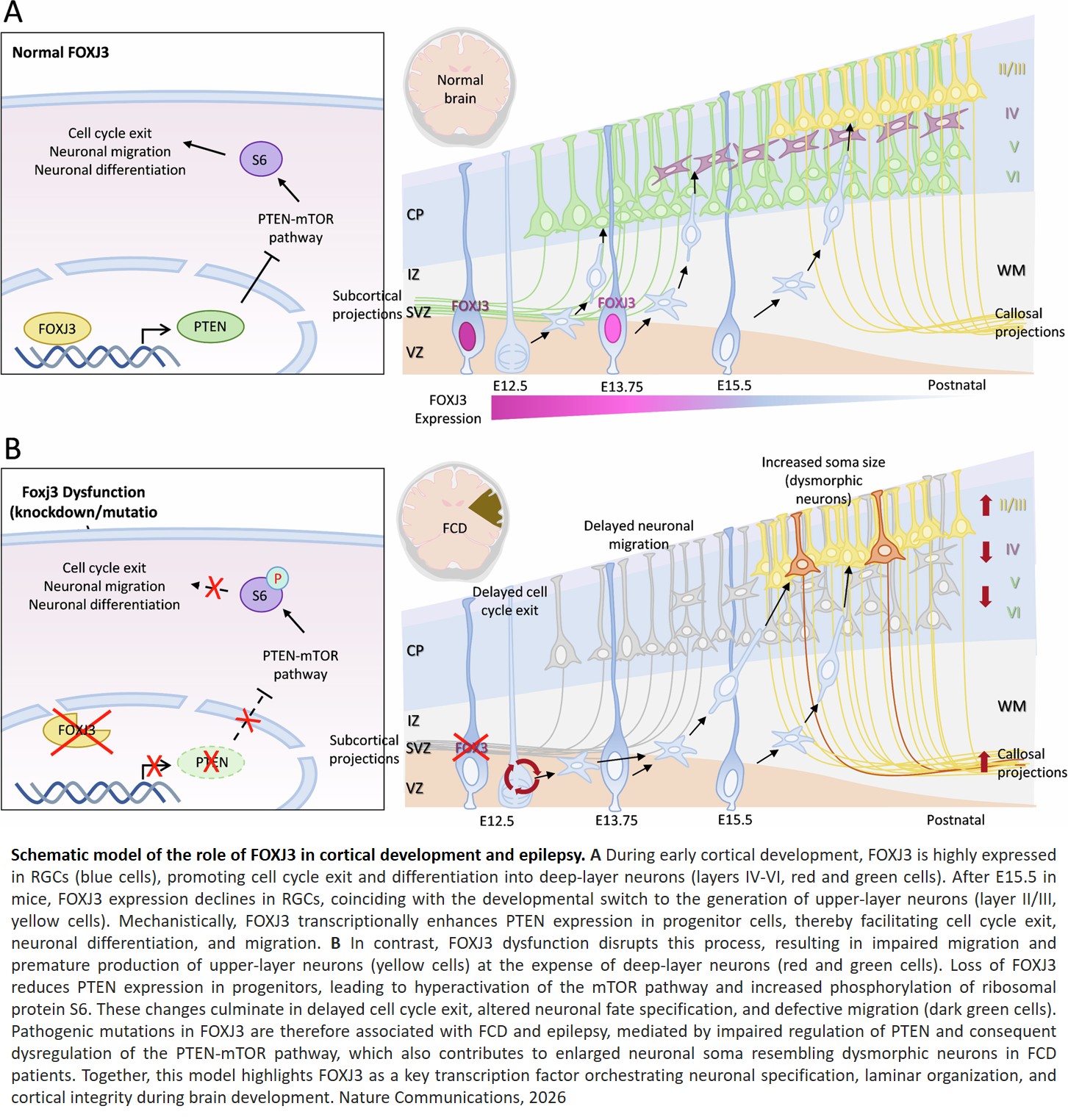
Researchers have discovered that mutations in the FOXJ3 gene act as a "master switch" failure, disrupting how the brain builds its layers and leading to FCD, a primary cause of drug-resistant epilepsy. The study reveals how FOXJ3 controls the formation of brain cortical layers during brain development by regulating the PTEN–mTOR signaling pathway.
The PTEN-mTOR signaling pathway acts as a critical control system for cell growth, proliferation, metabolism, and survival. When this system malfunctions, it causes many neurological disorders including FCD, tuberous sclerosis complex and neurofibromatosis. The discovery of FOXJ3, a transcription factor (a protein that regulates gene activity), as a new cause of these "mTOR pathway diseases" (mTORpathies) provides new insight into the biological origins of epilepsy and cortical malformations, as well as potential new treatments.
The research team by studying families with inherited focal epilepsy alongside mouse and single-cell analysis, uncovered how FOXJ3 mutations disrupt how brain cells move to their correct locations and take on their proper roles during early brain development.
“Focal cortical dysplasia is one of the most common causes of epilepsy that does not respond to medication, yet in many patients the underlying cause remains unknown,” said the corresponding author. “Our findings identify FOXJ3 as the critical genetic and molecular link between abnormal brain development and epilepsy.”
During normal brain development, neurons are generated in a precise inside-out sequence to form the six layers of the cerebral cortex. The study shows that FOXJ3 is highly active in neural progenitor cells (cells that produce neurons) during early stages of cortex formation and declines at a key developmental transition. When FOXJ3 function is disrupted, neurons fail to migrate properly and end up in incorrect cortical layers.
Mechanistically, the researchers demonstrate that FOXJ3 directly regulates PTEN, a well-known suppressor of the mTOR pathway that has been strongly implicated in epilepsy and cortical malformations. Disease-associated FOXJ3 variants fail to activate PTEN, leading to excessive mTOR signaling and enlarged, abnormally shaped neurons, hallmark features seen in FCD patient brain tissue.
Importantly, restoring PTEN activity was sufficient to rescue cortical defects in experimental models, pinpointing a FOXJ3-PTEN axis as a central pathway in cortical development.
Beyond identifying a new genetic cause of epilepsy, the findings advance fundamental understanding of how genes control what brain cells become and where they go during development. Clinically, the work may improve genetic diagnosis for patients with focal epilepsy, particularly those with normal brain MRI, and help guide future precision therapies targeting the mTOR pathway.
As epilepsy affects more than 50 million people worldwide, with a substantial proportion resistant to current treatments, uncovering its developmental and genetic roots has important societal implications.
“The discovery of a specific genetic mechanism underlying an individual's epilepsy is of enormous importance both at the personal and scientific levels,” said a co-author. “For the individual and their family, finally knowing the cause of the epilepsy in itself can bring relief, absolve feelings of guilt, end one diagnostic odyssey - though perhaps also start another. The finding may be of value for genetic counselling and family planning. Critically, the finding opens the way to scientific exploration of modifiable mechanisms - whether that be drug selection, repurposing of existing therapies, or the invention of a novel therapeutic approach including, for example, gene-based treatments. The discovery is the start of rational management aiming to better control the condition.”
https://www.nature.com/articles/s41467-026-69241-2
https://sciencemission.com/Epilepsy-associated-FOXJ3-variants