

Role of GRK2 in Alzheimer disease
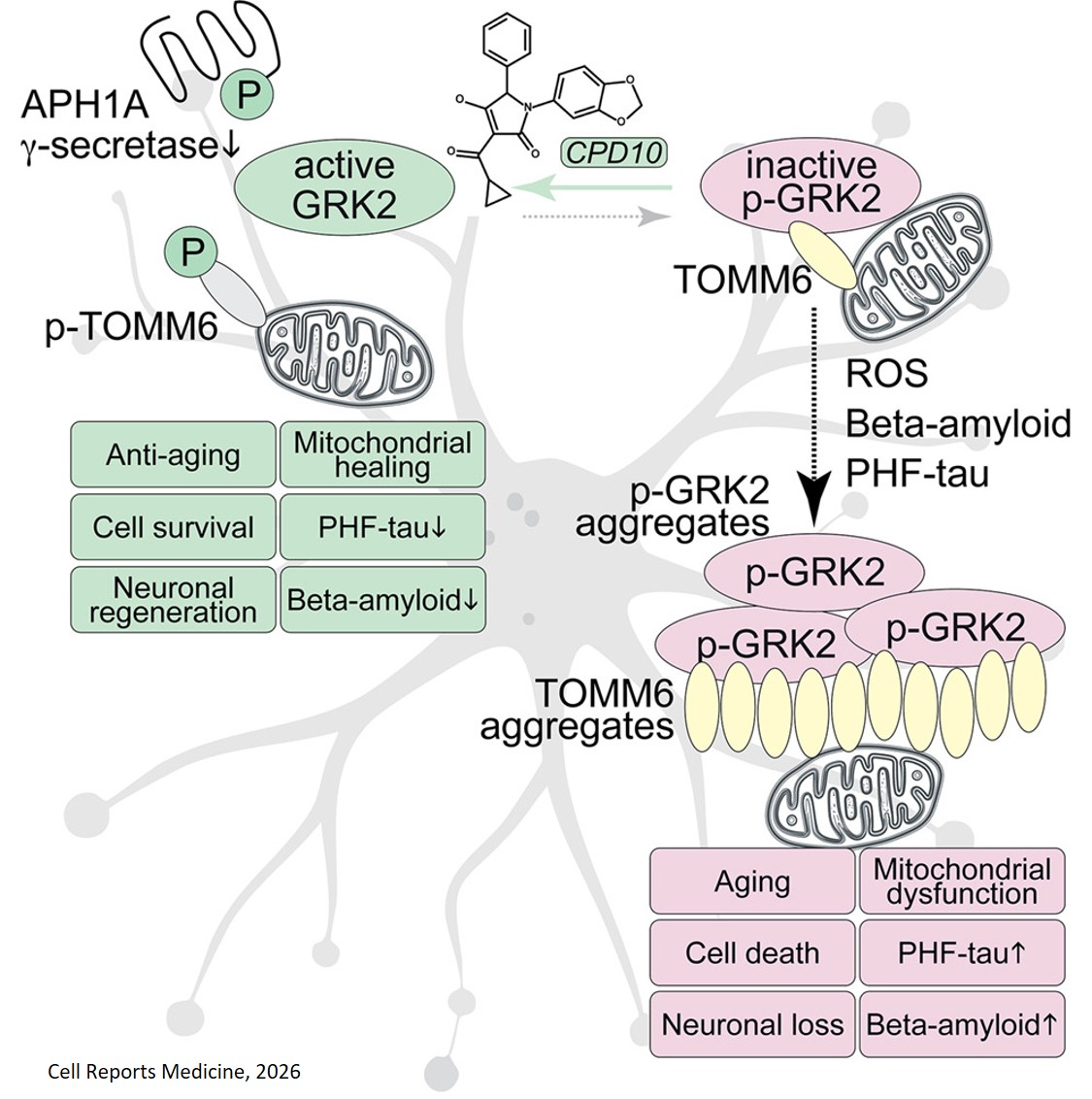
“Compound 10” is how the senior author refers to the chemical compound that the team has developed and which could slow down the progression of Alzheimer’s disease. The researchers have so far tested the active ingredient first on mice, revealing promising effects: the typical death of nerve cells seen in dementia is significantly slower, and the animals survive for longer.
The new substance is the result of research that began almost 20 years ago, when the author received tissue samples from patients of a doctor and colleague. These were samples of brain tissue that the doctor had removed during tumor surgery – both on people diagnosed with dementia and non-dementia patients.
The main focus of the research was a bodily enzyme that performs a vital role in many human cells: GRK2. As a regulatory protein, this enzyme helps cells respond correctly to signals, stress and strain. As well as in the heart, for example, it is also active in the brain – where it supports the function of nerve cells.
Through molecular analyses of the tissue samples the team showed what an important role the enzyme GRK2 plays in dementia. The researchers recently published their findings in the journal Cell Reports Medicine.
Two forms of the enzyme GRK2 occur in cells: a normal, functional form and a form that has been inactivated by the cellular metabolism. The team discovered that the inactivated form occurs in large quantities in the brain tissue of dementia patients. They were able to demonstrate the same thing in mice – specifically in a mouse model for Alzheimer’s disease.
The researchers also showed that the inactive form of this enzyme forms aggregates in brain cells in the event of dementia. These aggregates deposit on – and damage – the mitochondria (the “powerhouses” of the cells). “The GRK2 aggregates block the pores of the mitochondria, reducing the amount of energy they can supply and leading to a situation of stress inside the cells,” the author explains.
In experiments on mice, the researchers also observed that the inactive GRK2 promotes the production of amyloid beta, a protein fragment that is considered a main cause of Alzheimer’s.
What’s more, this leads to a self-perpetuating process: amyloid beta puts stress on the nerve cells and, in turn, this stress leads to the formation of more inactive and aggregated GRK2 – creating a vicious circle that contributes to the progression of dementia.
With a view to breaking this vicious circle, the researchers developed several chemical compounds, which they tested in cell culture experiments and on mice. Here, compound 10 proved to be particularly effective, preventing the GRK2 molecules from forming aggregates. As a result, the mitochondria work better, there is less deposition of amyloid beta in the cells, and the nerve cells maintain their function and do not die off.
In the mice, the team also observed effects outside the brain. Compound 10 had a positive influence on heart function and ageing processes. For example, the animals developed fewer grey hairs in old age.
The researchers have applied for a patent on compound 10, and the basic research is now complete. “It took so long simply because everything takes so long in Alzheimer’s research,” explains the author. As the researchers were investigating an age-related disease, they worked with older animals. For mice, this means an age of one and a half to two years. And it takes about one and a half to two years to complete each experiment from which conclusions can be drawn that then lead to the planning of the next experiment. “It’s all a great deal slower than in cancer research, for example.”
https://www.cell.com/cell-reports-medicine/fulltext/S2666-3791(26)00124-2
https://sciencemission.com/GRK2-aggregation-in-ALZ