

Intestinal enzyme FMO-2 regulates behavior
The pursuit of a longer life may currently be trending for tech bros, but the notion of a fountain of youth, or even immortality, has intrigued people for millennia.
Yet, some of the more evidence-based methods to increase longevity, such as dieting, are decidedly unpleasant to maintain over time.
New research uncovers interesting connections between a longevity gene, behavior and the environment.
The findings bring scientists closer to understanding the underlying biological mechanisms that might be exploited to extend life without the downsides.
The first study, appearing in PNAS, uses a worm (the popular research model species, C. elegans) to further explain the effect of environmental cues and food access on longevity.
“Believe it or not, most of the central ideas and types of metabolism we study are conserved from worms to people,” said the author.
When we perceive the environment, we release hormones like adrenaline or dopamine. Worms do the exact same thing; their neurons respond to the environment and change their physiology accordingly,” the author explained.
Previous research has shown that stress like food scarcity can promote survival.
Intriguingly, foundational work in flies from the lab showed that the mere smell of food can reverse this effect.
The researchers wondered whether other sensory inputs, like touch, would also mitigate the life-extending effects of dietary restriction, and if so, how?
To test this, they placed worms on a bed of beads with a texture similar to the E. coli buffet they would normally encounter during feeding.
The touch of the beads was enough to blunt the expression of a gene in the intestine related to longevity (fmo-2) and in doing so, reduced the life extension effect of dietary restriction.
The authors discovered that fmo-2 is a gene that is necessary and sufficient to extend lifespan downstream from dietary restriction in 2015.
“The fmo-2 enzyme remodels metabolism, and as a result increases lifespan,” the author explained. “Without the enzyme, dietary restriction does not lead to a longer lifespan.”
Specifically, their experiment showed that touch activates a circuit that modulates signals from cells that release dopamine and tyramine, which decreases intestinal fmo-2 induction and thus the longevity effect of a restricted diet.
Most importantly for human health, the work demonstrates that these circuits can be manipulated, said the author.
“If we could induce fmo-2 without taking away food, we could activate the stress response and trick your brain into making you long-lived.”
Before this can happen, however, it’s important to understand how else fmo-2 affects organisms.
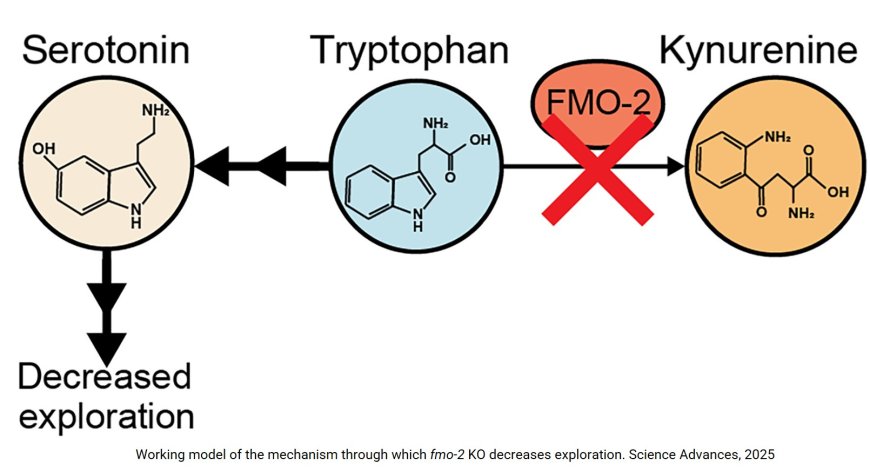
In another study, published in Science Advances, the team demonstrated that the enzyme affects behavior in noticeable ways.
Worms engineered to overexpress fmo-2 were apathetic to positive and negative changes in their environment: they did not flee from potentially harmful bacteria and when presented with food, didn’t slow to eat after a brief fast the way normal worms did.
Worms engineered to completely lack fmo-2 also explored their environments less often than normal worms did. Both behavioral states, they found, were caused by a change in tryptophan metabolism.
“There are going to be side effects to any intervention to extend life–and we think one of the side effects will be behavioral,” said the author.
“By understanding this pathway, we could potentially provide supplements to offset some of these negative behavioral effects.”
The authors plan to continue to study the connection between the brain, metabolism, behavior and health with the hopes of contributing to the development of drugs to target these innate pathways.
“Investigating all of the individual signals that our brain is responding to from the gut is a hot but not well understood area.”
https://www.pnas.org/doi/10.1073/pnas.2423780122