


Menopause leaves a fingerprint that may predict dementia risk
As women go through menopause, they often have the sense that it’s not just their body changing, but also their mind. They report hot flashes, anxiety, brain fog, and trouble sleeping — all symptoms that can trace back to the brain.
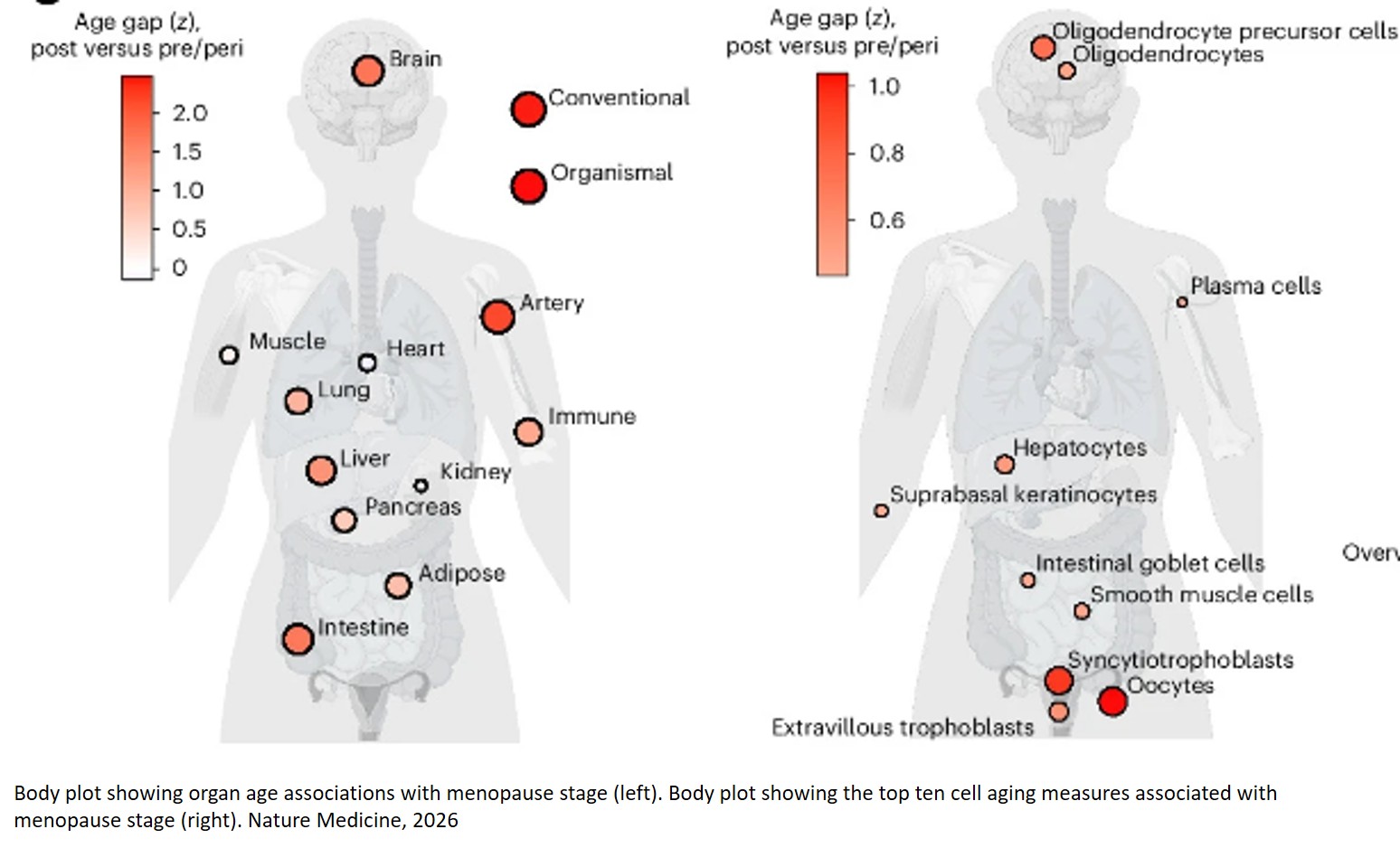
Now, researchers have found biological evidence to back them up. In a new study published in Nature Medicine, they’ve discovered how levels of 16 molecules in the blood, all linked to brain aging, rise during the menopause transition in midlife. In older women, higher levels of the same molecules were associated with worse memory and thinking skills, as well as Alzheimer’s disease risk. This suggests the biology of menopause may set the stage for brain health decades later.
“We don’t think that menopause is directly causing dementia,” said a co-senior author of the study. “But it’s possible that we may be able to predict a woman’s risk for dementia decades later by the levels of these molecules around menopause.”
Two-thirds of people with Alzheimer’s disease are women, and the disparity can’t just be explained by the longer average lifespan of women compared to men. Yet studies have not pinned down exactly what it is about women’s biology, or how they age, that makes them more prone to dementia.
What is known is that the earliest brain changes associated with Alzheimer’s disease begin decades before symptoms appear. For women, this points toward a critical window of time right around the time of menopause — the cessation of menstrual periods that occurs at an average age of 51. This led the authors to wonder whether there was something shifting in some women’s brains during menopause that could teach us about dementia risk and resilience.
But menopause is not a single moment; it unfolds over years, as hormone levels begin to change and symptoms emerge as early as a decade before that final menstrual cycle and last for years afterward. The group set out to map what changes when it comes to brain health across this entire timespan.
“Many studies just ask women whether they’ve gone through menopause and if so, when,” said the first author. “It was really important to us that we be more precise and capture these years of hormonal flux.”
The researchers recruited 80 women in their 40s and 50s and used a tool called STRAW+10, which combines symptoms and hormone levels, to gauge exactly where in the menopause transition each woman was.
Using a commercially available research blood test that measures over a hundred molecules linked to brain health, the team identified 16 molecules whose levels shifted throughout menopause. Each molecule’s levels were more closely associated with one or more hormone levels than with a woman’s exact age, suggesting that it was menopause — not just aging — that triggered the changes.
Molecules linked with inflammation tended to rise as levels of the hormone estradiol decreased, while a separate group of molecules linked to Alzheimer’s biology rose as follicle-stimulating hormone (FSH) levels increased. The findings were replicated in an analysis of previously collected data from more than 2,800 women in the UK Biobank.
When the scientists looked at levels of the same molecules in women in their 60s and early 70s — using data on almost 12,000 women from four previous studies — they found that older women who had the highest levels of those molecules had worse memory and a 15 percent higher risk of developing Alzheimer’s disease as they aged.
“We’re identifying molecular shifts in blood, in midlife post-menopausal women, that are also predicting cognition later in life,” said another co-senior author. “So, we think these molecules are really important markers of both menopause and cognitive aging.”
The researchers also found that women who reported night sweats tended to have a greater increase in the levels of inflammatory molecules during menopause. That link persisted for many years — older women who recalled having hot flashes during menopause also still had higher levels of those inflammatory markers.
The researchers were careful to describe their findings as correlational; they don’t yet know what brain changes or dementia risk factors the menopause transition may directly trigger. They also pointed out that in a small sample of midlife men, much of the molecular fingerprint was the same as it was in postmenopausal women. This suggests that menopause may trigger a rapid shift in biological aging that unfolds more gradually in men.
“Menopause is a normal physiological process that every person who has ovaries who lives long enough will go through,” said an author. “We don’t want it to be viewed as a bad thing, but as an opportunity to better understand and maybe modify the biology of brain aging in women.”
The team’s eventual goal, they said, is to develop a blood test that can act as an early-warning sign of dementia risk—the same way cholesterol tests are used to gauge heart disease risk. This could let clinicians identify people who, in midlife, might benefit from early interventions.
“Midlife is a critical window for both men and women where we can really set up the brain to be more resilient or more vulnerable to dementia in later life,” said the author. “For women, menopause may be this especially powerful time to intervene.”