

Microbial interactions predict gut health
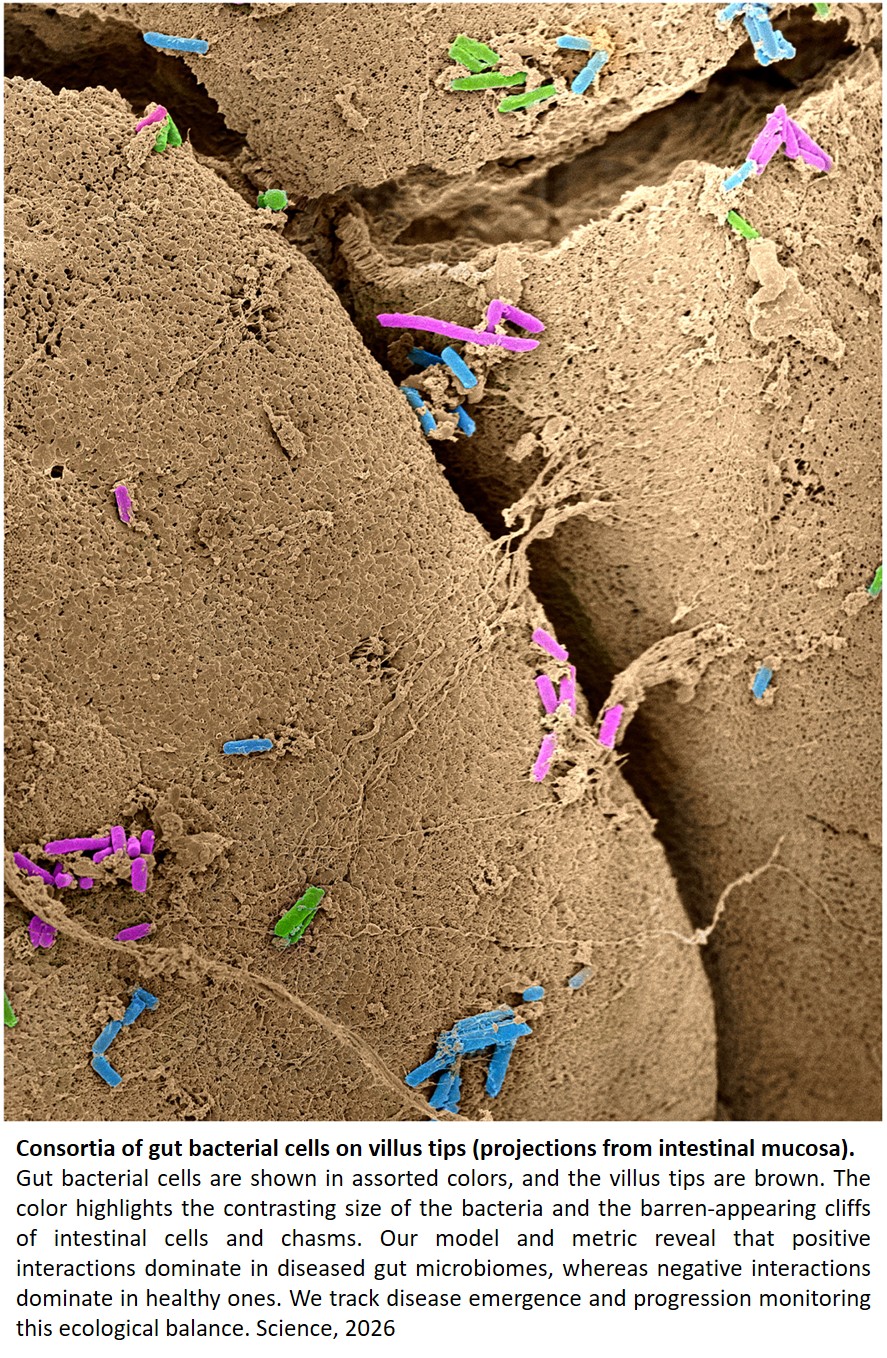
Scientists have identified a new way to distinguish healthy guts from diseased ones and track how some illnesses progress by measuring how gut bacteria interact with one another.
According to a study published in Science, scientists found that healthy and diseased gut microbiomes behave like two distinct ecological states, driven not by individual microbes but by how entire bacterial communities compete and cooperate.
“Instead of asking which bacteria are there, we started asking how they are related to other bacteria,” said a senior author of the study. “That change in perspective allowed us to see health and disease as two fundamentally different states of the gut microbiome.”
To measure how bacterial communities shift between health and disease, the team developed a new metric called the Ecological Network Balance Index, or ENBI, which captures whether microbial communities are dominated by competitive or cooperative interactions.
Applied to existing data, the ENBI consistently separated healthy individuals from patients across multiple diseases. In colorectal cancer, the index rose as the disease progressed.
“Our new measure could capture this shift by, for example, using stool samples, distinguishing healthy people from diseased people,” said an author of the study.
The author said the findings show how disease emerges when microbial communities reorganize themselves.
“This work shows that gut health is not just about which bacteria are present, but how they interact with one another,” the said author. “In diseases such as inflammatory bowel disease, C. difficile infection, irritable bowel syndrome and colorectal cancer, bacteria form more cooperative, tightly connected groups that can dominate and disrupt normal function.”
“This gives us a new way to think about what goes wrong in the microbiome,” the author said. “Instead of focusing on individual microbes, it shows that disease emerges when the entire system shifts. That opens the door to earlier detection and more targeted interventions.”
The team started their research by building computer models that simulate how gut bacteria compete for nutrients and exchange metabolic byproducts.
“At first we were just testing whether the model could reproduce basic features of real microbiomes,” said the study’s lead author. “But very early on, we saw that it naturally produced two distinct patterns.”
That prompted the researchers to compare their simulations with DNA data from patients.
“When we checked the data, we saw the same pattern,” said another author. “That’s when we realized we were capturing something fundamental about how these communities reorganize in disease.”
The gut microbiome consistently settled into one of two configurations: a diverse, competitive state associated with health, and a second state dominated by small, tightly connected groups of cooperating bacteria linked to disease.
The author said the insights and the tool could eventually help doctors identify problems earlier.
“In theory, it should be possible to measure it from just stool samples, which is a very non-invasive way to monitor gut health,” the author said.
The findings also may help explain why gut therapies such as probiotics and fecal microbiota transplants sometimes succeed and sometimes fail.
“Treatments are typically based on the idea that you need particular bacteria to be there,” the author said. “But if that is not the issue, if the issue is that key relationships are missing, then just adding the bacterium does not make a difference; it is necessary to recreate those relationships.”
With fecal transplants, the said, the benefit may come not from introducing individual species, but from restoring entire microbial communities.
“The interesting aspect of fecal transplants is not that you introduce the species then,” the author said. “It is that you introduce a whole community, and therefore you are keeping the interactions that allow that community to be healthy. It is not that certain bacteria need to be there. They need to be there with the right partners.”
“Right now, donor selection is largely based on availability and basic health screening,” said the author, referring to the process preceding fecal transplants. “Our work opens up the possibility of matching microbial communities based on how their interaction networks fit together, rather than just which species are present. That could help us design treatments that are tailored to each patient’s microbiome instead of relying on trial and error.”