

Oligodendrocyte molecular perturbations associated with tau in Alzheimer’s
In a study published in Nature Communications, the researchers have identified specific DNA-level changes in the brains of people with Alzheimer's disease (AD). Using advanced biological analysis, the team mapped alterations in the brain's regulatory landscape that may help explain why Alzheimer's presents and progresses differently from person to person. The findings could also open new avenues for understanding other neurodegenerative diseases.
Alzheimer's disease is the most common cause of dementia. Biologically, the disease begins with the formation of protein deposits, known as amyloid plaques, and neurofibrillary tangles in the brain. This causes brain cells to die over time and the brain to shrink. About 6.9 million people in the U.S. age 65 and older live with Alzheimer's disease. There is no cure, and in advanced stages, complications can result in a significant decline in quality of life and death.
The research team examining brain tissue from 472 people with AD, and analyzed patterns of DNA methylation — a type of chemical "tag" on DNA — across the genome. These samples include detailed measurements of Alzheimer's-related changes — both the visible brain changes seen under a microscope and the levels of key AD proteins.
"While our study findings are impactful by themselves, we did not want to stop there and sought to make both our data and results available to the research community in a way that also protects donor identities," says the senior author of the study. "We wanted to do this because relatively few groups have the expertise to analyze such big data and derive biological insights."
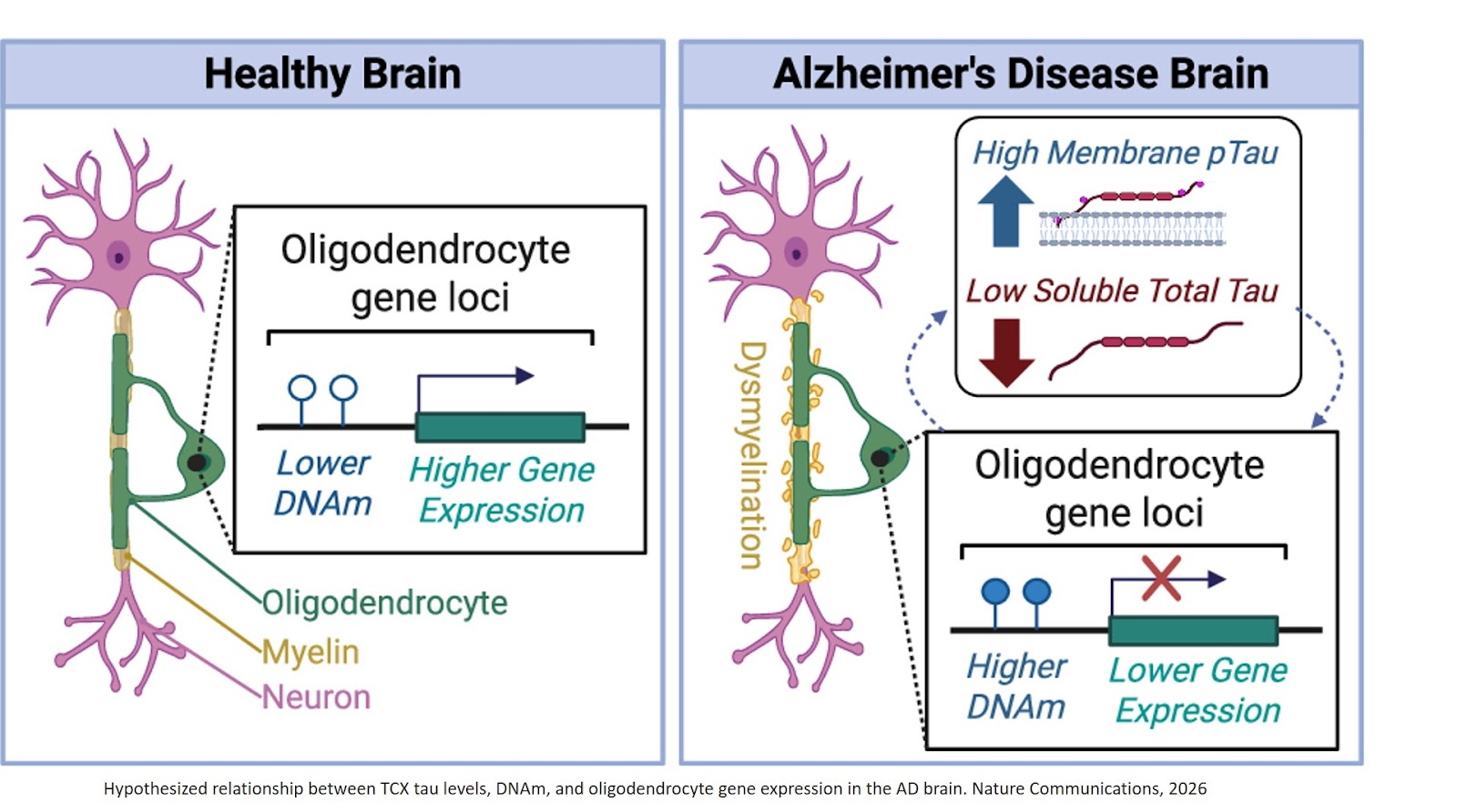
The findings suggest that in AD, part of what happens in the brain may involve changes in DNA tagging that affect the function of oligodendrocytes, particularly in relation to the buildup of the toxic protein tau.
Oligodendrocytes are the brain cells that make myelin, the insulation that helps nerve cells communicate. Scientists have theorized that disrupting neuron communication contributes to symptoms for people with AD. Researchers in this study found that nearly all significant methylation changes — small chemical tags added to DNA that help control when genes are turned on or off — were linked to the tau protein. This supports the idea that this protein plays a key role in brain cell changes tied to AD.
"Our team has previously shown that oligodendrocytes are affected in Alzheimer's and another tau-related disease, progressive supranuclear palsy (PSP)," says the author. "These new results further highlight that problems in oligodendrocytes and myelin are central to AD. They also point to specific molecular pathways, particularly epigenetic changes, that could be targeted in future therapies."
Epigenetic changes are chemical tags on DNA that help control how genes are expressed, or turned on or off, without altering the genetic code itself. Because these changes influence how brain cells function and may be reversible. They offer promising targets for future Alzheimer’s treatments.
The study results identified new genes that may play a role in AD, including one called LDB3, and confirmed many findings across multiple independent datasets, showing its reliability. The identification of specific genes provides potential targets for future research — for example, scientists might investigate whether interventions that reverse methylation or support oligodendrocyte health can slow or modify disease progression for patients with AD.
The research team also developed an interactive tool to help with digital searching of the dataset. Called the Multiomic Atlas of AD Brain Endophenotypes, this free application is a way to make information accessible and enable further research about AD and neurology. The dataset can be searched by gene name or chromosomal location, and results are presented in both table and interactive plot formats.
https://www.nature.com/articles/s41467-026-68864-9
https://sciencemission.com/oligodendrocyte-molecular-perturbation