


Origin cells for malignant brain tumor identified
IDH-mutant glioma, caused by abnormalities in a specific gene (IDH), is the most common malignant brain tumor among young adults under the age of 50. It is a refractory brain cancer that is difficult to treat due to its high recurrence rate. Until now, treatment has focused primarily on removing the visible tumor mass. However, a research team has discovered for the first time that normal brain cells acquire the initial IDH mutation and spread out through the cortex long before a visible tumor mass harboring additional cancer mutations forms, opening a new path for early diagnosis and treatment to suppress recurrence.
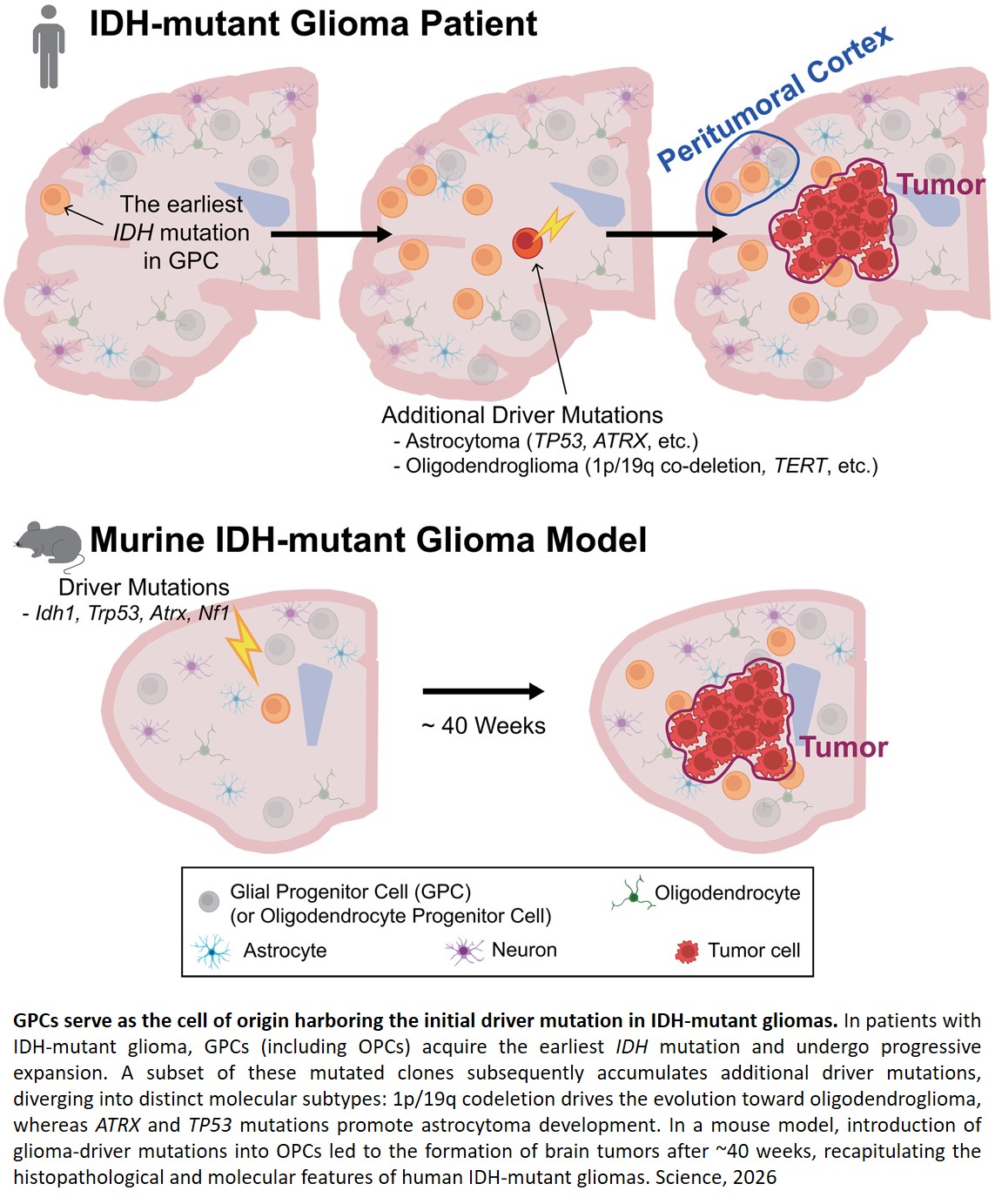
A joint research team has identified that IDH-mutant gliomas originate from Glial Progenitor Cells (GPCs) present in normal brain tissue.
Through precise analysis of tumor tissue obtained via extensive resection surgery and the surrounding normal cerebral cortex, the research team discovered that "cells of origin" harboring the IDH mutation already existed within brain tissue that appeared normal to the naked eye.
This result proves for the first time that malignant brain tumors do not emerge suddenly at a specific point in time, but rather begin within a normal brain and progress slowly over a long period.
The research team then used "spatial transcriptomics"—a cutting-edge analysis technology that shows "which genes are operating where" simultaneously—to confirm that these origin cells with mutations were indeed Glial Progenitor Cells (GPCs) located in the cerebral cortex.
Furthermore, they successfully reproduced the process of brain tumor development in an animal model by introducing the same genetic "driver mutation" found in patients into the GPCs of mice.
This study is a significant expansion of previous research identifying the "origin" of IDH wildtype malignant brain tumors. In 2018, the joint research team led a paradigm shift in brain tumor research by revealing that IDH wildtype glioblastoma, a representative malignant brain tumor, originates not from the tumor body itself, but from neural stem cells in the subventricular zone—the source of new brain cells in the adult brain (Lee et al., Nature, 2018).
The current study clarifies that even though "IDH wildtype glioblastoma" and "IDH-mutant glioma" are both types of brain cancer, their starting cells and points of origin are entirely different, proving that different types of brain tumors have fundamentally different developmental processes.
A co-corresponding Author stated, "Brain tumors may not start exactly where the tumor mass is visible. A target approach focused on the origin cells and the site of origin according to the brain tumor subtype will serve as a crucial clue to changing the paradigm of early diagnosis and recurrence suppression treatment."
Based on these research results, Sovagen Co., Ltd, a faculty startup is developing an innovative RNA-based drug to suppress the evolution and recurrence of IDH-mutant malignant brain tumors.
https://www.science.org/doi/10.1126/science.adt0559