
A high-protein diet can defeat cholera infection
Cholera, a severe bacterial infection that causes diarrhea and kills if untreated, can be defeated with a diet high in protein, according to a new study.
Specifically, the study found that diets high in casein, the main protein in milk and cheese, as well as wheat gluten, could make a dramatic difference in the amount of cholera bacteria able to infect the gut.
“I wasn’t surprised that diet could affect the health of someone infected with the bacteria. But the magnitude of the effect surprised me,” said, the senior author of the study published in Cell Host and Microbe.
“We saw up to 100-fold differences in the amount of cholera colonization as a function of diet alone,” the author said.
Knowing that food has a strong effect on the community of bacteria and other microbes naturally living in the gut, the researchers initially set out to understand whether infectious, invasive microbes would be similarly affected by diet.
The researchers tested diets high in protein, high in simple carbohydrates, and high in fat on cholera’s ability to colonize the gut of an infected mouse. High-fat diets did little to slow the infection, and carbohydrates showed limited effects. But the dairy and wheat gluten diets virtually shut the pathogen out.
“The high-protein diet had one of the strongest anti-cholera effects compared to a balanced diet. And not all proteins are the same,” the author said. “Casein and wheat gluten were the two clear winners.”
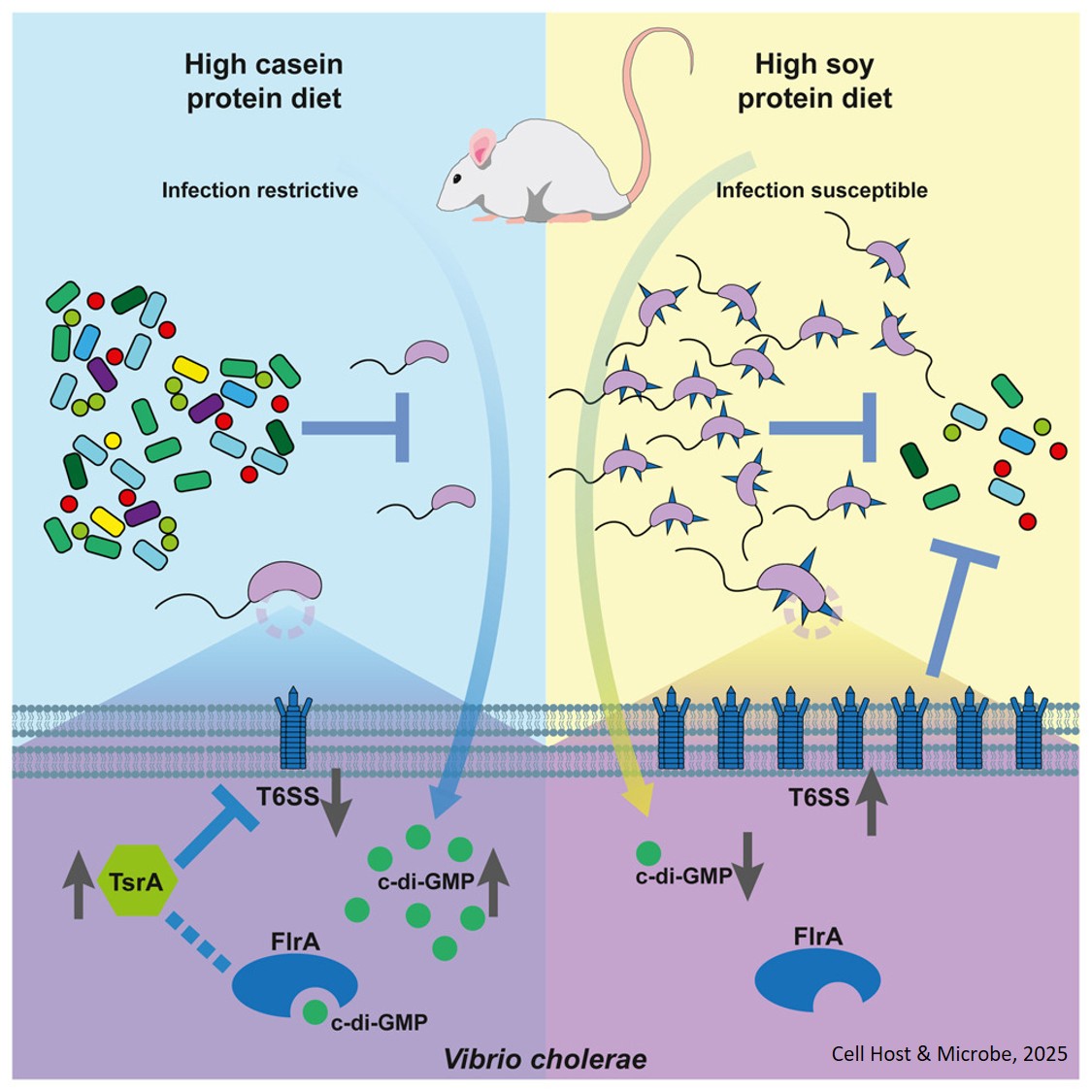
Looking more deeply into these results, the researchers found the proteins suppress a microscopic syringe-like structure on the surface of cholera bacteria used for injecting toxins into neighboring cells. When this structure, called the type 6 secretion system, or T6SS, is muted, cholera has a difficult time killing other bacteria and taking up space in the gut.
The researchers found that casein, alter levels of the V. cholerae central flagellar regulator, FlrA, which controls expression of the type VI secretion system (T6SS), a key mediator of intra-bacterial competition. Resultant decreases in T6SS lead to a competitive disadvantage for V. cholerae against human commensal Escherichia coli, as well as changes in the abundance and composition of a model human gut microbiota. Mutations in FlrA restore V. cholerae T6SS expression and abrogate diet-dependent impacts on V. cholerae infection.
Cholera remains a public health threat in parts of Asia and Sub-Saharan Africa with limited clean water access. Treatment typically focuses on rehydration. Antibiotics can shorten the illness, but they don’t neutralize the toxins cholera leaves behind.
Overuse of antibiotics also carries the risk of creating bacteria that no longer respond to drugs. Though antibiotic-resistant cholera is not an imminent threat, the quick-to-adapt nature of bacteria means a drug could quickly and sometimes unexpectedly change cholera’s behavior.
“Dietary strategies won’t generate antibiotic resistance in the same way a drug might,” the author said.
For now, dietary strategies could offer a low-cost, low-risk tool to reduce the severity or likelihood of infection in vulnerable human populations.
“Wheat gluten and casein are recognized as safe in a way a microbe is not, in a regulatory sense, so this is an easier way to protect public health,” the author said.
And although these findings come from mice, the senior author expects high-protein diets would have similar effects for humans, so he would like to test these results on human microbiomes in the future, as well as on other infectious bacteria.
“Some diets will be more successful than others, but if you try this for pathogens other than cholera, I suspect we’ll also see a beneficial effect,” the author said. “The more we can improve peoples’ diets, the more we may be able to protect people from succumbing to disease.”
https://www.cell.com/cell-host-microbe/fulltext/S1931-3128(25)00464-0
https://sciencemission.com/protein-production-16369