







Poor-quality sleep involves different parts of the brain, depending on age
Have trouble sleeping? The reason may depend in part on your age.
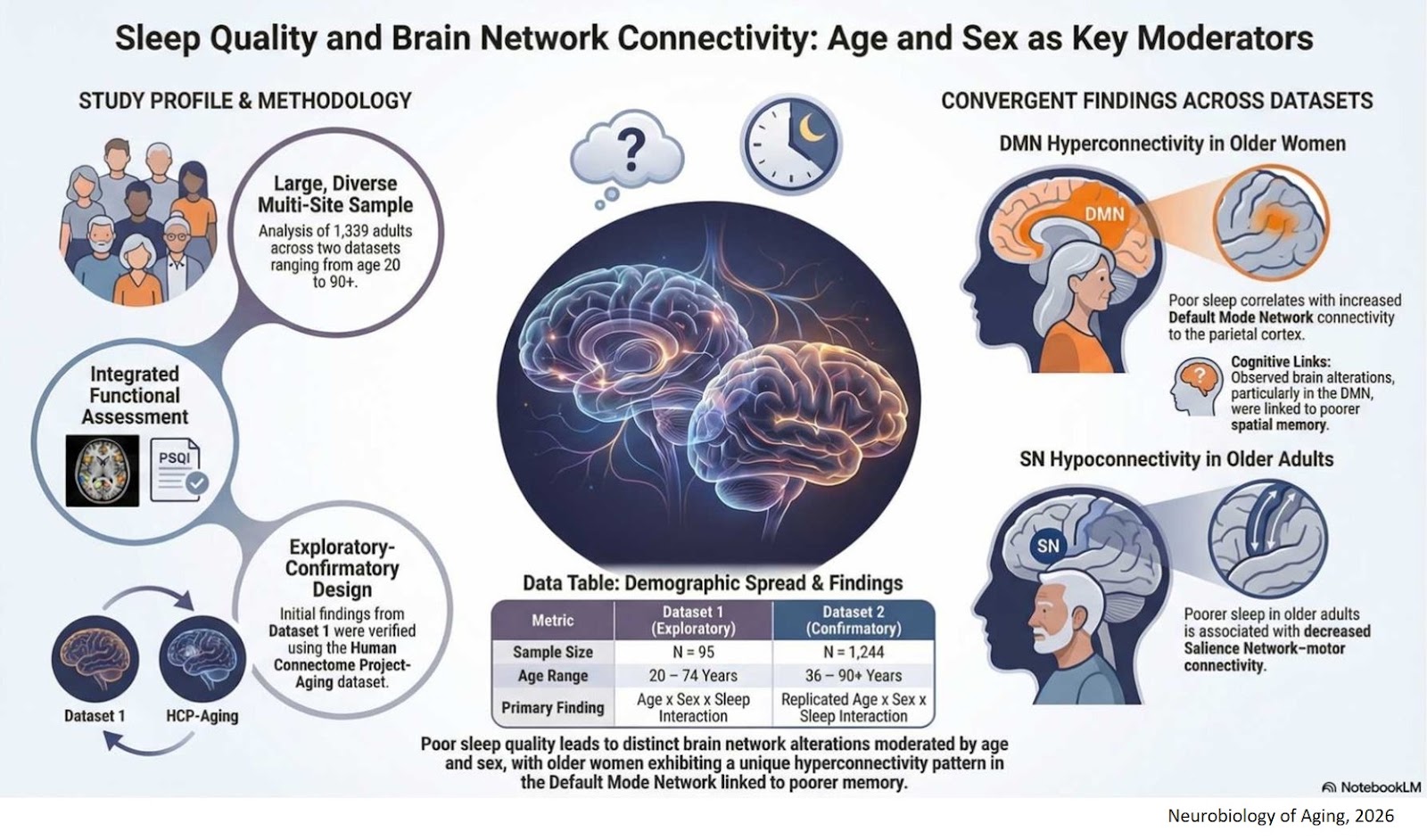
A recent study investigates how poor sleep alters brain communication across the adult lifespan, specifically examining how these changes vary by age and biological sex.
The article appeared in a recent edition of the journal Neurobiology of Aging.
The researchers analyzed brain scans from two large groups totaling more than 1,300 participants to see how brain networks connect at rest in people who report having poor sleep quality.
“We discovered that the poorly slept older brain looks like it is suffering from a general breakdown in its sleep-regulation systems,” the author said.
College-age adults with poor sleep quality exhibited overconnected brain regions involved in movement, suggesting that their bodies aren’t physically ready to sleep. In older adults, typically age 65 and above, these same regions were under-connected; instead, they showed hyperconnectivity in brain regions involved in cognition.
In particular, older women with poor sleep showed abnormal hyperconnectivity between the Default Mode Network (DMN), which is involved in internal thoughts and memory, and the Frontal Parietal Network (FPN), which is involved in sustained attention and working memory. This over-communication pattern was directly linked to poorer memory performance and mirrors brain wiring patterns seen in the preclinical, silent stages of Alzheimer’s disease, the author said.
The reasons behind these differences are currently unclear. Older adults may become habituated to hyperarousal or develop coping mechanisms, including a willingness to take sleep-related medications. Another possible factor is rumination, a state of overthinking often associated with anxiety or depression, although anyone can experience it, depending on their personal situation.
“One strong possibility is that people who have a lot of running thoughts right before bed are not in a calm state, but rather more of an agitated state,” the author said.
Depression has a complicated relationship with dementia, with some studies showing a link between the two conditions. Other research has suggested that depression can resemble cognitive decline, but cognition improves once the individuals are treated for depression, the author said.
A chicken-and-egg issue remains: Do abnormal connections in the brain cause sleep dysfunction, or does sleep dysfunction cause those abnormalities? Hyperconnectivity between the DMN and FPN was associated with poorer cognition over time, suggesting that cognitive consequences follow sleep disturbance or increased connectivity between these networks, the author said.
Growing evidence suggests that between-network connectivity, especially with the DMN, is an early sign of declining brain health. Because of this, getting enough shut-eye is essential.
For young adults, efforts to reduce arousal before bedtime could help, such as journaling to reduce running thoughts. For older adults, however, the mechanisms are less clear, given that hyperarousal may not be the source. If you’re having problems sleeping, consult your physician, the author recommended.
“If connectivity changes do precede sleep loss, then strengthening brain networks could be one solution,” the author said.
https://www.sciencedirect.com/science/article/abs/pii/S0197458026000692