



Sex difference in immune ageing
Analysis of 3.8 million immune cells from nearly 2,000 people reveals distinct waves of immune ageing and sex-specific changes that may help explain differences in age-related and autoimmune diseases.
It’s one of the biggest mysteries of age-related research: despite living longer, women are more likely than men to develop age and immune-related conditions, yet the biological reasons behind these differences remain poorly understood.
Scientists have shed new light on this by integrating and analysing large-scale immune-cell datasets to uncover how healthy immune cells change differently in men and women as they age. These findings, recently published in Nature Communications, pave the way for more personalised treatments for age and immune-related diseases, taking into account a patient’s sex and age.
More than 600,000 people in Singapore, or about 11 per cent of the population, suffer from autoimmune diseases such as lupus and rheumatoid arthritis. These are conditions where the immune system turns against itself and attacks the body’s major organs. Autoimmune conditions are strongly related to both age and sex.
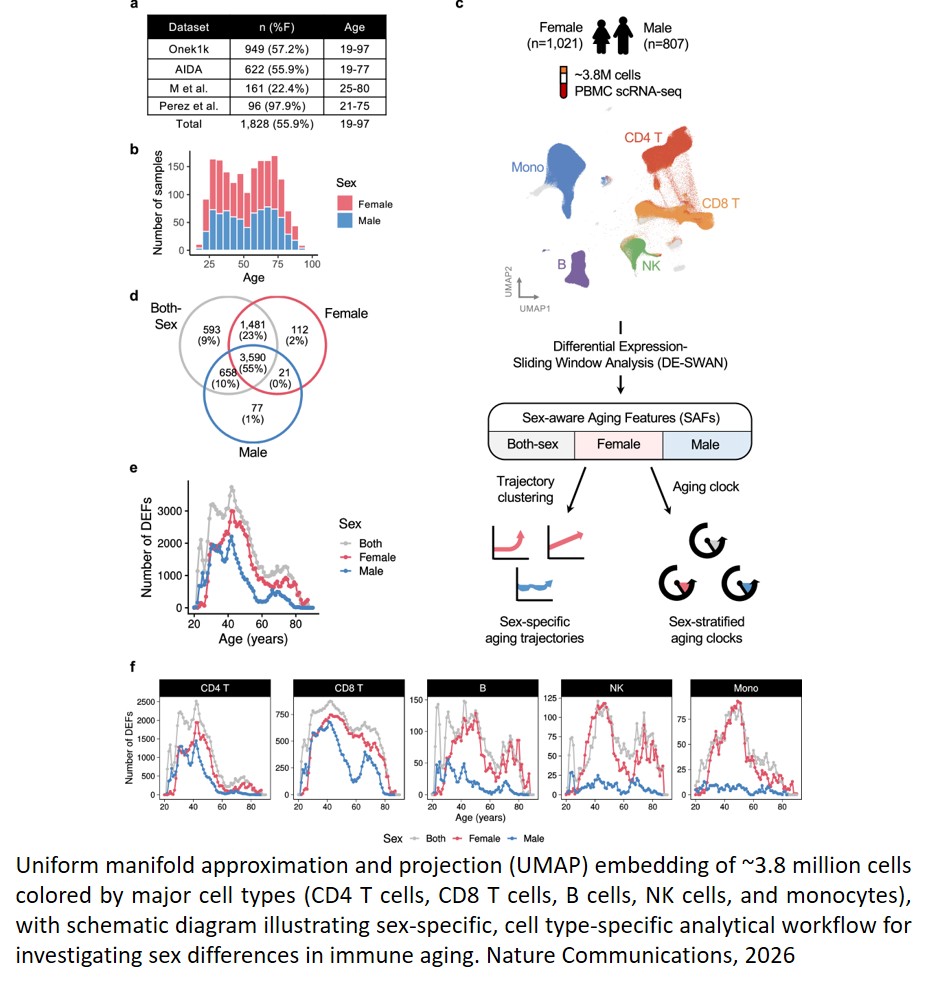
The scientists found that the immune cells circulating in our bloodstream do not age at a steady pace. Instead, they undergo periods of accelerated ageing, with major shifts in gene activity occurring around age 40 and again after 60. The analyses showed that the fundamental machinery behind cell function (i.e. genes responsible for synthesis of RNA and proteins) decline most at these two ageing peak points.
The authors studied how each immune cell type ages in men and women across a heathy lifespan. They found that T cells, a type of white blood cell that helps our immune system fight germs, showed the most pronounced changes in gene activity around people’s 40s. This reflects their central role in coordinating the body’s immune response and their sensitivity to the effects of ageing.
T cells were also predominantly found to be the main drivers of a second wave of changes after age 60. Interestingly, the type of T cells that change profoundly at 40s and 60s is different, suggesting their specialised roles at different stages of life. In addition, the way these specialised T cells change their activity throughout life show differences between men and women.
“We tend to think of ageing as a gradual process, but our findings show that the immune system does not simply decline at a steady rate. Instead, we see distinct periods of rapid change, particularly around 40 and again after 60, with T cells playing a major role. Understanding what drives these windows of immune ageing could eventually help us identify when, and for whom, interventions may have the greatest benefit. It could also shed light on why some autoimmune conditions disproportionately affect women,” explained the senior author of the study.
One of the largest and most diverse of its kind, the study examined the genetic activity of 3.8 million individual immune cells from nearly 2,000 healthy people aged 19 to 97. Among these people were those of Asian ethnicity, including Singaporeans. The cell data was collated from various publicly available research datasets and integrated to create an immune atlas.
“Our findings build on previous evidence that T cells are among the immune cells most affected by ageing. Understanding what drives these nonlinear changes in T cells over time will be an important next step. Changes in T cell function may help explain why older adults are more susceptible to infections and inflammatory conditions,” said one of the authors of the study.
The scientists used the study data to build AI models that would predict biological age—an estimation of the ‘true age’ of the human body that may differ from one’s actual age. With this tool, the scientists hope to do more research on specific biological pathways and time windows where interventions could be tailored by sex.