

Stromal-immune cell circuit in human lymph nodes
The research group has discovered that a fibroblast subtype is essential for coordinating certain immune cells within lymph nodes. This represents another step forward in understanding how the immune system functions in response to infections or cancer.
Our body contains hundreds of structures called lymph nodes, which act as checkpoints of the immune system. About the size of small peas, these organs are responsible for closely monitoring a fluid called lymph to protect the body from potential threats. They are highly organized, with distinct regions dedicated to different types of immune cells. This arrangement enables the immune system to detect and react to threats efficiently.
How is this spatial organization precisely established? How does each cell type know where to position itself within the lymph node? Until now, the answers to these questions remained unclear for certain immune cell types. A new study published in the journal Immunity (Cell press), identifies a key mechanism underlying lymph node compartmentalization.
Lymph nodes are small swellings distributed along lymphatic vessels and fullfill an essential function in the defense against infectious agents and cancer. They can be located near the surface - in the neck, armpit, or groin - as well as deeper in the abdomen or chest. When signs of infection or cancer are detected by immune surveillance in affected tissues and associated lymph nodes, an alarm is triggered and immune cells are activated within lymph nodes to combat the threat.
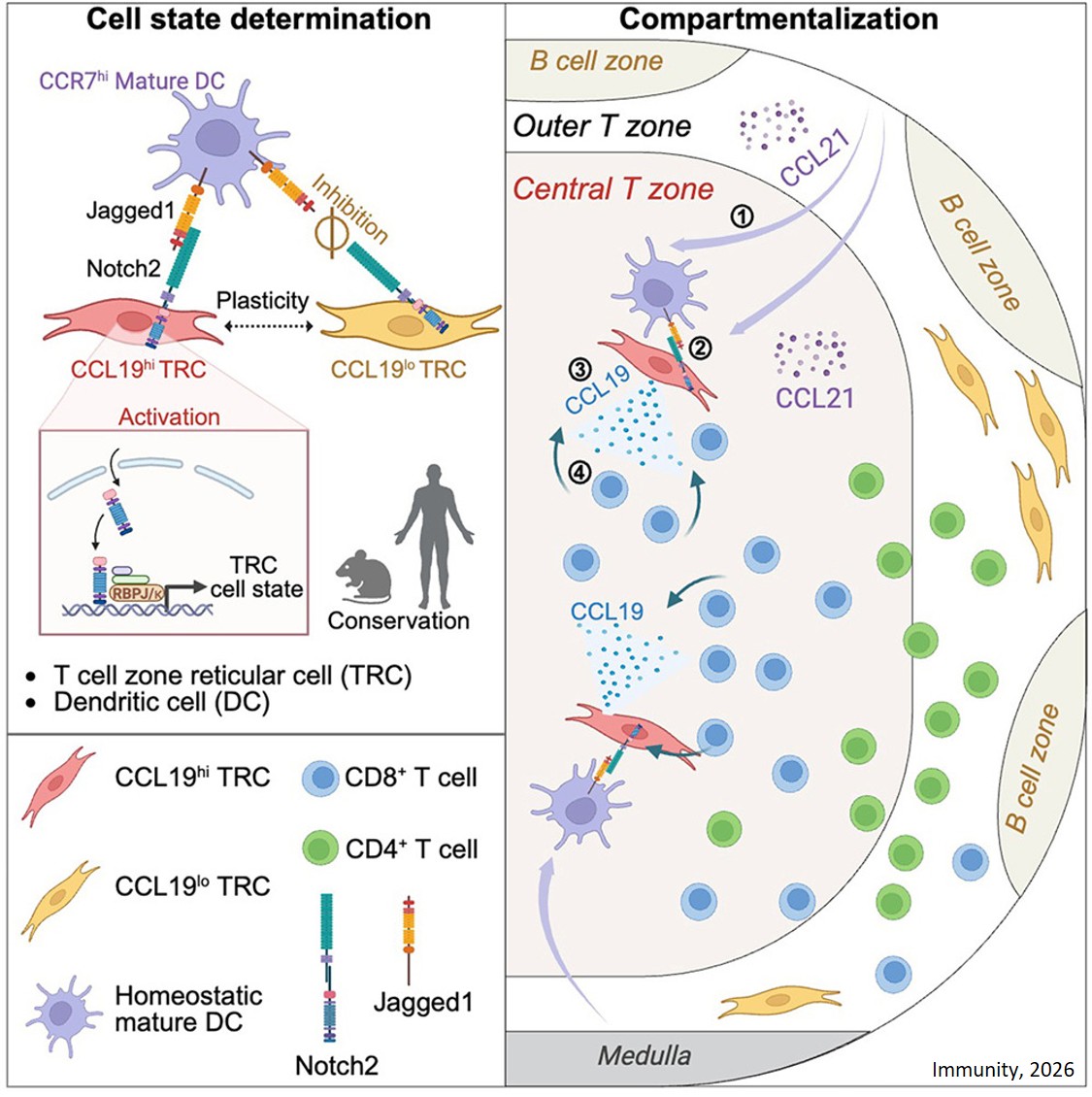
Among these are cytotoxic T lymphocytes, which rapidly proliferate, differentiate into “killer” cells, and migrate to affected areas to destroy infected or cancerous cells. This process is optimized by the precise cellular positioning within lymph nodes. “For example, cytotoxic T lymphocytes are typically found in central regions of the lymph node, where they colocalize and interact with specialized cells called type 1 dendritic cells that present danger signals to them,” explains a research scientist. The mechanism governing this cellular organization, however, has remained poorly understood.
For many years, the team has investigated interactions between structural cells, called fibroblasts, and immune cells, particularly within lymph nodes. In this new study, the researchers characterized a specific subset of fibroblasts that play a key role in organizing the central compartment of the lymph node in mice and humans. Fibroblasts in this central region (MAdCAM1⁺) produce high levels of the signaling molecule Ccl19, which acts as an “attractant signal” for cytotoxic T lymphocytes, bringing them into physical contact with type 1 dendritic cells.
The team also uncovered how these fibroblasts are themselves regulated. “A signaling pathway involving the molecules Notch2 and RBPj maintains the identity and activity of this fibroblast subset, while another molecule, Jagged-1 - produced mainly by type 1 dendritic cells - helps initiate this process,” explains the first author of this study.
Additional experiments showed that this molecular cascade must be continuously maintained throughout life to ensure proper immune cell organization and function. “In mice lacking Notch2 expression in fibroblasts, cytotoxic T lymphocytes fail to develop efficiently into memory T cells, which are normally required upon reinfection with the same pathogen or recurrence of the same tumor,” adds the senior author.
Although this study focused primarily on lymph nodes, the same mechanism - regulation of Ccl19 by Notch2 signaling in fibroblasts - was also observed in other lymphoid organs, such as the spleen, which filters the blood, and Peyer’s patches, which play a key role in intestinal immunity. While the work was conducted mainly in mice, similar cellular structures and interactions were identified in central regions of human lymph nodes, suggesting that the Notch2 dependence of Ccl19-producing fibroblasts is conserved across species.
“Overall, these findings deepen our understanding of the organization of the immune system and how effective T cell responses against infections and cancer are initiated. In the future, this knowledge could help improve vaccine design and clarify why immune defenses sometimes fail against certain pathogens or tumors,” concludes the study’s senior author.
https://www.cell.com/immunity/fulltext/S1074-7613(26)00134-2
https://sciencemission.com/Homeostatic-mature-dendritic-cells