



Taste connectome of adult Drosophila
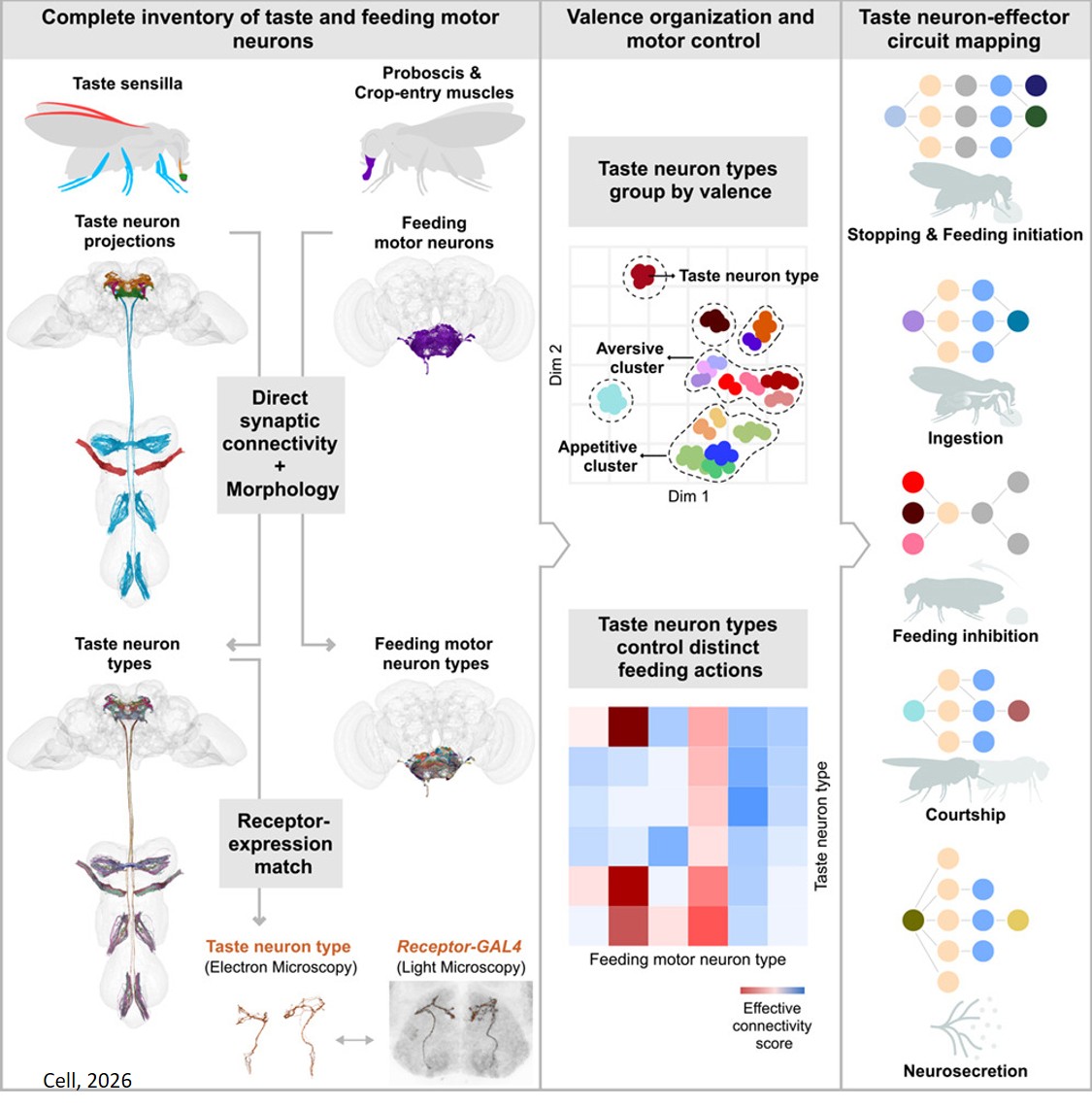
The taste map is one of two landmark studies published in Cell by a team of researchers in the US and Europe. It draws on a companion study that maps the wiring of the first complete central nervous system of a complex adult animal: nearly 167,000 neurons spanning the brain and nerve cord of a male fruit fly, with artificial intelligence (AI) making a reconstruction on this scale possible.
Together, the studies could accelerate understanding of how brains, including our own, turn sensation into action – and open a new window onto a sense that shapes everything from which flowers insects pollinate and which crops pests attack to where disease-carrying mosquitoes feed.
“This is the first time we have a connectome of the whole, intact central nervous system of an adult animal with complex anatomy and behaviors”, says the Principal Investigator. A connectome is a map showing how neurons connect to each other through synapses, the tiny junctions where signals pass from one neuron to another. “We already have female maps of different parts of the nervous system, so we can begin asking how differences in wiring between the sexes relate to differences in behavior”.
To build the first complete connectome of the central nervous system of an adult male fly, the team traced and catalogued 166,700 neurons, identifying over 11,000 distinct cell types. Importantly, the nervous system does not stop at the brain. An animal has to convert what it sees, smells and tastes into movements of its legs, wings and feeding apparatus. By preserving the connection between brain and nerve cord (the insect analogue of the spinal cord), the unified dataset makes it possible to follow neural routes across that divide.
AI was used both to trace neurons and their connections in the vast electron-microscopy dataset before extensive human proofreading and annotation, and to predict whether particular neurons excite or inhibit others – adding information not just about who talks to whom, but about what they might be saying.
“The exchange of ideas may, in turn, run in the other direction too”, notes the author. “The fly nervous system performs remarkably sophisticated computations with relatively few neurons and little energy, and its architecture could suggest principles for designing more efficient artificial systems. This work also provides a technical roadmap for more ambitious connectomics projects in the future, such as those for mice and humans”.
We tend to think of taste as something that happens in the mouth. A fruit fly would disagree. With taste receptor neurons located on its legs, wings, mouthparts and inside its throat, taste is much more widely distributed across the fly’s body than senses such as vision and smell. Consequently, mapping every one of these neurons represented a unique challenge. Until now, no one had done it.
“Taste often gets overlooked compared with vision or olfaction, and its circuitry has remained far less well mapped”, says the author, “but for an animal, deciding whether something should be eaten or avoided can be a matter of life or death. And for humans, understanding insect taste has implications for health and society, from disease transmission and agriculture to food security”.
With the male CNS connectome at hand, together with existing female brain and male nerve cord maps, the lab not only identified and classified every single taste receptor neuron across the fly’s body, but also traced how these signals connect to circuits that control feeding, locomotion, hormone release, and courtship.
“We wanted to go from sensation all the way to action”, says a co-first author of the study. “Taste is particularly suited to this because the relationship between stimulus and behavior is more hard-wired than with other senses. If something tastes good, the animal tends to eat it; if it tastes bad, it tends to reject it. That makes it easier to see how sensory inputs lead to motor outputs”.
Indeed, an intriguing organising principle emerged from the map. Although taste sensors are dispersed across the body, neurons carrying signals with a similar “valence” – whether something is “good” or “bad” – tend to converge onto the same circuits deeper in the brain. Yet this convergence does not erase where the taste came from: an attractive signal on the leg might tell the fly to stop walking and investigate, while one from inside the throat can regulate swallowing. As the author puts it, “the system brings together signals that carry similar value, but preserves enough information about where a taste was detected to produce the appropriate response”.
“Eating is not a single decision but a sequence”, explains another co-first author and research technician. “A fly must slow or stop, extend and position its feeding organ, sample the food and, finally, swallow. Taste sensors at different points along this journey act as successive checkpoints, helping determine whether the animal should proceed or stop”. By identifying 24 types of feeding motor neuron and tracing the pathways that lead to them, the researchers’ taste connectome reveals which routes might link a given taste input to a particular step of this sequence.
One recurring circuit motif involves disinhibition. “Rather than directly activating feeding motor neurons, the circuitry appears to keep a neural brake on them until an attractive taste is strong enough to release the latch”, says the author. “We think this helps prevent the intake of harmful substances. Once the brake is released, a second, slower pathway keeps the movement going while the fly feeds. This design could provide a way of making feeding both selective and stable”.
The map also revealed how taste can prepare the body for what is coming. Certain taste neurons inside the throat connect to neuroendocrine and insulin-producing cells, offering a first look at the precise wiring that lets hormonal responses begin before nutrients are fully absorbed. “The nervous system can effectively tell the body that food is on the way”, explains the author. “Anticipatory insulin responses to the sight, smell or taste of food are already known to occur, including in humans. What is exciting here is that we can now see a possible wiring for it, and the kinds of circuitry that might make the taste of a zero-calorie diet soda, for example, prompt insulin release, even if no actual calories follow”.
For years, producing a complete wiring diagram was itself the destination. Increasingly, it is the starting point. “This is a hypothesis-generation tool”, says the author. “Suppose you are interested in how taste controls locomotion. Now you can go to the map and ask: which sensory neurons are connected to the neurons controlling locomotion? Which intermediate neurons should I manipulate? It gives you a place to start”.
The maps could, for example, provide a fuller picture of how taste processing differs between the sexes – such as how female flies increase their appetite for protein after mating to support egg production. “A connectome becomes really powerful when you can use it to move from a question about behavior to a precise circuit that you can test. We now have the wiring diagram. The next step is to better understand how that wiring produces the animal’s decisions”.