


Tubulin prevents toxic protein clump formation
Researchers have discovered a potential new strategy to fight back against Alzheimer’s and Parkinson’s diseases, conditions that are linked to the toxic accumulation of Tau and alpha synuclein protein clumps in the brain. The team reports in Nature Communications that tubulin, the building block of microtubules, the cell’s internal ‘railway tracks,’ can stop Tau and alpha synuclein from forming toxic clumps and instead steer them into their normal, healthy roles.
“Tau and alpha synuclein are well known for their roles in neurodegenerative diseases like Alzheimer’s and Parkinson’s. In these conditions, these proteins can misfold, stick together and form harmful aggregates that damage neurons and contribute to memory loss, movement problems and other symptoms,” said the first author. “But Tau and alpha synuclein also fulfill essential functions in healthy neurons – they help maintain cell structure and support communication by interacting with tubulin and contributing to microtubule assembly and stabilization.”
To carry out their cellular functions, harmful or healthy, Tau and alpha synuclein concentrate inside tiny droplets, also called condensates. Although preventing the formation of these droplets is a potential therapeutic approach for neurodegenerative diseases, because such droplets also play healthy roles, their disruption could alter normal neuronal function.
“This led us to the following idea: what if instead of preventing the formation of droplets, we created conditions that would drive Tau and alpha synuclein inside the droplets toward their healthy path, discouraging them from taking the disease path?” said a co-corresponding author of the work.
“I think of Tau and alpha synuclein as troublemaker kids in school. You can keep them in the classroom with little to do but to act out or keep them engaged with schoolwork, sports or theater so they do not get in trouble,” the author said. “We found that tubulin can drive Tau and alpha synuclein troublemakers down a healthy path.”
The team worked with biochemical and biophysical techniques, high-resolution microscopy and neuronal-based assays to investigate tubulin’s role in modulating and preventing the formation of toxic aggregates in droplets.
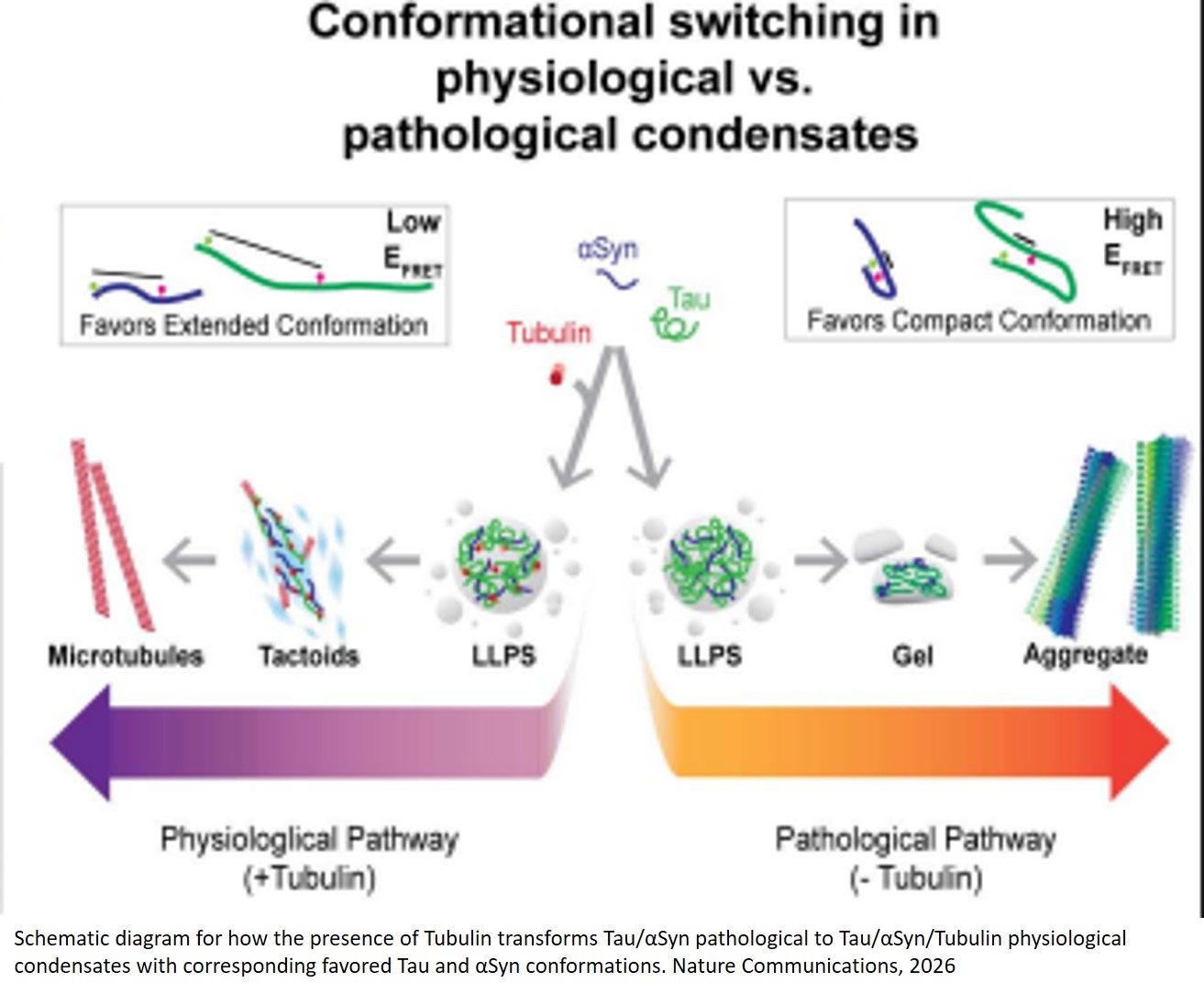
The researchers show that Tubulin modulates Tau:αSyn condensates by promoting microtubule interactions and inhibiting homotypic and heterotypic pathological oligomers. Tubulin partitioning into condensates promotes microtubule polymerization and prevents Tau and αSyn oligomerization.
In the absence of Tubulin, Tau-driven condensation accelerates formation of pathogenic Tau:αSyn heterodimers and amyloid fibrils. The authors also identify distinct Tau and αSyn structural states in pathological Tubulin-absent versus physiological Tubulin-rich condensates.
“When tubulin levels are low, as it has been found in Alzheimer’s disease, microtubules are less abundant and Tau and alpha synuclein can form toxic aggregates,” the author said. “But when tubulin is present, Tau and alpha‑synuclein shift away from harmful aggregates and instead promote the assembly of healthy microtubules,” the author said. “Tubulin redirects the activity of these proteins by giving them something productive to do.”
“Our findings significantly shift tubulin's role in neurodegeneration, from a passive casualty of disease to an active protector against toxic protein aggregation,” the author said. “Boosting the tubulin pool, rather than blocking droplet formation, can curb toxic aggregation while preserving the healthy roles of Tau and alpha synuclein, offering a potential selective therapeutic strategy.”
https://www.nature.com/articles/s41467-026-69618-3
https://sciencemission.com/Tubulin-transforms-Tau