

Preventing uptake of alpha-synuclein to slow Parkinson’s progression
Monoclonal antibodies can block a key immune‑related protein that drives the spread of brain cell damage in Parkinson’s disease (PD). This protein, called glycoprotein nonmetastatic melanoma B (GPNMB), might be part of a promising strategy for developing a treatment that slows disease progression at its earliest stages, according to a new study published in Neuron.
“Many patients with Parkinson’s disease are diagnosed in the early stages, when symptoms are relatively mild, but there is currently no treatment that slows the progression,” said the lead author. “These early results are a promising step towards developing this type of treatment.”
PD affects more than one million people in the United States, with roughly 90,000 new diagnoses each year. While the exact cause of the disease remains unclear, scientists have long known that PD spreads through the brain in stages.
This progression is driven by abnormal clumps of a neuronal protein called alpha‑synuclein. These clumps accumulate inside affected neurons, contributing to their dysfunction and death, and are then released and taken up by nearby healthy neurons. As this pathology moves through different brain regions, patients experience the worsening symptoms that characterize PD, like tremors and difficulty walking or swallowing.
While there are a number of medications and therapies that can help improve the symptoms of PD—ranging from a drug called levodopa to deep-brain stimulation delivered through an implanted electrode—there is no existing treatment that slows the progression of PD.
In earlier work published in 2022, the researchers identified GPNMB as a key molecule involved in the neuron‑to‑neuron spread of alpha‑synuclein pathology, making it a compelling therapeutic target.
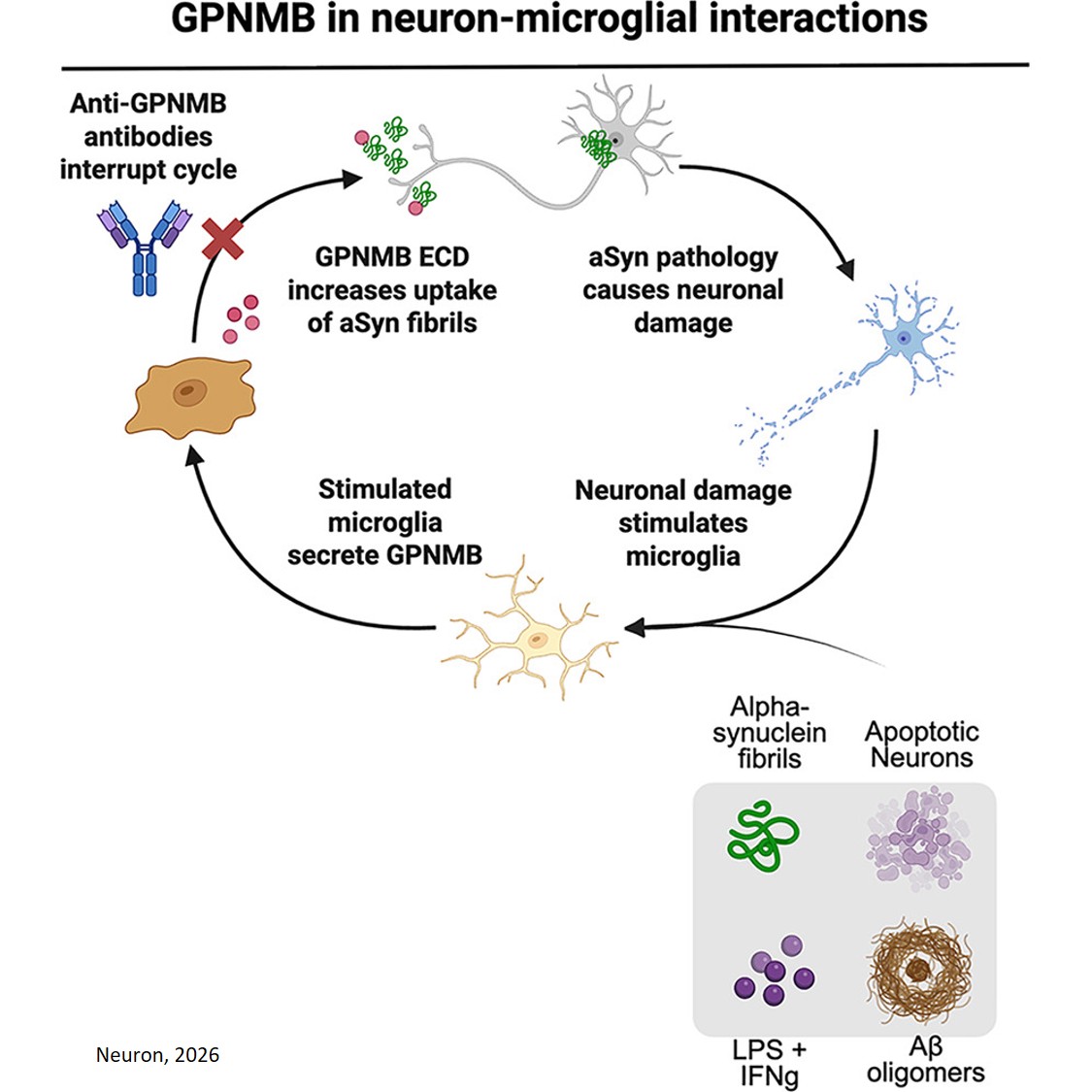
In this new study, the researchers discovered that microglia, the brain’s resident immune cells, are a major source of GPNMB related to Parkinson’s disease. When microglia are near injured or dying neurons, they produce increased amounts of GPNMB. Enzymes then separate the protein from the cell surface, releasing part of it to move freely between cells.
In preclinical experiments using cultured neurons, the authors developed antibodies that block GPNMB prevented the spread of alpha‑synuclein pathology from cell to cell.
“These results suggest Parkinson’s disease may be driven by a self reinforcing cycle—alpha-synuclein accumulates in neurons, damaging the neurons. The injury to the neurons initiates the release of GPNMB, which accelerates the spread of alpha-synuclein, leading to further damage,” the author said. “Interrupting this cycle would hopefully slow, or even stop, the spread of alpha-synuclein through the brain and the neurodegeneration that follows.”
To assess the relevance of these findings in people, the team analyzed tissue from 1,675 brains in the Penn Brain Bank. Individuals with genetic variants associated with higher GPNMB production showed more extensive alpha‑synuclein pathology, providing strong human evidence that the protein plays a central role in disease progression. What’s more, elevated levels of GPNMB were not associated with the markers of other neurodegenerative diseases like Alzheimer’s disease.
“These results are promising for laboratory models and human brain tissue analysis, but we still have a lot of work to do before we can translate this therapy into humans,” said the author. “That being said, these results are encouraging as we continue to work towards a novel treatment for PD.”