


Highly potent compound that blocks Ebola virus entry discovered!
A research team has discovered a highly potent small molecule that blocks Ebola virus entry by stabilizing the virus's entry protein and provides strong protection when given orally in a preclinical model.
The study was recently published in Nature Communications.
MWAC-3634 targets the Ebola virus entry protein. All previously structurally characterized small molecules targeting this protein destabilized it. MWAC-3634 instead stabilizes the entry protein, preventing the shape changes required for viral entry. It is also at least 100 times more potent than previously reported small-molecule Ebola entry inhibitors.
“This compound works in the opposite way from previously studied Ebola entry inhibitors,” said the senior author. “Earlier compounds destabilized the Ebola entry protein. MWAC-3634 stabilizes it, essentially locking the protein so the virus cannot make the changes required to enter a cell. That reveals a new strategy for blocking infection.”
Researchers used DNA-Encoded Chemistry Technology to screen approximately 4.73 billion molecules directly against the Ebola entry protein, uncovering a promising chemical starting point.
“DNA-encoded libraries let us search billions of molecules in a single discovery campaign,” said another author. “That scale allowed us to explore chemical space far beyond a conventional screen and uncover a promising starting point we might otherwise have missed.”
Stereochemical analysis of the initial hit identified MWAC-3634 as the most active form. Against authentic Ebola virus, the compound inhibited infection with an IC50 of 0.65 nM and showed no detectable toxicity to cells under the conditions tested.
“The initial hit was only a starting point,” said another author. “The starting compound was a mixture of closely related forms. By identifying the most active form, we substantially increased its potency.”
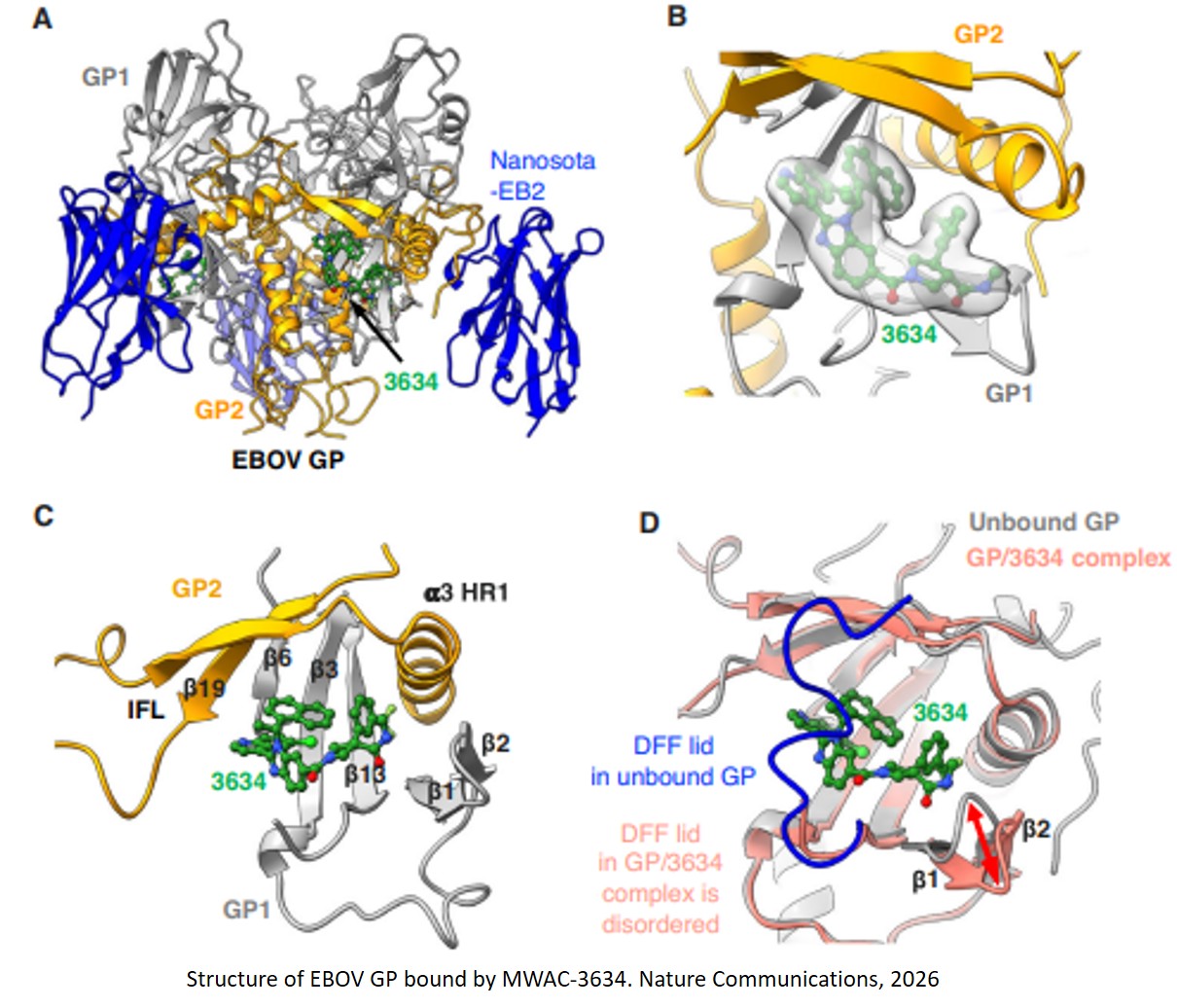
High-resolution structural studies showed that MWAC-3634 fits into a pocket in the Ebola entry protein and holds it in a stable state. Normally, the protein must change shape for the virus to fuse with and enter a host cell. Locking it in place blocks infection at one of its earliest stages.
“The structure allowed us to see exactly where MWAC-3634 binds and how it stabilizes the Ebola entry protein,” said the author. “That molecular view helps explain the compound’s high potency and gives us a blueprint for designing improved versions.”
In a preclinical model, oral treatment with MWAC-3634 substantially improved survival, reduced signs of illness and lowered virus levels. The compound also showed 69% oral bioavailability relative to intravenous dosing.
“The protection we saw with oral treatment is particularly encouraging,” said another author. “This is still an early-stage compound, and additional development and testing will be needed before we know whether it could be useful in people.”
The study combined DNA-encoded library screening, stereochemical analysis, structural biology, authentic Ebola virus testing, drug exposure studies and animal studies across four institutions.
https://www.nature.com/articles/s41467-026-77332-3
https://sciencemission.com/small-molecule-inhibits-Ebola-virus