






Optical neural control by blood-catalyzed polymers
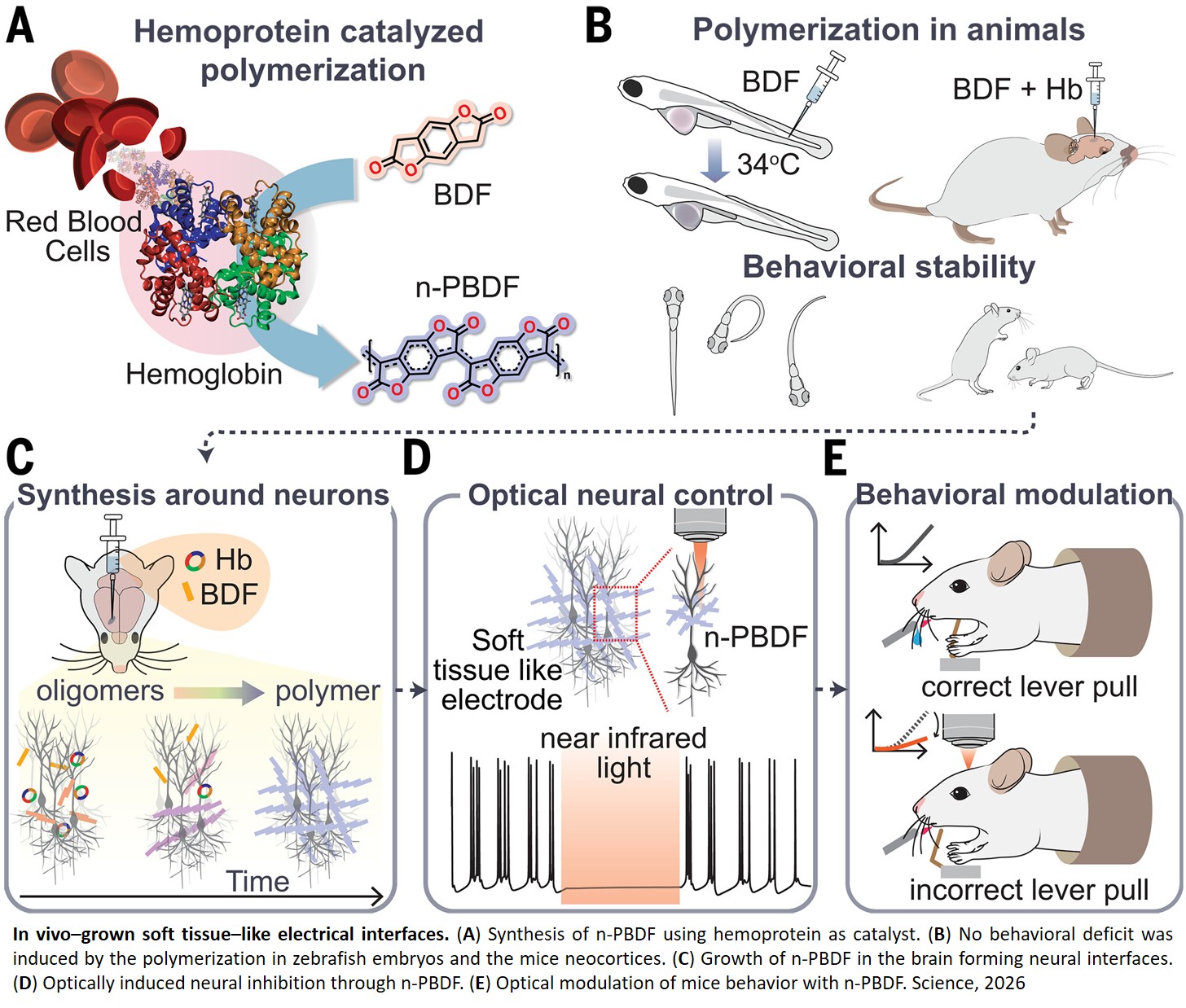
The researchers report a method for assembling a conductive polymer (CP) within embryonic and brain tissues of living zebrafish and mice, using natural blood proteins and whole blood as catalysts.
The researchers show that these in vivo-assembled polymers, interfacing with neurons, can be targeted with near-infrared light to selectively and reversibly control neuronal activity in living mice.
The blood-catalyzed system offers “a promising pathway to seamlessly integrate electronics into living tissues by creating functional synthetic CPs directly within biological systems,” write the authors.
Researchers are interested in expanding the use of CPs for bioelectronic devices, because they are biocompatible and stable in biofluid environments and offer precise electronic communication needed for neuromodulation. Building these polymer interfaces inside the body from the start could increase their biocompatibility and reduce the use of residual, potentially toxic catalyst materials.
The researchers demonstrated this approach by creating n-doped poly(benzodifurandione) (n-PBDF) with hemoprotein catalysts, resulting in stable and ionically sensitive CP networks living systems.
In zebrafish embryos, the injection of the BDF monomer triggered a visible darkening of the yolk, signaling the formation of the polymer. In embryos developed normally, moved naturally, and showed more than 80% survival after 1 week, with no behavioral deficits.
In mice, injection of the monomer into the brain led to localized polymerization of n-PBDF. The material formed stable deposits without signs of inflammation, neural cell loss, or changes in animal behavior. Electrophysiological recordings revealed its effects: n-PBDF altered the activity of sodium and potassium channels, mechanisms critical for controlling neuronal firing. The authors could reversibly silence neurons within milliseconds, a capability absent in p-type polymer systems.