

Which breast lesions will progress to cancer?
A discovery opens a path towards identifying precancerous breast lesions that will develop into tumors. This study is published in the journal Nature Communications.
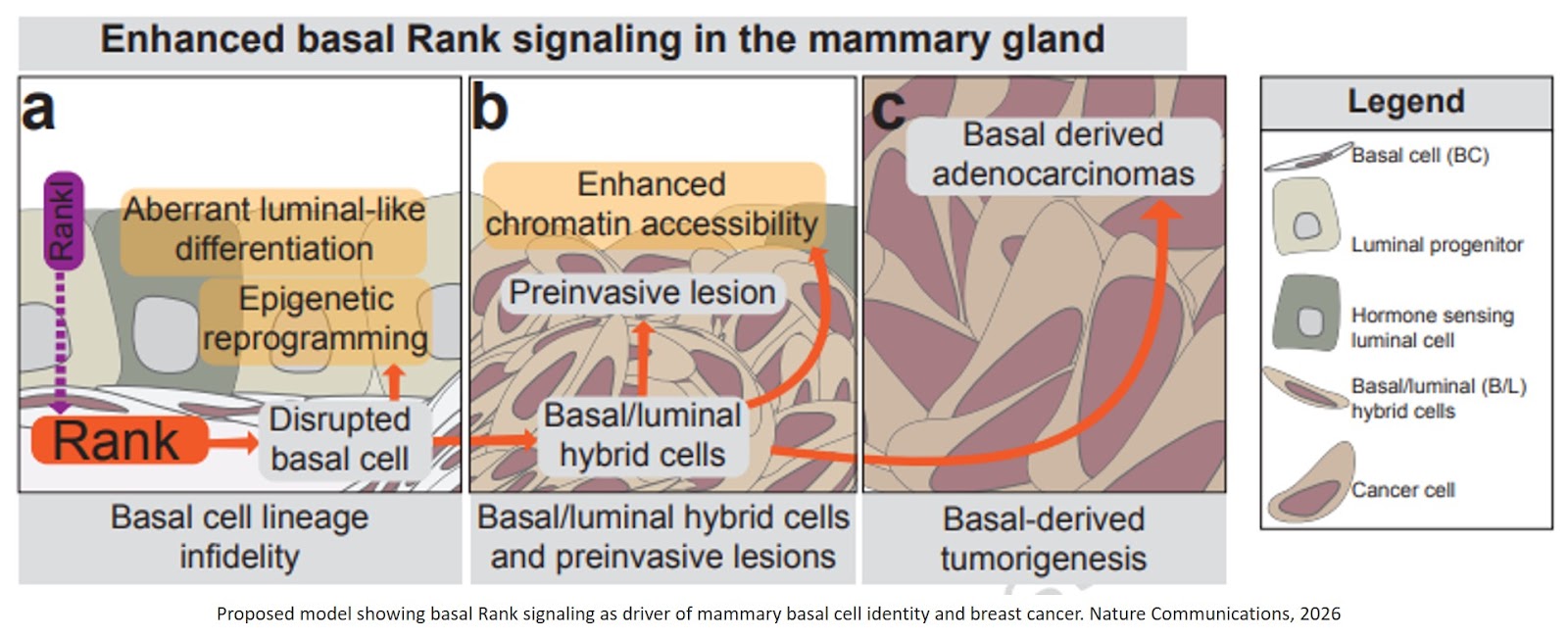
There are two types of cells in breast tissue: luminal cells, which produce milk, and basal cells, which are contractile and allow that milk to be ejected. Several studies suggested that breast tumors originate exclusively in a subpopulation of luminal cells, known as luminal progenitors.
The study now being published reveals, however, that tumors start in a different type of cells, referred to as infidel cells by the authors, and which derive from basal cells.
The new research shows that the expression of the RANK protein in basal cells causes them to lose their identity and become new cells that are neither clearly basal nor luminal, but rather hybrid, sharing characteristics from both types. These are the infidel cells.
All types of breast tumors would begin in these ‘traitorous’ cells, including luminal tumors, which express hormone receptors (+), as well as triple negative tumors that do not express them (-).
“What we know now is that basal cells in the breast can give rise to all types of tumors,” explains the lead author. “We could say that a defined cell identity protects against the appearance of tumors. However, when cells lose their initial identity and become these hybrid or infidel cells, regardless of their origin, that’s when cancer arises.”
The group has developed a genetic signature that detects these infidel cells at the origin of precancerous lesions, identifying which of these cells will evolve into invasive tumors.
After identifying the genetic signature in mice, the group tested this new marker on a cohort of human precancerous breast lesions and confirmed that it can identify which lesions will indeed develop into cancer.
“A common diagnosis in breast medicine is ductal carcinoma in situ, which is considered a precancerous lesion, and it was previously impossible to know whether it would progress to cancer,” says the author. “As we haven’t been able to tell for sure so far, all women diagnosed with these lesions are treated as if it were already cancer. In other words, a very high number of women are being over-treated.”
Diagnoses of these precancerous lesions have increased thanks to screening programmes and the improvement of imaging techniques, to the point that, at this current moment in time, 20% of all cancer diagnoses are these precancerous lesions that are not actually cancer. Among them, only 30% will develop into cancer, but the inability to know which ones has led to the vast majority to be treated as cancer.
The genetic signature identified by the group could detect which precancerous lesions will evolve into invasive tumors, that is, into cancer.
“Now we still need to confirm the signature with an independent cohort, and refine it to be able to use it in clinical practice to identify which lesions will indeed develop into invasive cancer,” the author states.
https://www.nature.com/articles/s41467-026-70020-2
https://sciencemission.com/Rank-signaling