

How cellular self-organization steers and stops waves of cell death
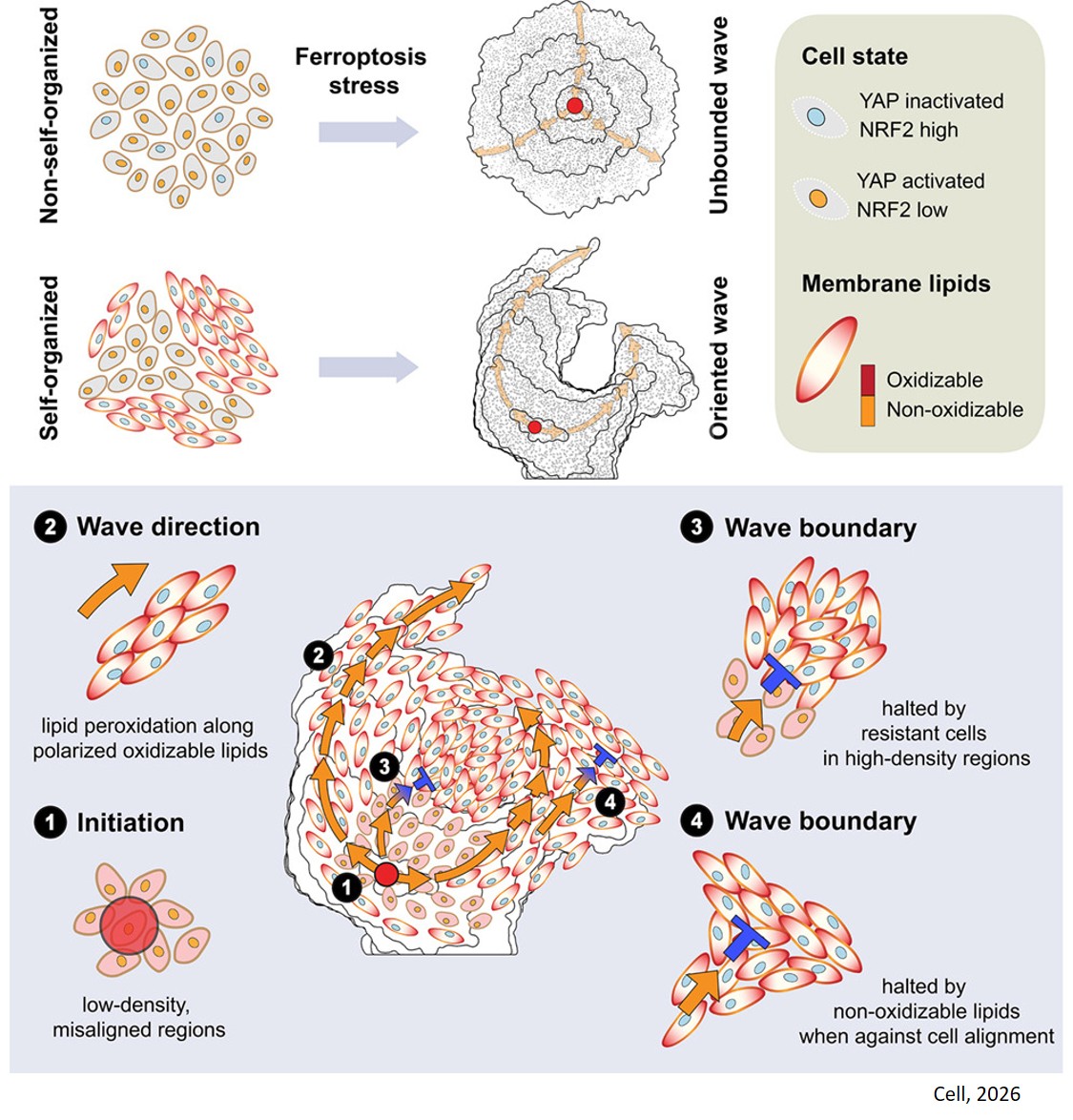
Why do waves of cell death spread through some regions of a cell population but stop at others? Researchers have found that the way cells organize themselves helps determine where ferroptosis begins, how it travels, and where it stops. In cultured human epithelial cell populations, local cell density and alignment influenced susceptibility to ferroptosis, while the distribution of oxidizable lipids within cells helped direct the waves. The study was published in the journal Cell.
Ferroptosis is a form of cell death driven by oxidative damage to membrane lipids. The team previously showed that ferroptosis can spread between cells as a self-sustaining “trigger wave,” potentially causing extensive tissue damage. Their new study addresses a complementary question: What determines the path of these waves, and what prevents them from spreading without limit?
To investigate, the researchers combined live-cell imaging, single-cell RNA sequencing, chemical and genetic perturbations, and mathematical modeling to study self-organized populations of human epithelial cells. They found that local cell density and alignment shaped regional vulnerability to ferroptosis, while lipid polarization influenced the direction of wave propagation.
Ferroptosis was more likely to begin in sparsely populated regions where cells were less orderly aligned. In contrast, densely packed, coherently aligned regions were more resistant and acted as natural barriers that could halt advancing waves of cell death.
Cell alignment also affected where oxidizable lipids were located within individual cells. As cells elongated and aligned, these lipids became enriched at the cell poles. This polarization guided ferroptosis waves preferentially along the direction of cell alignment, rather than allowing them to spread equally in every direction.
“Cells do not decide their fate independently,” said the author. “The spatial patterns formed by a cell population create a map that provides routes for cell death while also establishing protective boundaries.”
Together, the findings show that the organization of a cell population can help shape collective cell survival, beyond the molecular processes operating within individual cells. By linking cellular architecture to regional susceptibility and directional wave propagation, the study offers a framework for investigating how ferroptosis waves spread and where they can be contained.
The study raises questions about whether similar mechanisms operate during embryonic development, tissue injury, degenerative disease, and cancer. The experiments were conducted mainly in cultured human epithelial cells, and their relevance to physiology remains to be established.