


A new kind of cold sensor
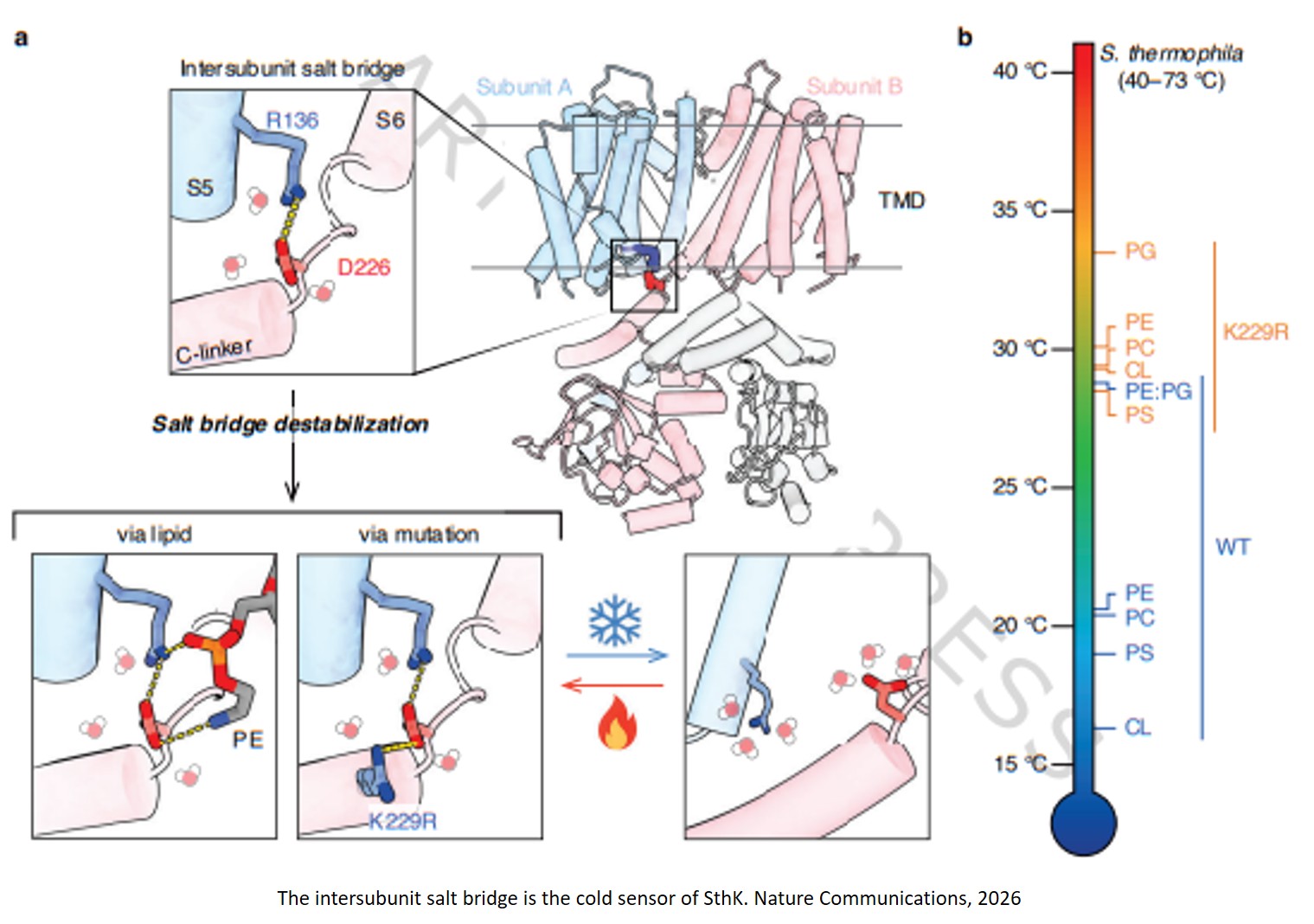
All life forms need to continuously adapt to temperature changes to survive. Now, investigators studying a bacterial protein have identified a new mechanism of sensing cold temperatures. The finding points to the possibility that this same type of mechanism exists in other organisms, including humans, and may have relevance for disorders involving faulty temperature regulation.
In the study, published in Nature Communications, the researchers focused on a protein called SthK, found in a species of swimming thermophilic bacteria called Spirochaeta thermophila. SthK is a cell membrane protein known as an ion channel, which can open and close to allow small, charged molecules to pass through the membrane. Ion channels are often involved in mediating sensory functions. The researchers found that SthK is indeed cold-sensitive, with higher activity at temperatures below 20 degrees C, due to an unusual sensing mechanism requiring a certain type of lipid—a fat-related molecule—in the membrane surrounding the channel.
“These findings highlight how thermosensitivity can emerge from cooperative interactions between a protein and the surrounding membrane, and suggest that we may find similar temperature-sensing mechanisms in other ion channels,” said study senior author.
SthK is a popular laboratory model for studying ion channels, in part because it is relatively easy to produce and purify in quantities needed for analyses. The first author reasoned that SthK is particularly likely to be temperature-sensitive because it is found in S. thermophila, which thrives in scalding-hot water around 65 degrees C, such as at geothermal vents.
The researchers evaluated SthK with high-resolution electron microscopy and lab-dish studies, comparing its structure and function at different temperatures, and comparing normal SthK with versions in which different areas of the ion channel were mutated.
In this way, they were able to zero in on a key component responsible for the channel’s temperature sensitivity: a special bond that can form between amino acids with opposite charges when they are located very close to each other, called a salt bridge. This salt bridge locks together two parts of the channel when the channel is closed and hinders its re-opening. The authors found that at lower temperatures the salt bridge is weaker, allowing the channel to open much more often.
The researchers also found that the cold sensitivity of the channel depends on the surrounding lipids, specifically requiring lipids containing amine groups. These lipids tune the salt bridge to a “Goldilocks” state: sufficiently weakened to facilitate cold-induced opening, but not so destabilized as to cause constitutive activity and apparent loss of responsiveness.
This combination of a salt-bridge cold sensor tuned by lipid composition has not been seen before, though the authors suspect that it exists in other proteins and organisms—and can perhaps be found more easily, now that researchers know what to look for.
https://www.nature.com/articles/s41467-026-71714-3
https://sciencemission.com/lipid-dependent-cold-sensitivity