



How cells eliminate inefficient ribosomes
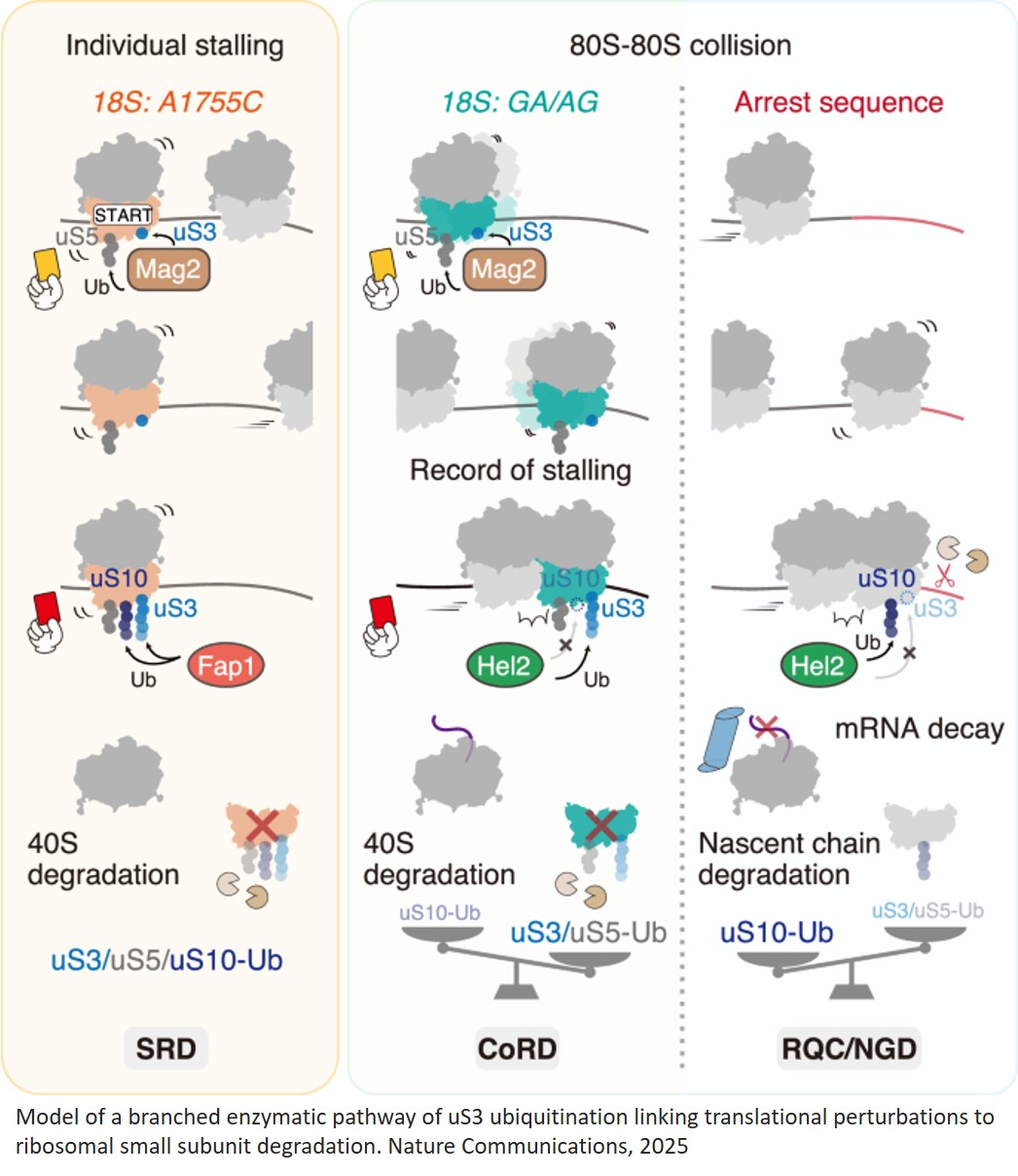
Ribosomes—the tiny factories that build proteins in our cells—don’t all work with the same efficiency. Researchers have discovered that ribosomes actually compete with one another, and those that perform poorly are selectively broken down when more efficient ones are present. This built-in “survival of the fittest” mechanism keeps protein synthesis accurate and efficient, shedding new light on how cells maintain quality control and prevent ribosome-related diseases.
Inside every cell, ribosomes act as tiny but vital factories that build proteins, translating genetic information into the molecules that sustain life. Although ribosomes share the same basic structure, not all of them work with equal precision. Until now, scientists did not fully understand how cells detect and handle ribosomes that underperform.
Addressing this question, a team of researchers has identified a quality control mechanism that ensures only the most competent ribosomes survive. Their study, published in Nature Communications shows that ribosomes compete during protein synthesis. When translation is disrupted, the less efficient ribosomes are selectively broken down, while the stronger ones continue functioning.
Using biochemical and genetic analyses in yeast, the researchers examined how ribosomes behave when translation is disrupted. The team engineered cells to contain a functional but suboptimal ribosome variant. These slower-moving ribosomes are overtaken on messenger RNA by faster, native ribosomes, causing the two types to collide. Such ribosome-ribosome collisions activate a ubiquitination-dependent quality control pathway that selectively removes the less efficient ribosomes.
“Our study introduces the concept of ribosome competition, showing that even functional but slower ribosomes are selectively degraded when more capable ones are available,” explains the lead researcher. “It is fascinating to see how cells apply a principle similar to survival of the fittest at the molecular level.”
The team also explored how external factors, such as the anticancer drug cisplatin affect this process. Cisplatin, known for binding to RNA and DNA, was found to increase ribosome collisions, which in turn promoted ribosome degradation. This insight could improve understanding of how the drug acts inside cells and why it sometimes causes side effects.
“Ribosome collisions act like a cellular warning signal,” highlights the author. “When ribosomes bump into each other, it alerts the cell that something is wrong. The cell then removes the problematic ribosomes to maintain efficient protein production.”
The implications of this discovery extend beyond basic biology. By showing how cells maintain the quality of their protein factories, the study provides a foundation for understanding disorders caused by ribosome malfunction, known as ribosomopathies. It may also open the door to new approaches for improving the safety and effectiveness of certain drugs.
In the short term, the researchers hope their work will inspire curiosity about the hidden molecular dynamics inside cells. “We hope people find it interesting that even at the microscopic level, competition drives quality and resilience,” the lead adds. “This discovery connects a fundamental evolutionary idea to the inner workings of our cells.”
In the long term, understanding how cells detect and eliminate underperforming ribosomes could guide the development of therapies for diseases linked to translation errors. The study offers a new perspective on how living systems maintain balance, efficiency, and accuracy—qualities that ultimately sustain life itself.
https://www.nature.com/articles/s41467-025-66026-x
https://sciencemission.com/Collision-induced-ribosome-degradation