


Master fragile X syndrome regulator identified!
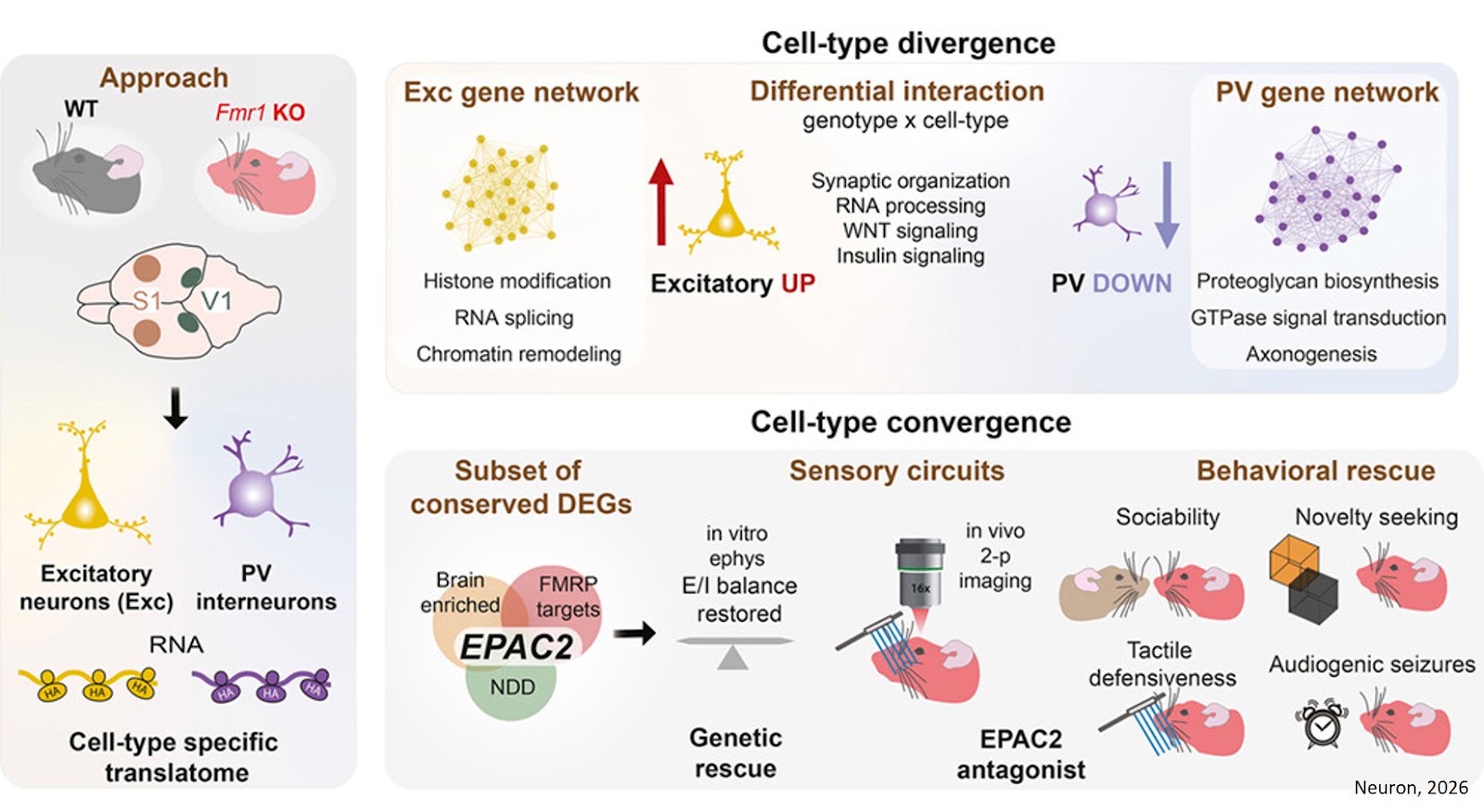
Fragile X Syndrome is caused by the loss of FMRP, an RNA-binding protein, known for putting the brakes on mRNA translation. Historically, it was assumed that without FMRP, all neurons simply over-translate proteins. This study completely overturned that assumption.
By profiling translation at cell-type resolution in Fmr1 knockout mice, the authors proved that the disease exerts fundamentally opposing forces on the active translatomes of excitatory and inhibitory neurons, rendering bulk-tissue therapeutic approaches obsolete.
In excitatory cortical pyramidal neurons, the loss of FMRP triggers a massive up-regulation of ribosome-bound transcripts. This drives structural hyper-connectivity and the classic over-excitation seen in autism spectrum conditions. Remarkably, in parvalbumin-positive (PV⁺) GABAergic inhibitory interneurons, the loss of FMRP leads to the exact opposite outcome—a severe down-regulation of local protein synthesis.
Because the translation machinery is depressed inside PV⁺ interneurons, their structural development stalls, leading to a profound failure of network inhibition. This combined "push-pull" effect creates the devastating E/I (excitation/inhibition) imbalance that underlies FXS sensory hypersensitivity and seizures.
The authors identified EPAC2 (Exchange Protein Directly Activated by cAMP 2) as a molecular master regulator that could restore balance to both cell types simultaneously. EPAC2 inhibitor (such as ESI-05), successfully normalized signaling in both cell classes. The compound effectively mutes the over-translation in pyramidal cells while simultaneously rescuing the stalled protein synthesis pathways in PV⁺ interneurons.
#sciencenewshighlights #ScienceMission
https://www.cell.com/neuron/fulltext/S0896-6273(26)00327-2
https://sciencemission.com/excitatory-neurons-of-fragile-X