

Identifying genetic causes of blindness in people and macaques
An inherited form of blindness directly comparable to a common inherited optic nerve disease in humans has been discovered in rhesus macaques. The work, published in Proceedings of the National Academy of Sciences, could lead to a better understanding of autosomal dominant optic atrophy, or ADOA, and potentially to new treatments.
ADOA affects about 3 in 100,000 people worldwide, causing progressive vision loss and eventual blindness. People with the disease develop blind spots, or scotoma, and there is no available treatment, said the senior author on the paper. Many patients are diagnosed between the ages of 10 and 30 and it is thus a significant cause of vision loss in children.
In humans, ADOA is related to mutations in a gene called OPA1 which affects mitochondria. While mitochondria are found throughout the body, the long nerve axons that run from the retina to the brain are particularly vulnerable to mitochondrial defects.
Rhesus macaques and other non-human primates have a very similar eye structure and vision system to humans. The researchers found that some of the monkeys at the research center had a spontaneous mutation in OPA1 that leads to changes in the eye very similar to those in people with ADOA.
The mutation in OPA1 had previously been identified by sequencing the DNA of 1,800 animals at the center. But it had not been tied to any eye disease.
“It didn't look very obvious to me that there's something going on. I actually expected it to be a negative study,” the senior author said.
Using imaging techniques from human ophthalmology, the authors found that an animal with eye abnormalities also carried a copy of the OPA1 mutation.
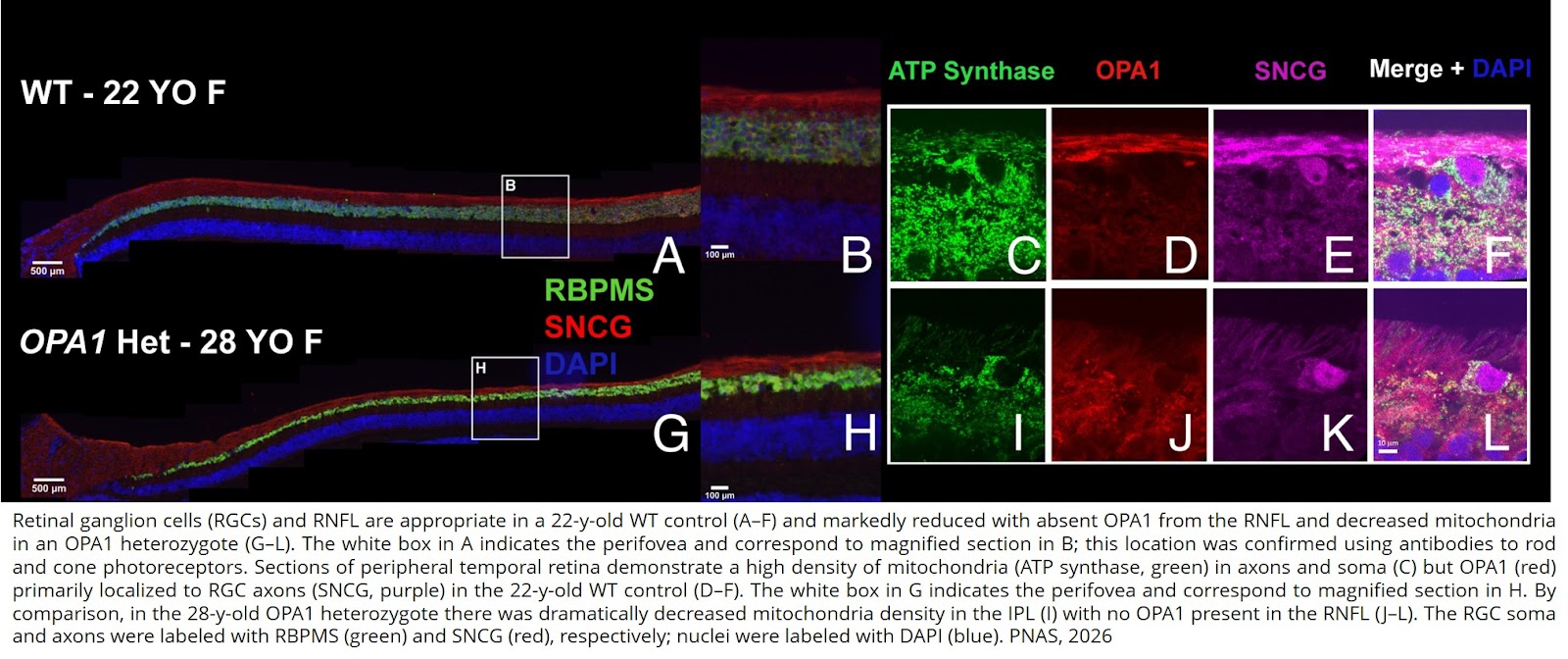
The researchers observed thinning of the retinal nerve fiber layer (RNFL) and optic nerve head degeneration, hallmark features of ADOA, in affected macaques. Decreased RGC function in the OPA1 heterozygotes was also demonstrated. They also found RGC loss in the papillomacular bundle, with reduced OPA1 and mitochondria in the RGC axons, indicating dysfunctional mitochondrial dynamics and reduced function consistent with ADOA.
Ultrastructural changes including dysmorphic mitochondria, axonal loss, myelin disruption, and hypertrophic astrocytic processes.
The researchers plan to look at how the disease progresses over time and how it differs between animals with a single copy or two copies of the OPA1 mutation. The rhesus macaque could be a model to study gene therapy to prevent ADOA, or to test treatments that could slow or block progression in humans, the senior author said.
The have been able to identify equivalents of other human inherited eye diseases in macaques. These include achromatopsia, in which the cone cells responsible for color vision are destroyed, and age-related macular degeneration.
https://www.pnas.org/doi/10.1073/pnas.2509165123
https://sciencemission.com/OPA1-mutation