

Alternative splicing in heart development and disease
The human heart must constantly adapt to changing demands — a task that requires tightly coordinated molecular shuffling in heart cells. One of the key regulators of this process is RBM20, a protein that controls an editing step called “alternative splicing,” which results in cells producing different forms of messenger RNA from the same gene.
Among other proteins in the heart, RBM20 helps regulate titin, a giant protein that acts like a molecular spring and makes heart muscle flexible. Defects in RBM20 can make heart-muscle less elastic and are linked to severe cardiomyopathies and heart failure.
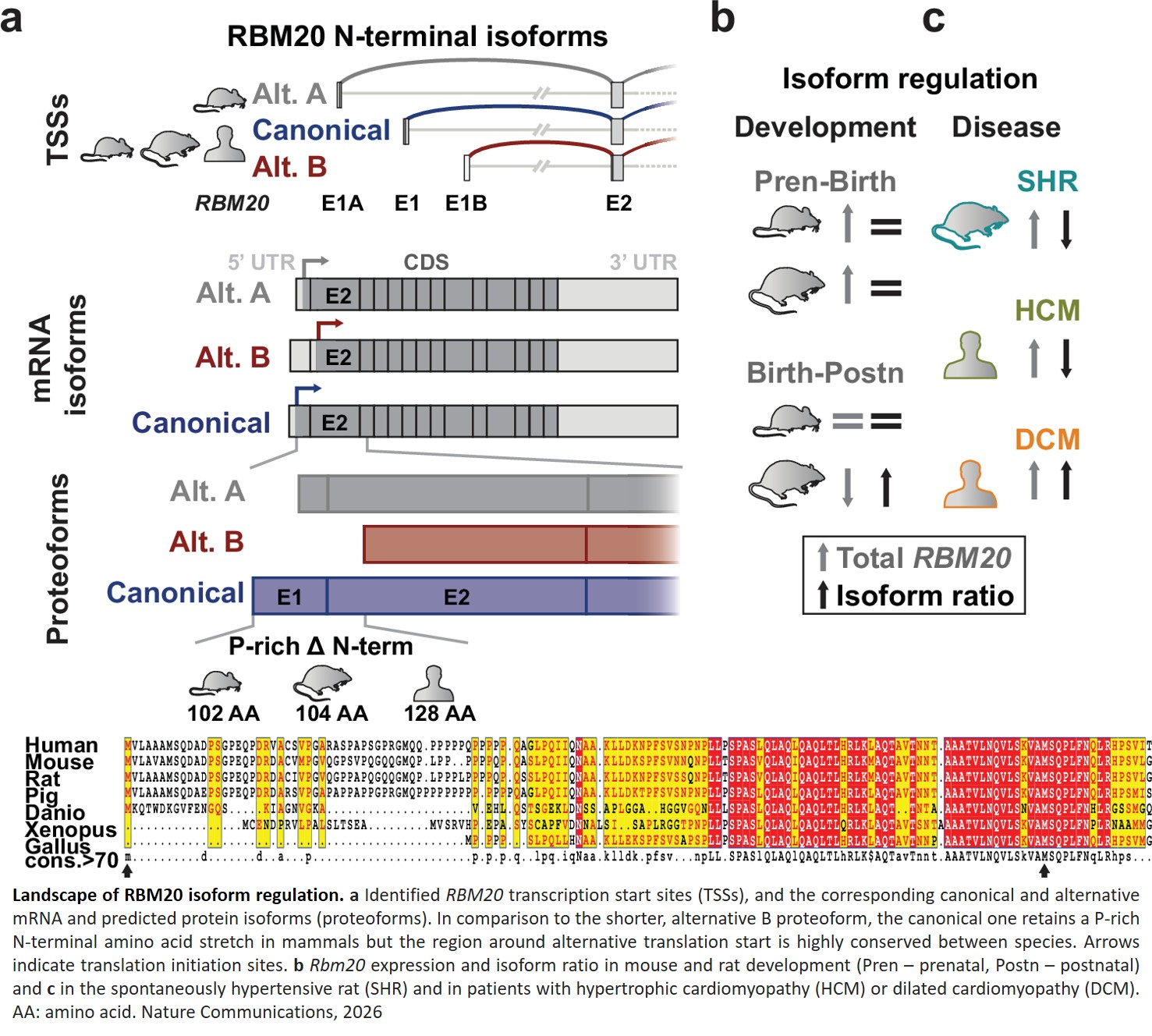
Now, researchers have discovered that the RBM20 gene can be switched on from different starting points. This produces distinct RBM20 RNA and protein isoforms — different forms of a protein that are encoded by the same gene. The findings, published in “Nature Communications,” reveal an unexpected new layer of cardiac gene regulation.
“RBM20 is already an important disease gene and therapeutic target in cardiomyopathy and heart failure,” says a co-first author of the paper. “Our study suggests that future therapeutic strategies may need to consider not only how much RBM20 is produced, but also which isoform.”
To uncover the mechanism, the researchers engineered a mouse model in which the genetic code that flags where transcription of the RBM20 gene should start was altered and substituted with a reporter gene – a gene that allows researchers to visualize when and where a genetic program is active. They expected the insertion to block production of the RBM20 protein. Instead, the mice still produced RBM20, but as a shorter version, or isoform. “That completely surprised us,” says the author.
The team then used RNA sequencing, ribosome profiling and molecular imaging to analyze heart tissue from mice, rats and human patients. They found that the RBM20 gene does not rely on a single transcription start site, as was previously assumed, but rather on multiple transcription start sites. The team further discovered that the balance of RBM20 isoforms is tightly regulated around birth, when the heart transitions from supporting fetal to adult function.
Studies of human heart tissues revealed disease-specific patterns. In hypertrophic cardiomyopathy, a condition in which the heart muscle becomes abnormally thick, the total amount of RBM20 was higher in the disease samples compared to controls, but this increase was driven largely by the shorter, alternative isoform. In dilated cardiomyopathy, where the heart enlarges and weakens, levels of both isoforms were increased compared to control samples, with a stronger increase in the longer isoform.
“These findings show that heart cells regulate RBM20 with much more complexity than we realized,” adds the senior author of the study. “It is not only the amount of RBM20 that matters, but also which version of the protein is produced.”
RBM20 has emerged as a promising target for new drugs because altering its activity can make heart muscle more flexible. “Selectively shifting the balance between the two forms could eventually help researchers develop more precise ways to adjust heart-muscle stiffness, while reducing unwanted effects,” says the author.
Future studies will focus on fine-tuning our understanding of the function of RBM20 isoforms and testing the functional relevance of these isoforms in larger patient cohorts and disease models.
https://www.nature.com/articles/s41467-026-73230-w
https://sciencemission.com/RBM20-isoform