


A muscle specific protein reduces high ketone levels in diabetic patients
A researcher finds management of diabetic ketoacidosis may center around reducing ketone levels in diabetic patients and increasing exercise capacity for better health outcomes. That could be life-changing for approximately 20-30% of the 830 million diabetic patients who develop ketoacidosis, which occurs when there are too many ketones in the blood, and is life-threatening if left untreated.
Most people are familiar with the humble ketone, a little energy molecule which the liver creates when the body lacks sugar. About 12.9 million Americans follow the ketogenic, or keto diet, and with a global market for keto products valued at over $10 billion, the appetite for the diet does not seem to be reducing.
For the uninitiated, a keto dieter consumes few carbohydrates and little sugar, forcing the liver to create ketones that burn fat for energy, and this fat burning can initiate weight loss. Since the body uses ketones as a backup source for energy, it’s perfectly safe for ketones to ride around in the blood stream. But if too many ketones are on board, blood can become toxic.
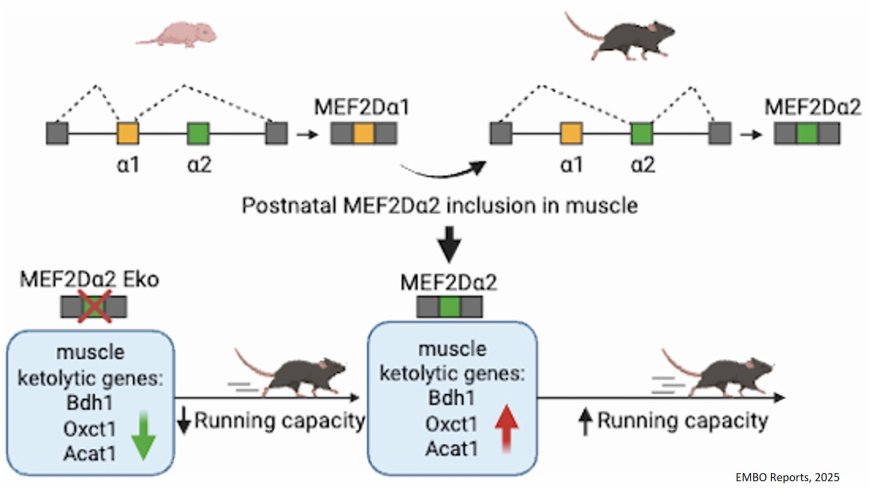
Just after birth, a muscle-specific protein isoform is formed called MEF2Dα2. It’s produced through regulated alternative splicing, a process by which a single gene makes different proteins. It is a variant of MEF2D, which plays a role in muscle development. It turns out that while MEF2D is active in many different organs, MEF2Dα2 is only present in muscles, which contribute up to 40% of body mass and are one of the top consumers of ketone bodies at rest.
The team used Nobel Prize-winning CRISPR/Cas9 gene editing, often referred to as “genetic scissors” to test the function of this isoform.
“Our findings identify a new role for the MEF2Dα2 protein isoform in regulating skeletal muscle ketone body oxidation, exercise capacity and systemic ketone body levels,” reports the senior author in EMBO reports. “It is often assumed that if ketones are produced and released in the bloodstream, they will be utilized by peripheral organs. Our work shows that the optimum utilization of ketone bodies in skeletal muscle is regulated by the muscle-specific variant of MEF2D gene, MEF2Dα2.”
When the team used the CRISPR technology to switch off the Mef2dα2 protein, they found that enzymes that use ketones in muscle are expressed at reduced levels, compromising the ability of muscle to use ketones for energy. Recent studies have also shown that ketones are utilized during exercise, and subjects lacking MEF2D⍺2 showed reduced capacity to run.
“A reduced utilization of ketones by skeletal muscle led to increased ketone levels in the blood after exercise and after eating a high-fat keto diet. In the future, our findings can be utilized to increase exercise capacity or reduce high ketone body levels in diabetic patients for better health outcomes,” said the author.
https://www.embopress.org/doi/full/10.1038/s44319-025-00578-3
https://sciencemission.com/muscle-specific-MEF2D%CE%B12-isoform