


A missing link in how the brain regulates appetite
When your stomach is full, how does your brain know to stop eating?
Scientists long assumed the answer lies mainly with neurons, the brain’s primary signaling cells.
But a new study published in the Proceedings of the National Academy of Sciences suggests that another type of brain cell called astrocytes, usually seen as “support staff,” may be playing a far more active role in controlling behavior than previously thought.
The research identified a previously unknown communication chain in the hypothalamus—the region of the brain responsible for regulating hunger and fullness. The team noted that these findings could eventually point to new ways of targeting appetite-related conditions such as obesity and eating disorders.
“People tend to immediately think of neurons when they think about how the brain works,” said a corresponding author of the study. “But we’re finding that astrocytes, what we used to think of as just secondary support cells, are also participating in how our brains regulate how much we eat. This research changes how we think about these communication circuits.”
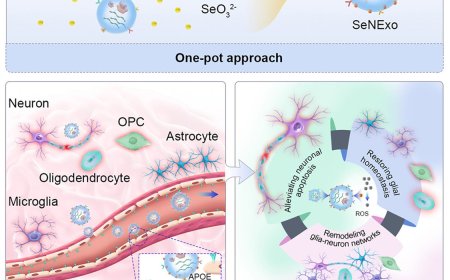
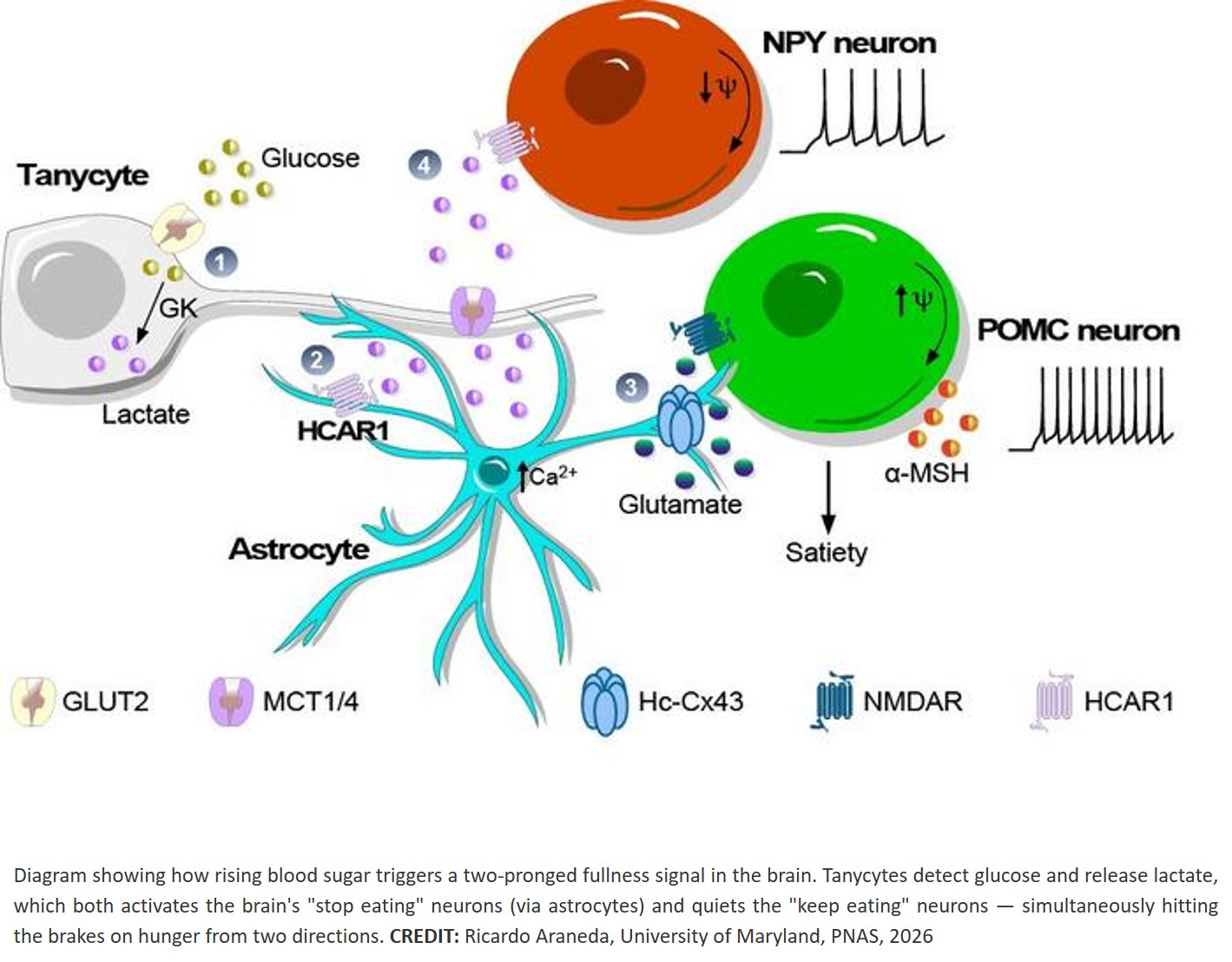
The communication chain begins with a specialized type of brain cell called a tanycyte. Tanycytes line a fluid-filled cavity deep inside the brain and detect glucose (the sugar that fuels the body) as it circulates through cerebrospinal fluid. When glucose levels rise after eating a meal, tanycytes process the sugar and release a byproduct called lactate into the surrounding brain tissue. That lactate then reaches a neighboring class of cells called astrocytes, triggering the next step in the chain.
“Researchers used to think that lactate produced from tanycytes ‘spoke’ directly to neurons involved in appetite control,” the author explained. “But we found that there was an unexpected middleman in that conversation, astrocytes.”
Astrocytes are among the most abundant cells in the brain and have traditionally been seen as critical for supporting neuronal function, yet with limited direct effector roles on their own. But the team overturned that assumption when they found that astrocytes express a specialized receptor HCAR1 that detects lactate. When lactate binds to HCAR1, astrocytes activate and release their own chemical signals called glutamate. When those glutamate signals reach the appetite-suppressing neurons in the brain, it triggers a feeling of fullness.
“What surprised us was the complexity of it,” the author said. “To put it simply, we found that tanycytes ‘talk’ to astrocytes, and then astrocytes ‘talk’ to neurons.”
One of the study’s experiments involved delivering glucose directly into a single tanycyte while monitoring surrounding astrocytes. That one cell’s activity was enough to trigger responses in multiple neighboring astrocytes, demonstrating that even a tiny, localized metabolic event ripples outward throughout the brain’s network.
“We also noticed a dual effect of sorts,” the author noted. “The hypothalamus contains two opposing populations of neurons: those that promote hunger and those that suppress it. We found that it might be possible that lactate can work on both simultaneously—activating the fullness neurons through astrocytes, while potentially quieting the hunger neurons through a more direct route.”
While this study was conducted in animal models, tanycytes and astrocytes are present in all mammals, including humans. The team’s next steps include investigating whether directly manipulating the HCAR1 receptor in astrocytes can change feeding behavior in animals, a necessary step before this research can progress to clinical applications. While drugs don’t currently target this exact pathway, the author suggests that it could one day offer a novel approach to treating eating disorders.
“We now have a different mechanism where we might be able to target astrocytes or specifically this HCAR1 receptor,” the author added. “It would be a novel target that may complement existing therapies like Ozempic, for example, and improve the lives of many who suffer from obesity and other appetite-related conditions.”