

Small-molecule inhibitors for β-arrestin proteins
To function normally, nearly every cell in the human body relies on G-protein coupled receptors (GPCRs) to receive and send signals. That’s why GPCRs are targeted by roughly one-third of all FDA‑approved drugs.
But the signals from these receptors don’t act alone. Decades ago, the researchers discovered β-arrestins — proteins that attach to activated GPCRs, dampen their signaling, and pull them inside the cell. In the early 2000s, the lab showed that β-arrestins also launch their own signaling pathways, expanding their role far beyond simply shutting receptors off.
Now, researchers have identified three powerful, drug-like molecules that directly target β-arrestins. The findings, published in Nature, provide the first clear way to control these proteins with pharmacological precision.
In multiple tests, the compounds blocked β-arrestins from interacting with GPCRs and carrying out their normal functions, without interfering with the receptors themselves. Instead of shutting down GPCR activity, the molecules effectively remove β-arrestin control, allowing signaling through G proteins to persist.
The discovery provides the first chemical tools for studying β-arrestins, opening the door for scientists to better understand how β-arrestins shape cellular responses. And it suggests a path toward more precise therapies for conditions involving metabolism, immune responses, cardiovascular function, and brain signaling.
The team began with a broad, unbiased search of the National Cancer Institute’s vast compound library to identify molecules that might bind β-arrestins. Then they narrowed the field using tests that showed which compounds physically interacted with the protein and stabilized it. The most promising candidates were studied in engineered human cell systems, where researchers could track real-time GPCR signaling, and later in physiologically relevant immune and heart muscle cells to determine whether their effects extended beyond simplified laboratory models.
Through this step-by-step process, the researchers identified three compounds that disrupted multiple aspects of β-arrestin function — blocking their recruitment to receptors, preventing receptor desensitization and internalization, and shutting down β-arrestin–specific signaling pathways — while leaving G protein signaling intact.
“We tested these compounds from every angle we could think of before we were convinced they were bona fide β-arrestin inhibitors,” the lead author said.
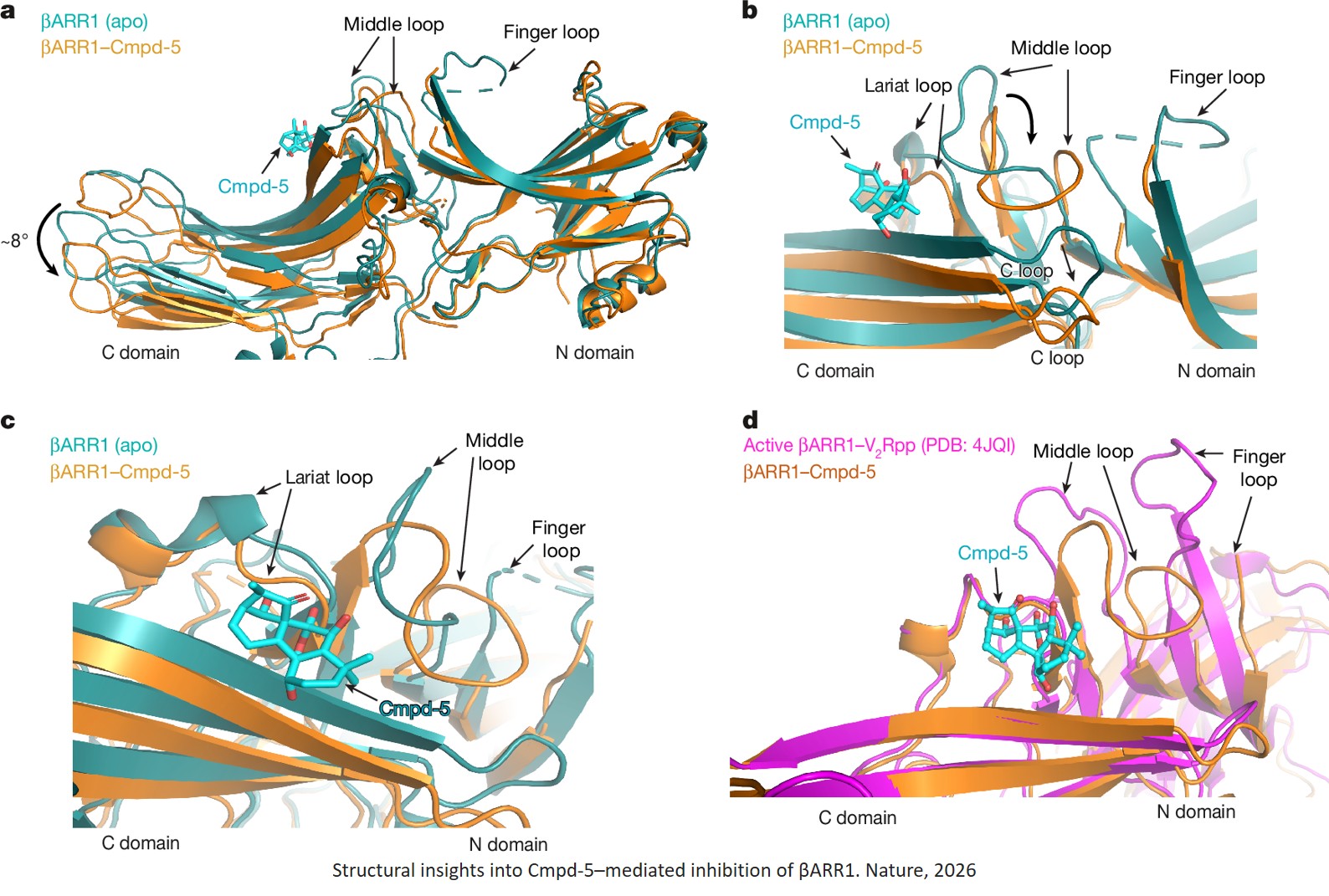
A pivotal moment came when the authors used Cryo-electron microscopy to visualize one of the compounds, called Cmpd-5, binding to a previously unknown “pocket” on β-arrestin. This visualization showed that the inhibitor works “allosterically” – when it binds to this pocket, it changes the shape of β-arrestin globally and prevents it from fully engaging with GPCRs.
The team tested the inhibitors with several GPCRs, including the GLP-1 receptor, which is the target of widely used weight-loss drugs Ozempic and Wegovy. Even when the receptor was being stimulated by these drugs, adding the new compounds inhibited β‑arrestin control and allowed G protein signaling to continue longer than usual.
Such an approach promises to allow researchers to dial specific pathways up or down, potentially improving treatment precision while reducing unwanted side effects.
https://www.nature.com/articles/s41586-026-10683-5
https://sciencemission.com/Small-molecule-modulation-of-%CE%B2-arrestins