


Key mechanism of liquid-liquid phase separation
Have you ever wondered how mussels instantly glue themselves to rocks, allowing them to survive the crushing force of ocean waves? They complete this process in under 30 seconds. Yet, in a laboratory, replicating this process of molecular self-assembly, known as liquid-liquid phase separation (LLPS), typically takes dozens of minutes, if not hours.
A research team has recently solved this long-standing puzzle using large-scale molecular dynamics simulation and theoretical analysis, revealing the secret to nature’s incredible speed and providing implications for instant biocompatible surgical glues.
This theoretical breakthrough, published in Nature Communications fundamentally changes our understanding of how charged polymers form complex structures.
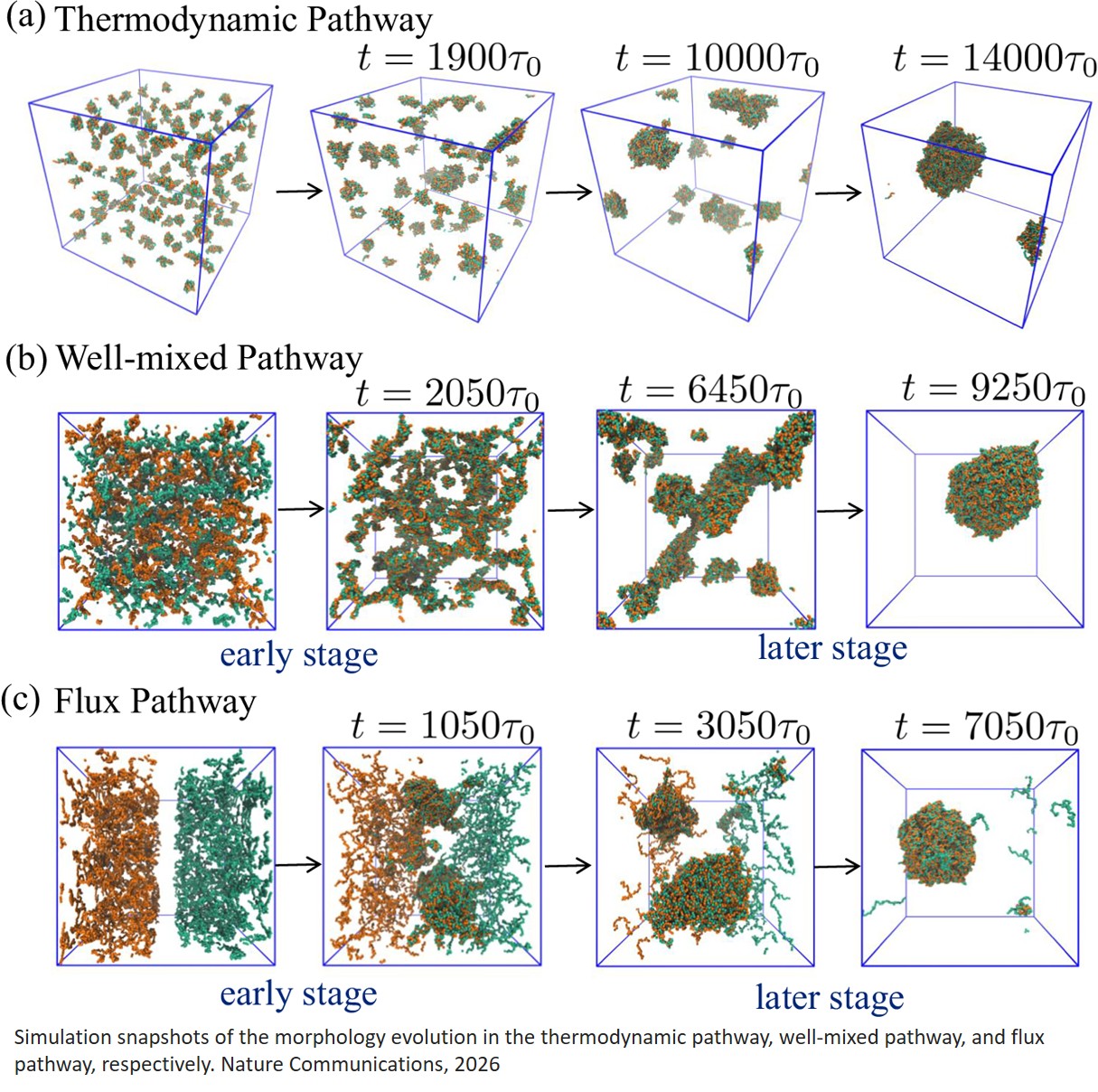
This latest study builds on the previous successes of the team’s work. Using a powerful, custom-built simulation platform that tracks over one million charged particles, the researchers were the first to simulate the entire LLPS process from start to finish, explicitly modeling both hydrodynamic and electrostatic forces. They discovered that mimicking nature’s “Flux Pathway” - in which molecules mix at a target spot - creates an electrochemical “superhighway” that drives assembly at an incredible rate.
Under this particular pathway, the condensed domain in LLPS dynamically grows with time following a power law of t2/3, whereas classical theory predicts a scaling of t1/3. This difference in scaling leads to a staggering result: simulations show that forming a half-centimeter adhesive droplet takes just 10 seconds using nature’s method, while conventional laboratory techniques would require over 47 years.
The senior author said: “Nature has been our ultimate inspiration. The disconnect between the slow pace in experimental labs and the ultrafast assembly in marine life was a critical problem we had to solve. Our earlier work first discovered that there is a fundamental difference between LLPS dynamics of polyelectrolyte systems and classical theories, but this new study provides the practical blueprint. By simulating the entire process at unprecedented length and time scales, we have moved beyond theory to demonstrate how nature achieves such remarkable speed. This finally gives us a hint to create materials that can assemble on demand, with significant implications ranging from instant, biocompatible surgical glues to programmable smart materials.”
https://www.nature.com/articles/s41467-026-68296-5
https://sciencemission.com/liquid%E2%80%93liquid-phase-separation-dynamics