

Unknown mechanism in pre-eclampsia discovered
Pre-eclampsia is one of the most serious complications in pregnancy, affecting millions of women and newborns worldwide and potentially life-threatening. Despite intensive research, it has remained unclear what processes in the placenta lead to the disease.
Now, a research team has discovered a previously unknown mechanism that plays a decisive role in the development of pre-eclampsia. The results, currently published in the journal Nature Communications, could open up new possibilities for diagnosis and treatment.
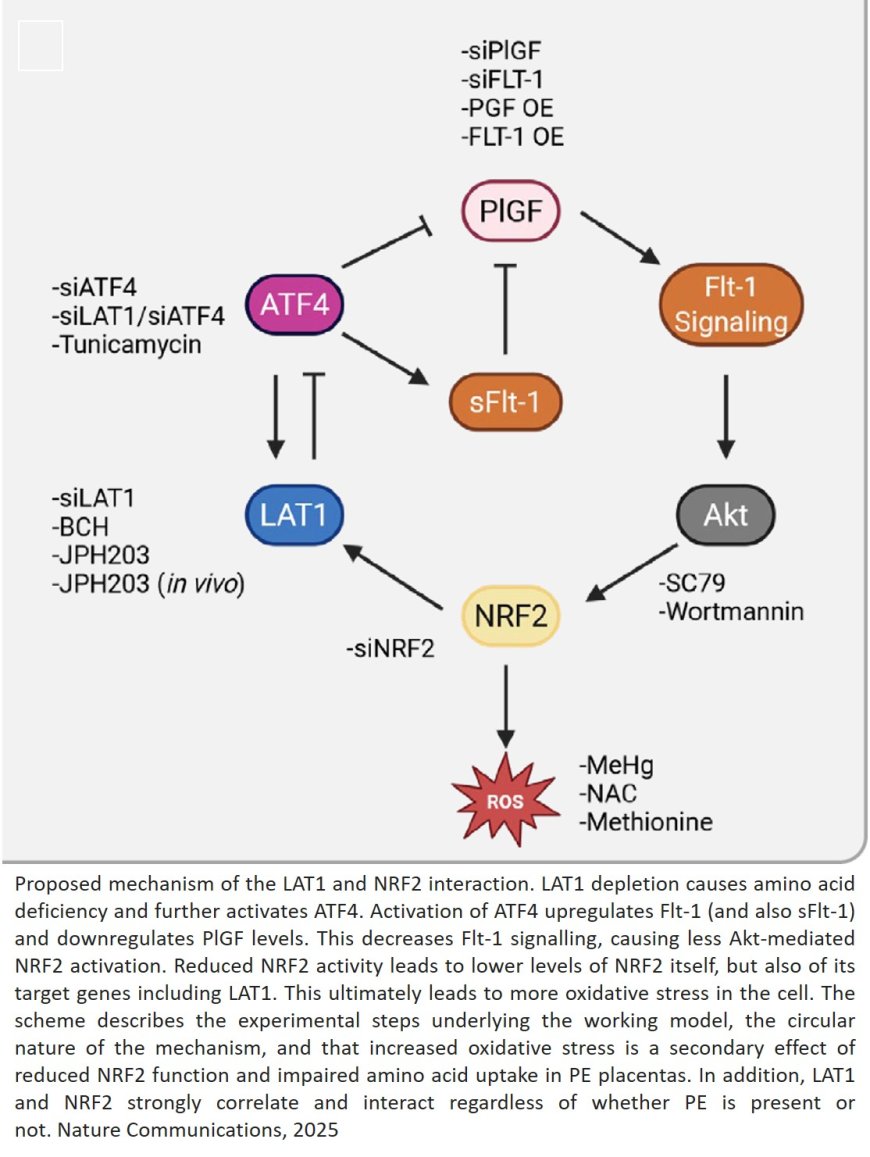
The research team investigated why the so-called sFlt-1/PlGF ratio – a blood value that is considered the most important indicator of impending pre-eclampsia – becomes unbalanced in affected pregnant women. They found that two proteins, the amino acid transporter LAT1 and the transcription factor NRF2, play a central role. These two molecules work together to control angiogenesis, and to protect cells from oxidative stress – i.e., from an excess of harmful oxygen compounds. If this interaction is disrupted, the imbalance that is typical of pre-eclampsia occurs. The researchers were also able to show that increased oxidative stress is not the cause of the disease, as previously assumed, but rather a consequence of it.
"We have found a mechanism that regulates oxidative stress in a cell. Even more significant is the finding that this mechanism is dysregulated in pre-eclampsia," explains the study leader. "A better understanding of these mechanisms opens up new possibilities for the diagnosis and treatment of pre-eclampsia – and thus for the health of mothers and children."
Pre-eclampsia usually occurs in the second or third trimester of pregnancy. The disease is characterised by high blood pressure and increased protein excretion in the urine and, without timely treatment, can lead to serious complications for both mother and child. Often, the only option is early delivery.
Women and children affected by pre-eclampsia also have an increased risk of cardiovascular and metabolic diseases later in life. The new findings help to better understand the disease at a molecular level and could, in the long term, help to develop new approaches to diagnosis and treatment.